Broad Institute of MIT and Harvard, Cambridge, Massachusetts, United States of America.
PLoS Genet. 2013 Jun;9(6):e1003272. doi: 10.1371/journal.pgen.1003272. Epub 2013 Jun 13.
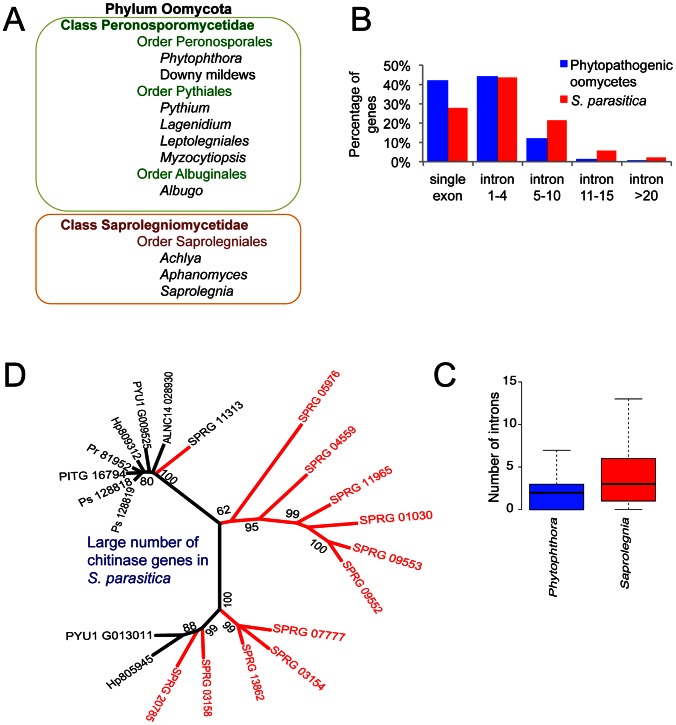
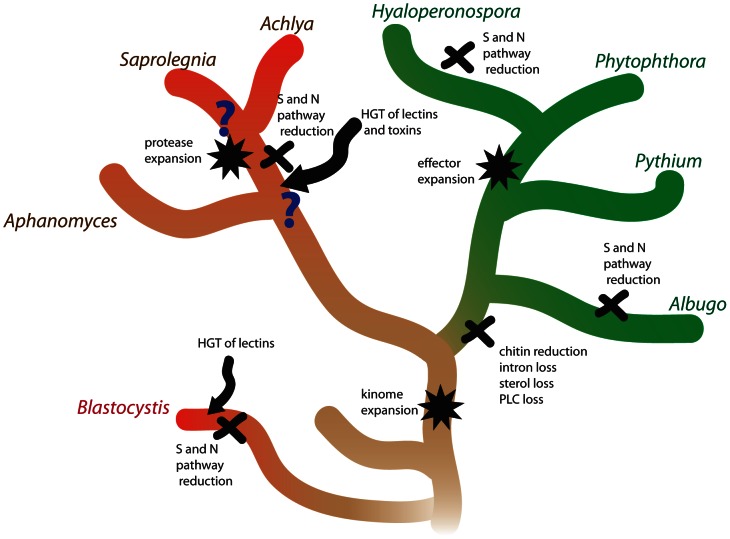
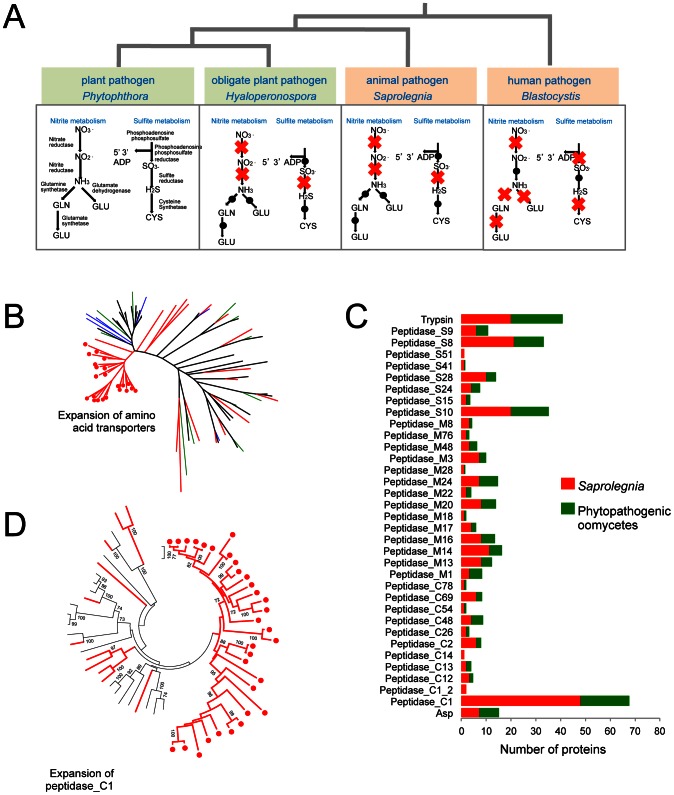
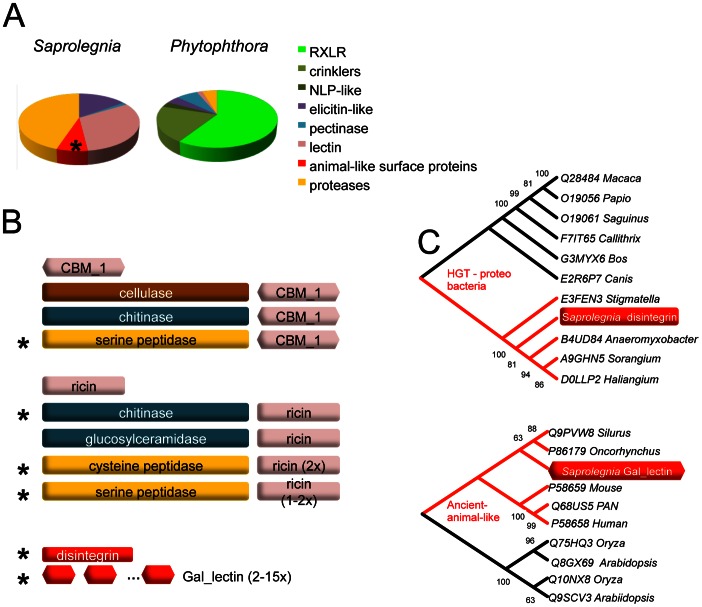
Oomycetes in the class Saprolegniomycetidae of the Eukaryotic kingdom Stramenopila have evolved as severe pathogens of amphibians, crustaceans, fish and insects, resulting in major losses in aquaculture and damage to aquatic ecosystems. We have sequenced the 63 Mb genome of the fresh water fish pathogen, Saprolegnia parasitica. Approximately 1/3 of the assembled genome exhibits loss of heterozygosity, indicating an efficient mechanism for revealing new variation. Comparison of S. parasitica with plant pathogenic oomycetes suggests that during evolution the host cellular environment has driven distinct patterns of gene expansion and loss in the genomes of plant and animal pathogens. S. parasitica possesses one of the largest repertoires of proteases (270) among eukaryotes that are deployed in waves at different points during infection as determined from RNA-Seq data. In contrast, despite being capable of living saprotrophically, parasitism has led to loss of inorganic nitrogen and sulfur assimilation pathways, strikingly similar to losses in obligate plant pathogenic oomycetes and fungi. The large gene families that are hallmarks of plant pathogenic oomycetes such as Phytophthora appear to be lacking in S. parasitica, including those encoding RXLR effectors, Crinkler's, and Necrosis Inducing-Like Proteins (NLP). S. parasitica also has a very large kinome of 543 kinases, 10% of which is induced upon infection. Moreover, S. parasitica encodes several genes typical of animals or animal-pathogens and lacking from other oomycetes, including disintegrins and galactose-binding lectins, whose expression and evolutionary origins implicate horizontal gene transfer in the evolution of animal pathogenesis in S. parasitica.
真核生物鞭毛菌亚门丝壶菌目卵菌纲中的卵菌已进化为两栖动物、甲壳类动物、鱼类和昆虫的严重病原体,导致水产养殖的重大损失和水生生态系统的破坏。我们已经对淡水鱼类病原体寄生卵菌的 63Mb 基因组进行了测序。大约 1/3 的组装基因组表现出杂合性丢失,表明其具有揭示新变异的有效机制。寄生卵菌与植物病原卵菌的比较表明,在进化过程中,宿主细胞环境导致植物和动物病原体基因组中基因的扩张和丢失呈现出截然不同的模式。寄生卵菌拥有最大的蛋白酶组之一(270 种),这在感染过程中的不同时间点通过 RNA-Seq 数据确定。相比之下,尽管能够以腐生方式生存,但寄生导致无机氮和硫同化途径的丧失,与专性植物病原卵菌和真菌的丧失惊人地相似。植物病原卵菌的特征是大型基因家族,例如 Phytophthora 似乎在寄生卵菌中缺失,包括那些编码 RXLR 效应子、Crinkler's 和坏死诱导样蛋白(NLP)的基因家族。寄生卵菌也有一个非常大的激酶组,包含 543 种激酶,其中 10%在感染时被诱导。此外,寄生卵菌编码了一些动物或动物病原体特有的基因,而其他卵菌则缺乏这些基因,包括分裂素和半乳糖结合凝集素,它们的表达和进化起源暗示了水平基因转移在寄生卵菌动物发病机制进化中的作用。