Lancet Neurol. 2013 Aug;12(8):768-76. doi: 10.1016/S1474-4422(13)70130-3. Epub 2013 Jun 21.
Few data are available from randomised trials about the effect of thrombolysis with alteplase on long-term functional outcome in patients who have had acute ischaemic stroke and no trial has reported effects on health-related quality of life. A secondary objective of the third International Stroke Trial (IST-3) was to assess the effect of thrombolysis on such outcomes at 18 months.
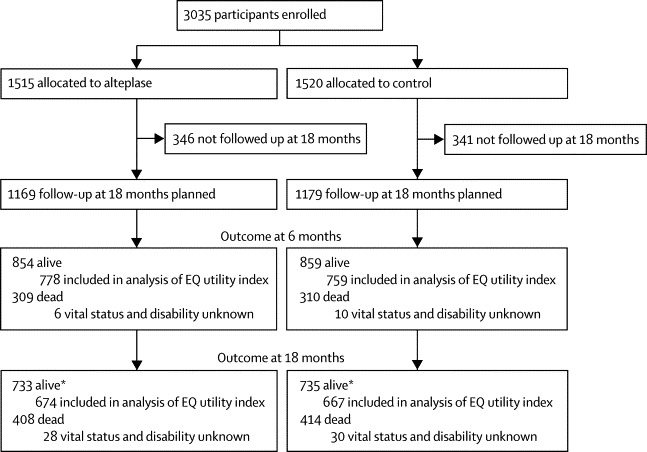
In this open-label, international, multicentre, randomised, controlled trial, 3035 patients with ischaemic stroke from 12 countries were randomly allocated within 6 h of onset via a secure central system to either intravenous alteplase (0·9 mg/kg; n=1515) plus standard care or standard care alone (control; n=1520). 2348 patients were scheduled for 18-month follow-up. For our main analysis, survivors were assessed at 18 months with the Oxford handicap scale (OHS; the primary outcome was the adjusted odds of OHS score 0-2). We also used the EuroQoL (EQ) instrument and asked questions about overall functioning and living circumstances. We analysed the OHS and the five EQ domains by ordinal logistic regression and calculated the mean difference between treatment groups in EQ utility index and visual analogue scale score. Analyses were adjusted for key baseline prognostic factors. This study is registered with controlled-trials.com, number ISRCTN25765518.
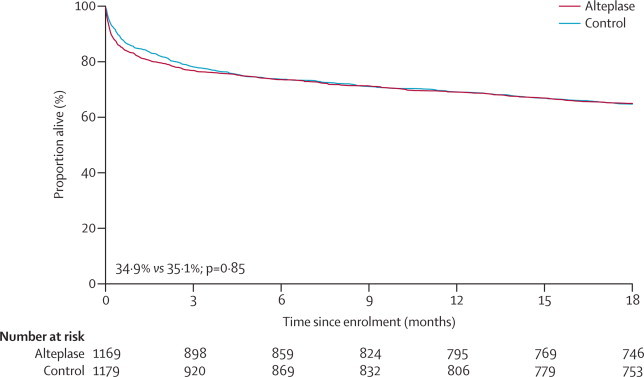
At 18 months, 408 (34·9%) of 1169 patients in the alteplase group versus 414 (35·1%) of 1179 in the control group had died (p=0·85). 391 (35·0%) of 1117 patients versus 352 (31·4%) of 1122 had an OHS score of 0-2 (adjusted odds ratio [OR] 1·28, 95% CI 1·03-1·57; p=0·024). Treatment was associated with a favourable shift in the distribution of OHS grades (adjusted common OR 1·30, 95% CI 1·10-1·55; p=0·002). Alteplase treatment was associated with significantly higher overall self-reported health (adjusted mean difference in EQ utility index 0·060; p=0·019). The differences between the groups in visual analogue scale score and the proportion living at home were not significant.
IST-3 provides evidence that thrombolysis with intravenous alteplase for acute ischaemic stroke does not affect survival, but does lead to statistically significant, clinically relevant improvements in functional outcome and health-related quality of life that are sustained for at least 18 months.
UK Medical Research Council, Health Foundation UK, Stroke Association UK, Research Council of Norway, AFA Insurances Sweden, Swedish Heart Lung Fund, The Foundation of Marianne and Marcus Wallenberg, Polish Ministry of Science and Education, the Australian Heart Foundation, Australian National Health and Medical Research Council, Swiss National Research Foundation, Swiss Heart Foundation, Assessorato alla Sanita (Regione dell'Umbria, Italy), and Danube University.
关于接受阿替普酶溶栓治疗的急性缺血性脑卒中患者的长期功能结局,随机试验的数据很少,也没有试验报告对健康相关生活质量的影响。第三次国际卒中试验(IST-3)的次要目标是评估溶栓治疗在 18 个月时对这些结局的影响。
在这项开放标签、国际、多中心、随机、对照试验中,来自 12 个国家的 3035 名缺血性脑卒中患者在发病后 6 小时内通过安全的中央系统随机分配至静脉内阿替普酶(0.9mg/kg;n=1515)+标准治疗组或标准治疗组(对照组;n=1520)。2348 名患者计划进行 18 个月随访。对于我们的主要分析,在 18 个月时使用牛津残疾量表(OHS;主要结局为调整后的 OHS 评分 0-2 的优势比)对幸存者进行评估。我们还使用了 EuroQoL(EQ)工具,并询问了总体功能和生活状况的问题。我们通过有序逻辑回归分析了 OHS 和五个 EQ 域,并计算了治疗组之间 EQ 效用指数和视觉模拟量表评分的平均差异。分析调整了关键的基线预后因素。本研究在 controlled-trials.com 注册,编号为 ISRCTN25765518。
在 18 个月时,阿替普酶组 1169 名患者中有 408 名(34.9%)死亡,对照组 1179 名患者中有 414 名(35.1%)死亡(p=0.85)。阿替普酶组 1117 名患者中有 391 名(35.0%),对照组 1122 名患者中有 352 名(31.4%)OHS 评分为 0-2(调整后的比值比[OR]1.28,95%CI1.03-1.57;p=0.024)。治疗与 OHS 等级分布的有利变化相关(调整后的常见 OR1.30,95%CI1.10-1.55;p=0.002)。阿替普酶治疗与总体自我报告健康状况显著改善相关(调整后的 EQ 效用指数平均差异 0.060;p=0.019)。两组之间的视觉模拟量表评分和在家中生活的比例差异无统计学意义。
IST-3 提供的证据表明,急性缺血性脑卒中患者静脉内使用阿替普酶溶栓不会影响生存率,但确实导致功能结局和健康相关生活质量有统计学显著、临床相关的改善,这些改善至少持续 18 个月。
英国医学研究理事会、英国健康基金会、英国中风协会、挪威研究理事会、AFA 保险公司瑞典、瑞典心肺基金会、马琳和马库斯·沃伦伯格基金会、波兰科学和教育部、澳大利亚心脏基金会、澳大利亚国家健康与医学研究理事会、瑞士国家研究基金会、瑞士心脏基金会、翁布里亚地区评估署(意大利)和多瑙河大学。