Institute of Molecular Biology, Friedrich-Loeffler-Institut, WHO Collaborating Centre for Rabies Surveillance and Research, 17493 Greifswald-Isle of Riems, Germany.
Philos Trans R Soc Lond B Biol Sci. 2013 Jun 24;368(1623):20120142. doi: 10.1098/rstb.2012.0142. Print 2013 Aug 5.
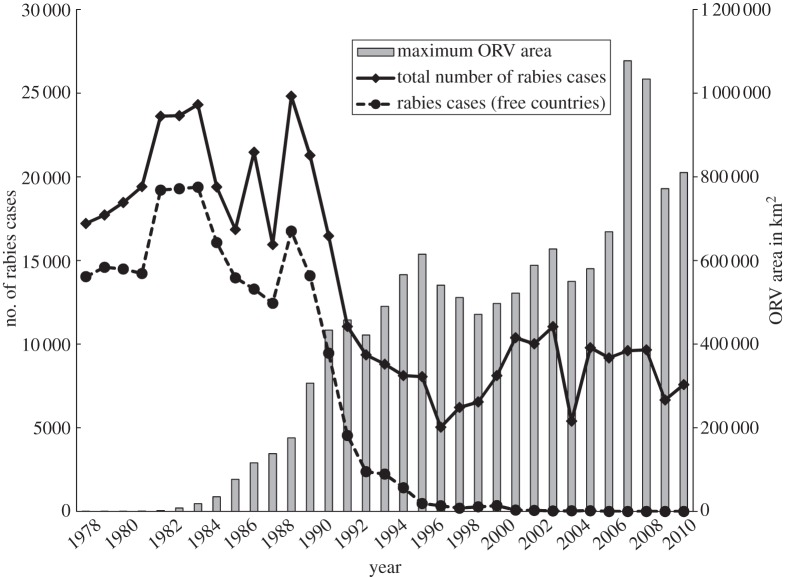
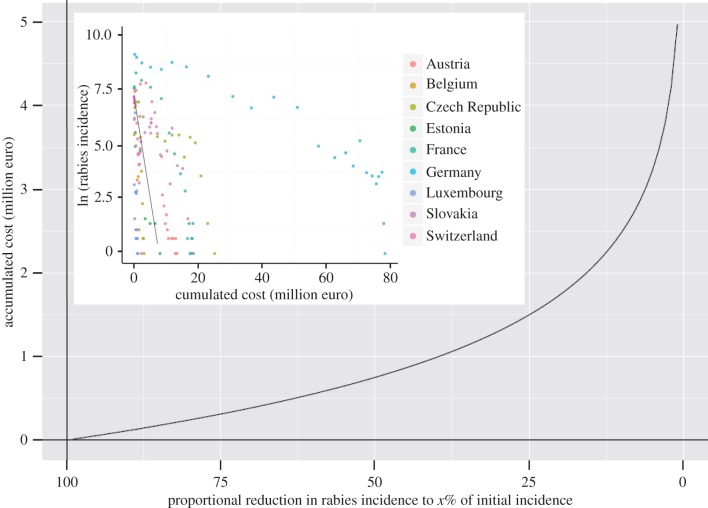
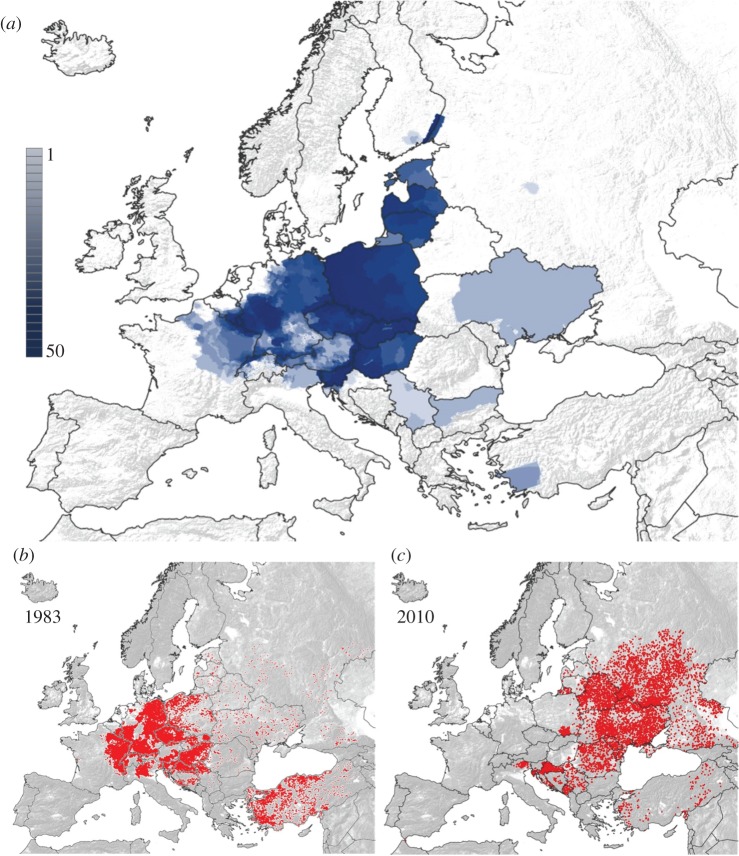
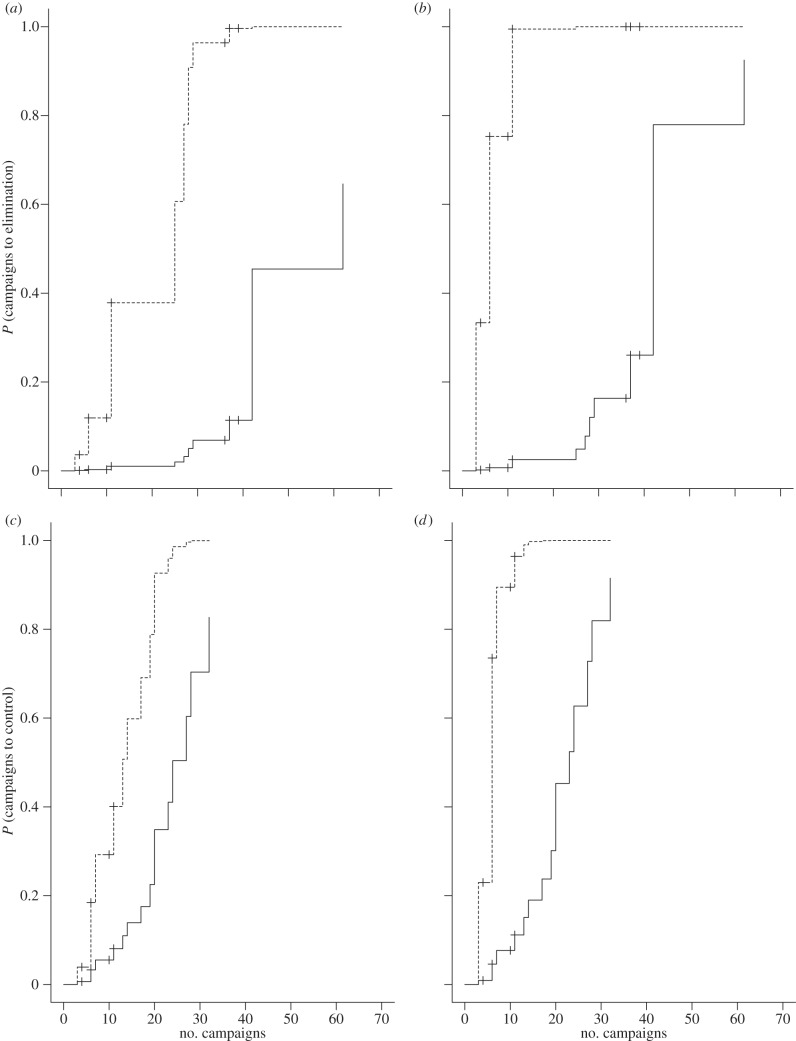
Despite perceived challenges to controlling an infectious disease in wildlife, oral rabies vaccination (ORV) of foxes has proved a remarkably successful tool and a prime example of a sophisticated strategy to eliminate disease from wildlife reservoirs. During the past three decades, the implementation of ORV programmes in 24 countries has led to the elimination of fox-mediated rabies from vast areas of Western and Central Europe. In this study, we evaluated the efficiency of 22 European ORV programmes between 1978 and 2010. During this period an area of almost 1.9 million km² was targeted at least once with vaccine baits, with control taking between 5 and 26 years depending upon the country. We examined factors influencing effort required both to control and eliminate fox rabies as well as cost-related issues of these programmes. The proportion of land area ever affected by rabies and an index capturing the size and overlap of successive ORV campaigns were identified as factors having statistically significant effects on the number of campaigns required to both control and eliminate rabies. Repeat comprehensive campaigns that are wholly overlapping much more rapidly eliminate infection and are less costly in the long term. Disproportionally greater effort is required in the final phase of an ORV programme, with a median of 11 additional campaigns required to eliminate disease once incidence has been reduced by 90 per cent. If successive ORV campaigns span the entire affected area, rabies will be eliminated more rapidly than if campaigns are implemented in a less comprehensive manner, therefore reducing ORV expenditure in the longer term. These findings should help improve the planning and implementation of ORV programmes, and facilitate future decision-making by veterinary authorities and policy-makers.
尽管控制野生动物传染病存在诸多挑战,但对狐狸进行口服狂犬病疫苗接种(ORV)已被证明是一种非常成功的工具,也是从野生动物宿主中消除疾病的复杂策略的一个主要范例。在过去的三十年中,24 个国家实施了 ORV 计划,使得狂犬病从西欧和中欧的大片地区中消除。在本研究中,我们评估了 1978 年至 2010 年期间 22 个欧洲 ORV 计划的效率。在此期间,近 190 万平方公里的区域至少接受过一次疫苗诱饵的靶向投放,具体控制时间取决于国家,为 5 至 26 年不等。我们研究了影响控制和消除狐狸狂犬病所需努力的因素,以及这些计划的成本相关问题。曾经受到狂犬病影响的土地面积比例以及捕获连续 ORV 运动规模和重叠的指数被确定为对控制和消除狂犬病所需的运动次数具有统计学显著影响的因素。重复全面的、完全重叠的运动可以更快速地消除感染,并且从长期来看成本更低。在 ORV 计划的最后阶段需要更多的不成比例的努力,一旦发病率降低 90%,就需要额外进行 11 次综合运动来消除疾病。如果连续的 ORV 运动覆盖整个受影响的区域,那么狂犬病的消除速度将比以不那么全面的方式实施运动更快,因此从长期来看,ORV 支出将会减少。这些发现应该有助于改善 ORV 计划的规划和实施,并为兽医当局和决策者提供未来决策的便利。