Department of Psychiatry and Biobehavioral Sciences, UCLA Semel Institute, Los Angeles, CA 90024, USA.
Transl Psychiatry. 2013 Jun 25;3(6):e274. doi: 10.1038/tp.2013.26.
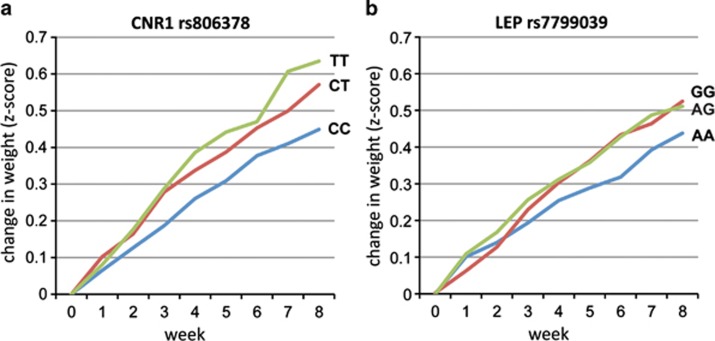
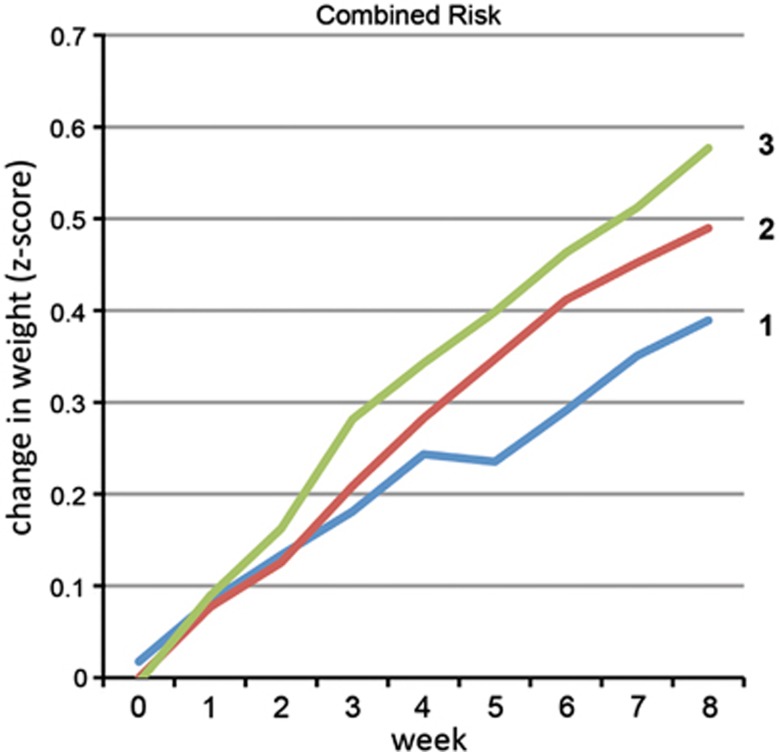
Second-generation antipsychotic exposure, in both children and adults, carries significant risk for excessive weight gain that varies widely across individuals. We queried common variation in key energy balance genes (FTO, MC4R, LEP, CNR1, FAAH) for their association with weight gain during the initial 8 weeks in the two NIMH Research Units on Pediatric Psychopharmacology Autism Network trials (N=225) of risperidone for treatment of irritability in children/adolescents aged 4-17 years with autism spectrum disorders. Variants in the cannabinoid receptor (CNR)-1 promoter (P=1.0 × 10(-6)), CNR1 (P=9.6 × 10(-5)) and the leptin (LEP) promoter (P=1.4 × 10(-4)) conferred robust-independent risks for weight gain. A model combining these three variants was highly significant (P=1.3 × 10(-9)) with a 0.85 effect size between lowest and highest risk groups. All results survived correction for multiple testing and were not dependent on dose, plasma level or ethnicity. We found no evidence for association with a reported functional variant in the endocannabinoid metabolic enzyme, fatty acid amide hydrolase, whereas body mass index-associated single-nucleotide polymorphisms in FTO and MC4R showed only trend associations. These data suggest a substantial genetic contribution of common variants in energy balance regulatory genes to individual antipsychotic-associated weight gain in children and adolescents, which supersedes findings from prior adult studies. The effects are robust enough to be detected after only 8 weeks and are more prominent in this largely treatment naive population. This study highlights compelling directions for further exploration of the pharmacogenetic basis of this concerning multifactorial adverse event.
第二代抗精神病药物在儿童和成人中使用都会导致明显的体重过度增加风险,且个体间差异很大。我们对关键能量平衡基因(FTO、MC4R、LEP、CNR1、FAAH)中的常见变异进行了查询,以研究其与两项 NIMH 儿童精神药理学自闭症网络研究单位(Research Units on Pediatric Psychopharmacology Autism Network,RUPP Autism Network)自闭症谱系障碍儿童/青少年(年龄 4-17 岁)利培酮治疗激惹的初始 8 周内体重增加的相关性。大麻素受体(cannabinoid receptor,CNR)-1 启动子(P=1.0×10(-6))、CNR1(P=9.6×10(-5))和瘦素(leptin,LEP)启动子(P=1.4×10(-4))的变异赋予了体重增加的显著独立风险。结合这三种变异的模型具有高度显著性(P=1.3×10(-9)),最低和最高风险组之间的效应大小为 0.85。所有结果均通过多次检验校正,且不依赖于剂量、血浆水平或种族。我们没有发现与内源性大麻素代谢酶脂肪酸酰胺水解酶报道的功能变异相关的证据,而 FTO 和 MC4R 中与体重指数相关的单核苷酸多态性仅显示出趋势相关性。这些数据表明,能量平衡调节基因中的常见变异对儿童和青少年抗精神病药物相关体重增加有很大的遗传贡献,这超过了之前成人研究的结果。这些影响在仅 8 周后就很显著,且在这个大部分未经治疗的人群中更为突出。这项研究强调了进一步探索这种令人关注的多因素不良事件的药物遗传学基础的重要方向。