Department of Psychology and Centre for Brain Science, University of Essex Colchester, UK.
Front Psychol. 2013 Jun 21;4:345. doi: 10.3389/fpsyg.2013.00345. eCollection 2013.
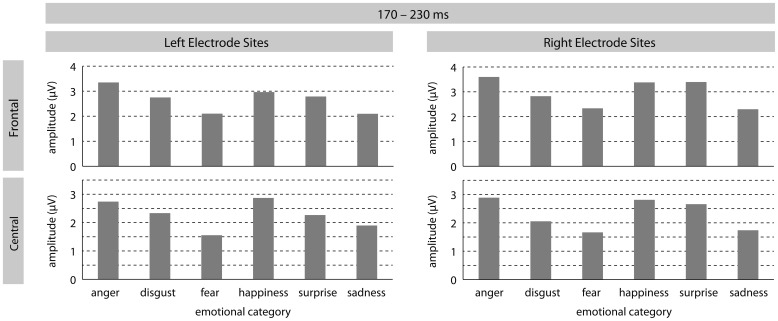
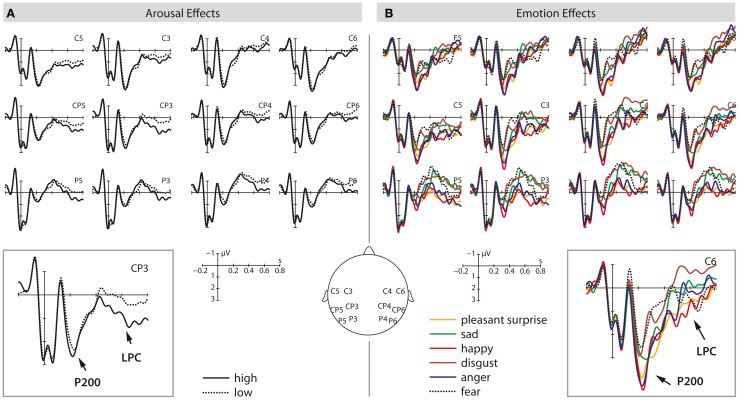
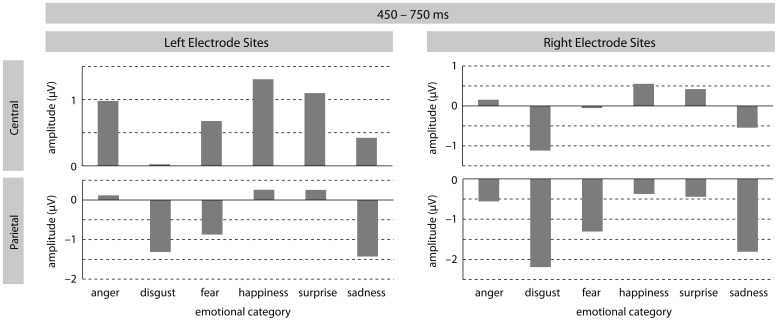
Previous research suggests that emotional prosody processing is a highly rapid and complex process. In particular, it has been shown that different basic emotions can be differentiated in an early event-related brain potential (ERP) component, the P200. Often, the P200 is followed by later long lasting ERPs such as the late positive complex. The current experiment set out to explore in how far emotionality and arousal can modulate these previously reported ERP components. In addition, we also investigated the influence of task demands (implicit vs. explicit evaluation of stimuli). Participants listened to pseudo-sentences (sentences with no lexical content) spoken in six different emotions or in a neutral tone of voice while they either rated the arousal level of the speaker or their own arousal level. Results confirm that different emotional intonations can first be differentiated in the P200 component, reflecting a first emotional encoding of the stimulus possibly including a valence tagging process. A marginal significant arousal effect was also found in this time-window with high arousing stimuli eliciting a stronger P200 than low arousing stimuli. The P200 component was followed by a long lasting positive ERP between 400 and 750 ms. In this late time-window, both emotion and arousal effects were found. No effects of task were observed in either time-window. Taken together, results suggest that emotion relevant details are robustly decoded during early processing and late processing stages while arousal information is only reliably taken into consideration at a later stage of processing.
先前的研究表明,情绪韵律处理是一个高度快速且复杂的过程。特别是,已经表明不同的基本情绪可以在早期的事件相关脑电位(ERP)成分 P200 中区分出来。通常,P200 之后会出现后来的持续时间较长的 ERP,如晚期正性复合波。本实验旨在探讨情绪和唤醒度在多大程度上可以调节这些先前报道的 ERP 成分。此外,我们还研究了任务需求(隐式与显式刺激评估)的影响。参与者在以六种不同的情绪或中性语调说话的假句子(没有词汇内容的句子)时,要么对说话者的唤醒度进行评级,要么对自己的唤醒度进行评级。结果证实,不同的情绪语调可以首先在 P200 成分中区分出来,反映了对刺激的初步情绪编码,可能包括一种效价标记过程。在这个时间窗口中还发现了一个边缘显著的唤醒效应,高唤醒刺激比低唤醒刺激引发更强的 P200。P200 成分之后是一个持续时间在 400 到 750 毫秒之间的长时正性 ERP。在这个晚期时间窗口中,都发现了情绪和唤醒效应。在这两个时间窗口中都没有观察到任务的影响。总的来说,结果表明,在早期处理和晚期处理阶段,与情绪相关的细节可以稳健地解码,而唤醒信息仅在处理的后期阶段可靠地被考虑。