Daru. 2013 Jun 27;21(1):51. doi: 10.1186/2008-2231-21-51.
Traditional preparations of the root of Biebersteinia multifida DC (Geraniaceae), a native medicinal plant of Irano-Turanian floristic region, have been used for the treatment of phobias as anxiolytic herbal preparation.
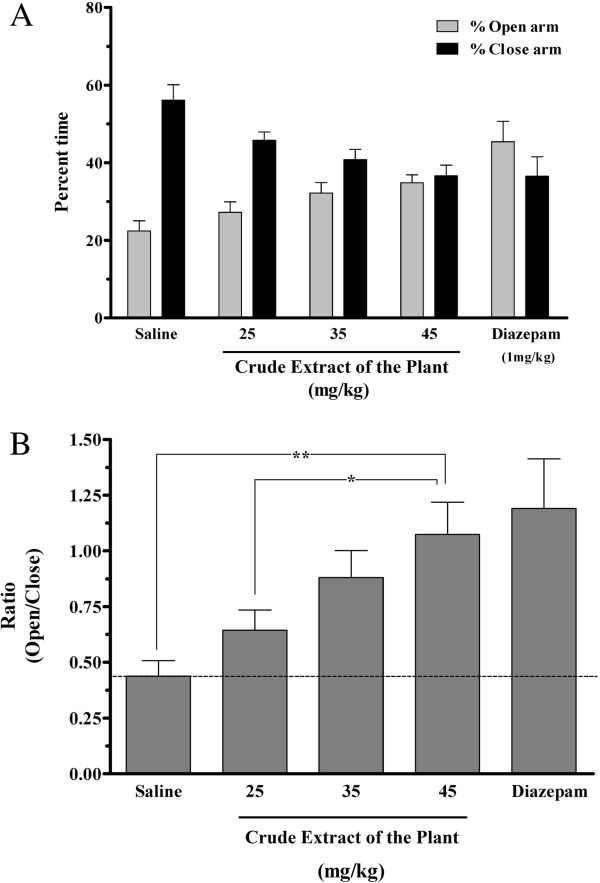
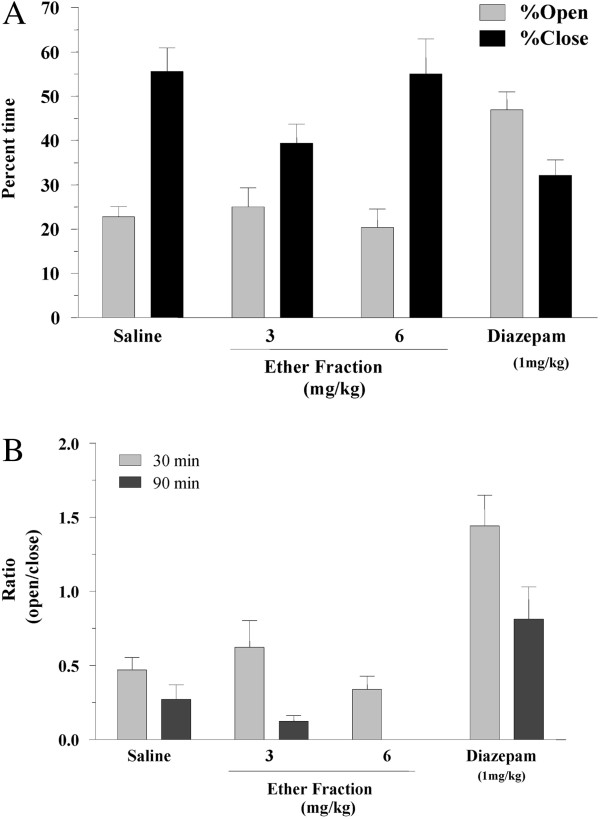
We utilized the phobic behavior of mice in an elevated plus-maze as a model to evaluate the anxiolytic effect of the plant extract and bio-guided fractionation was applied to isolate the active compounds. Total root extract, alkaline and ether fraction were administered to mice at different doses 30 and 90 min prior to the maze test. Saline and diazepam were administered as negative and positive controls, respectively. The time spent in open and closed arms, an index of anxiety behavior and entry time, was measured as an index of animal activity.
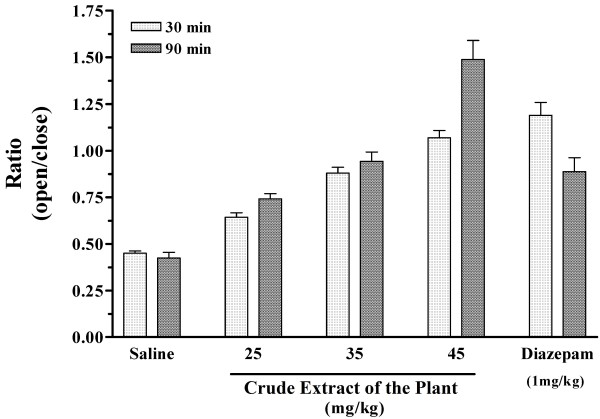
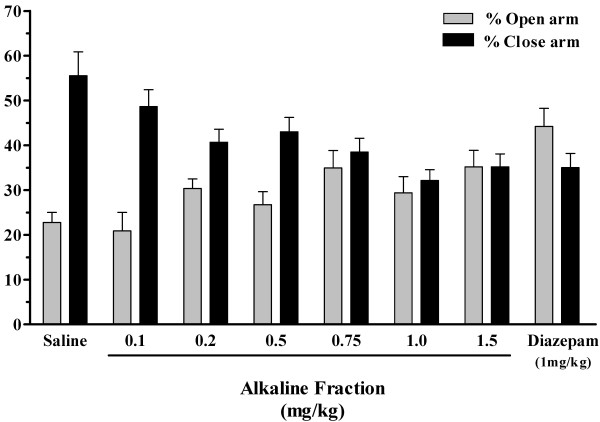
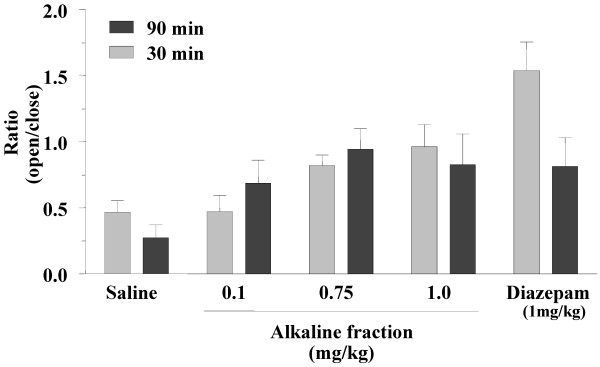
The total root extract exhibited anxiolytic effect which was comparable to diazepam but with longer duration. This sustained effect of the crude extract was sustained for 90 min and was even more after injection of 45 mg/kg while the effect of diazepam had been reduced by 90 min. The anxiolytic effect factor was only present in the alkaline fraction and displayed its effect at lower doses than diazepam while pure vasicinone as the previously known alkaloid did not shown anxiolytic effect. The effect of the alkaline fraction was in a dose dependent manner starting at 0.2 mg/kg with a maximum at 1.0 mg/kg. Bio-guided fractionation using a variety of chromatographic methods led to isolation and purification of three coumarin derivatives from the bioactive fraction, including umbelliferone, scopoletin, and ferulic acid.
For the first time, bio-guided fractionation of the root extract of B. multifida indicates significant sustained anxiolytic effects which led to isolation of three coumarin derivatives with well-known potent MAO inhibitory and anti-anxiety effects. These data contribute to evidence-based traditional use of B. multifida root for anxiety disorders.
原产于伊朗-图兰植物区系的药用植物绵毛婆婆纳根的传统制剂,已被用作抗焦虑草药制剂来治疗恐惧症。
我们利用小鼠在高架十字迷宫中的恐惧行为作为模型,评估植物提取物的抗焦虑作用,并应用生物导向分离来分离活性化合物。在迷宫试验前 30 和 90 分钟,将总根提取物、碱性和乙醚部分以不同剂量施用于小鼠。盐水和地西泮分别作为阴性和阳性对照。用动物活动的指标,即开放臂和封闭臂的停留时间和进入时间来测量焦虑行为的指数。
总根提取物表现出与地西泮相当的抗焦虑作用,但作用持续时间更长。这种粗提物的持续作用可持续 90 分钟,在注射 45mg/kg 后甚至更长,而地西泮的作用在 90 分钟后已经减弱。抗焦虑作用因子仅存在于碱性部分,其作用剂量低于地西泮,而先前已知的生物碱瓦西定酮则没有表现出抗焦虑作用。碱性部分的作用呈剂量依赖性,从 0.2mg/kg 开始,在 1.0mg/kg 时达到最大值。使用多种色谱方法进行的生物导向分离,从生物活性部分中分离和纯化了三种香豆素衍生物,包括伞形酮、东莨菪内酯和阿魏酸。
首次对绵毛婆婆纳根提取物进行生物导向分离,表明其具有显著的持续抗焦虑作用,从而分离出三种具有已知强效 MAO 抑制和抗焦虑作用的香豆素衍生物。这些数据为绵毛婆婆纳根用于焦虑症的基于证据的传统用途提供了依据。