Division of Systems Medicine, Department of Pediatrics, Stanford University School of Medicine, 251 Campus Drive, Palo Alto, CA 94304, USA ; Lucille Packard Children's Hospital, 725 Welch Rd, Palo Alto, CA 94304, USA.
School of Biology, Georgia Institute of Technology, 310 Ferst Drive, Atlanta GA 30332, USA.
Genome Med. 2013 Jun 27;5(6):58. doi: 10.1186/gm462. eCollection 2013.
Whole genome sequencing is poised to revolutionize personalized medicine, providing the capacity to classify individuals into risk categories for a wide range of diseases. Here we begin to explore how whole genome sequencing (WGS) might be incorporated alongside traditional clinical evaluation as a part of preventive medicine. The present study illustrates novel approaches for integrating genotypic and clinical information for assessment of generalized health risks and to assist individuals in the promotion of wellness and maintenance of good health.
Whole genome sequences and longitudinal clinical profiles are described for eight middle-aged Caucasian participants (four men and four women) from the Center for Health Discovery and Well Being (CHDWB) at Emory University in Atlanta. We report multivariate genotypic risk assessments derived from common variants reported by genome-wide association studies (GWAS), as well as clinical measures in the domains of immune, metabolic, cardiovascular, musculoskeletal, respiratory, and mental health.
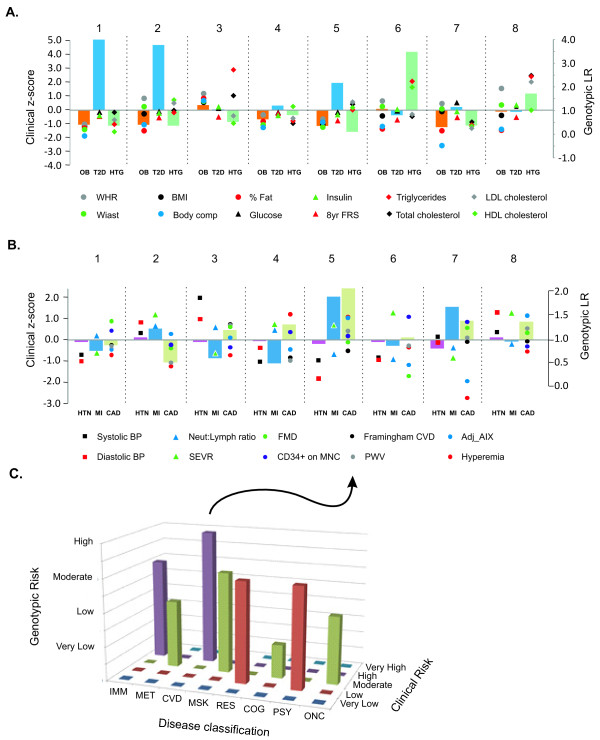
Polygenic risk is assessed for each participant for over 100 diseases and reported relative to baseline population prevalence. Two approaches for combining clinical and genetic profiles for the purposes of health assessment are then presented. First we propose conditioning individual disease risk assessments on observed clinical status for type 2 diabetes, coronary artery disease, hypertriglyceridemia and hypertension, and obesity. An approximate 2:1 ratio of concordance between genetic prediction and observed sub-clinical disease is observed. Subsequently, we show how more holistic combination of genetic, clinical and family history data can be achieved by visualizing risk in eight sub-classes of disease. Having identified where their profiles are broadly concordant or discordant, an individual can focus on individual clinical results or genotypes as they develop personalized health action plans in consultation with a health partner or coach.
The CHDWB will facilitate longitudinal evaluation of wellness-focused medical care based on comprehensive self-knowledge of medical risks.
全基因组测序有望彻底改变个性化医疗,为广泛的疾病风险分类提供能力。在这里,我们开始探索全基因组测序 (WGS) 如何与传统临床评估相结合,成为预防医学的一部分。本研究展示了将基因型和临床信息整合用于评估广义健康风险以及帮助个人促进健康和保持良好健康的新方法。
描述了来自亚特兰大埃默里大学健康发现与健康中心 (CHDWB) 的八名中年白种人参与者(四名男性和四名女性)的全基因组序列和纵向临床概况。我们报告了来自全基因组关联研究 (GWAS) 的常见变体衍生的多基因风险评估,以及免疫、代谢、心血管、肌肉骨骼、呼吸和心理健康领域的临床测量。
为每位参与者评估了超过 100 种疾病的多基因风险,并相对于基线人群患病率进行了报告。然后提出了两种用于结合临床和遗传谱进行健康评估的方法。首先,我们提出根据 2 型糖尿病、冠状动脉疾病、高甘油三酯血症和高血压以及肥胖症的观察到的临床状态来调节个体疾病风险评估。观察到遗传预测与观察到的亚临床疾病之间的一致性约为 2:1。随后,我们展示了如何通过可视化八种疾病亚类的风险来实现遗传、临床和家族史数据的更全面组合。在确定了他们的个人资料大致一致或不一致的地方后,个人可以专注于个人的临床结果或基因型,因为他们与健康伙伴或教练一起制定个性化的健康行动计划。
CHDWB 将促进基于对医疗风险的全面自我了解的以健康为重点的医疗保健的纵向评估。