Institute for Immunology and Informatics; University of Rhode Island; Providence, RI USA; EpiVax, Inc.; Providence, RI USA.
Hum Vaccin Immunother. 2013 May;9(5):950-6. doi: 10.4161/hv.24939. Epub 2013 May 1.
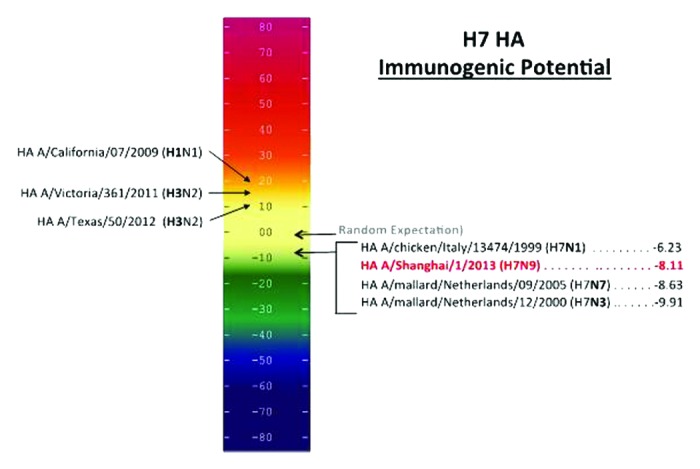
A new avian-origin influenza virus emerged near Shanghai in February 2013, and by the beginning of May it had caused over 130 human infections and 36 deaths. Human-to-human transmission of avian-origin H7N9 influenza A has been limited to a few family clusters, but the high mortality rate (27%) associated with human infection has raised concern about the potential for this virus to become a significant human pathogen. European, American, and Asian vaccine companies have already initiated the process of cloning H7 antigens such as hemagglutinin (HA) into standardized vaccine production vehicles. Unfortunately, previous H7 HA-containing vaccines have been poorly immunogenic. We used well-established immunoinformatics tools to analyze the H7N9 protein sequences and compare their T cell epitope content to other circulating influenza A strains as a means of estimating the immunogenic potential of the new influenza antigen. We found that the HA proteins derived from closely related human-derived H7N9 strains contain fewer T cell epitopes than other recently circulating strains of influenza, and that conservation of T cell epitopes with other strains of influenza was very limited. Here, we provide a detailed accounting of the type and location of T cell epitopes contained in H7N9 and their conservation in other H7 and circulating (A/California/07/2009, A/Victoria/361/2011, and A/Texas/50/2012) influenza A strains. Based on this analysis, avian-origin H7N9 2013 appears to be a "stealth" virus, capable of evading human cellular and humoral immune response. Should H7N9 develop pandemic potential, this analysis predicts that novel strategies for improving vaccine immunogenicity for this unique low-immunogenicity strain of avian-origin influenza will be urgently needed.
一种新型禽流感病毒于 2013 年 2 月在上海附近出现,截至 5 月初,已导致超过 130 人感染,36 人死亡。人感染禽流感 H7N9 的人际传播仅限于少数家庭聚集性病例,但与人类感染相关的高死亡率(27%)引起了人们对这种病毒可能成为重要人类病原体的担忧。欧洲、美国和亚洲的疫苗公司已经开始将 H7 血凝素(HA)等抗原克隆到标准化疫苗生产载体中。不幸的是,以前含有 H7HA 的疫苗的免疫原性较差。我们使用成熟的免疫信息学工具分析 H7N9 蛋白序列,并将其 T 细胞表位内容与其他循环流感 A 株进行比较,以估计新流感抗原的免疫原性潜力。我们发现,源自密切相关的人源 H7N9 株的 HA 蛋白所含的 T 细胞表位比其他最近流行的流感株少,而与其他流感株的 T 细胞表位保守性非常有限。在这里,我们详细描述了 H7N9 中包含的 T 细胞表位的类型和位置及其在其他 H7 和循环(A/California/07/2009、A/Victoria/361/2011 和 A/Texas/50/2012)流感 A 株中的保守性。基于这项分析,2013 年的禽流感 H7N9 似乎是一种“隐形”病毒,能够逃避人体细胞和体液免疫反应。如果 H7N9 发展为大流行潜力,这一分析预测,需要为这种独特的低免疫原性禽流感病毒株开发提高疫苗免疫原性的新策略。