Physical Activity Exchange, Research Institute for Sport and Exercise Sciences, Liverpool John Moores University, 62, Great Crosshall Street, Liverpool, UK.
BMC Public Health. 2013 Jul 2;13:626. doi: 10.1186/1471-2458-13-626.
This pragmatic evaluation investigated the effectiveness of the Children's Health, Activity and Nutrition: Get Educated! (CHANGE!) Project, a cluster randomised intervention to promote healthy weight using an educational focus on physical activity and healthy eating.
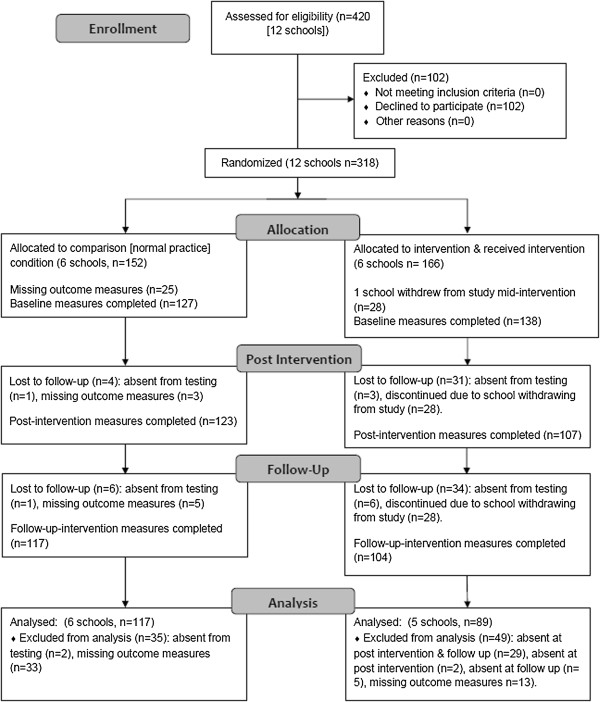
Participants (n = 318, aged 10-11 years) from 6 Intervention and 6 Comparison schools took part in the 20 weeks intervention between November 2010 and March/April 2011. This consisted of a teacher-led curriculum, learning resources, and homework tasks. Primary outcome measures were waist circumference, body mass index (BMI), and BMI z-scores. Secondary outcomes were objectively-assessed physical activity and sedentary time, and food intake. Outcomes were assessed at baseline, at post-intervention (20 weeks), and at follow-up (30 weeks). Data were analysed using 2-level multi-level modelling (levels: school, student) and adjusted for baseline values of the outcomes and potential confounders. Differences in intervention effect by subgroup (sex, weight status, socio-economic status) were explored using statistical interaction.
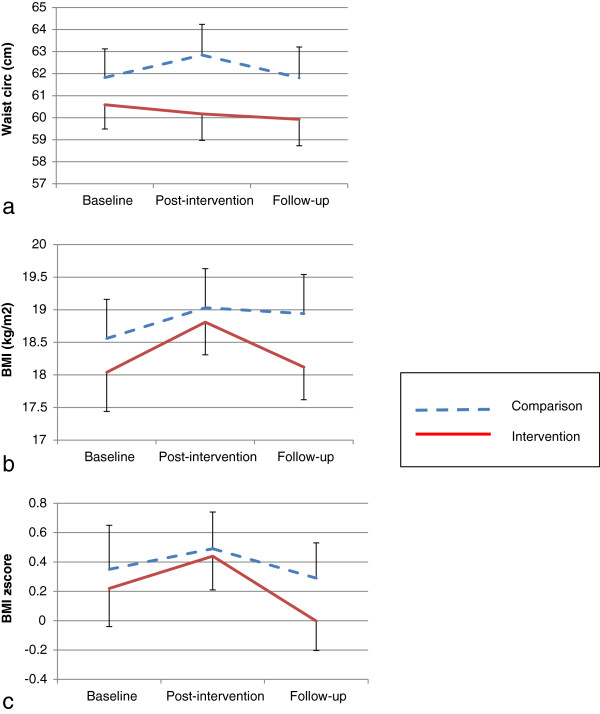
Significant between-group effects were observed for waist circumference at post-intervention (β for intervention effect =-1.63 (95% CI = -2.20, -1.07) cm, p<0.001) and for BMI z-score at follow-up (β=-0.24 (95% CI = -0.48, -0.003), p=0.04). At follow-up there was also a significant intervention effect for light intensity physical activity (β=25.97 (95% CI = 8.04, 43.89) min, p=0.01). Interaction analyses revealed that the intervention was most effective for overweight/obese participants (waist circumference: β=-2.82 (95% CI = -4.06, -1.58) cm, p<0.001), girls (BMI: β=-0.39 (95% CI = -0.81, 0.03) kg/m2, p=0.07), and participants with higher family socioeconomic status (breakfast consumption: β=8.82 (95% CI = 6.47, 11.16), p=0.07).
The CHANGE! intervention positively influenced body size outcomes and light physical activity, and most effectively influenced body size outcomes among overweight and obese children and girls. The findings add support for the effectiveness of combined school-based physical activity and nutrition interventions. Additional work is required to test intervention fidelity and the sustained effectiveness of this intervention in the medium and long term.
Current Controlled Trials ISRCTN03863885.
本实用评价研究调查了儿童健康、活动和营养:接受教育!(CHANGE!)项目的有效性,这是一项通过教育促进身体活动和健康饮食来促进健康体重的集群随机干预措施。
2010 年 11 月至 2011 年 3 月/4 月期间,来自 6 所干预学校和 6 所对照学校的 318 名 10-11 岁的参与者参加了为期 20 周的干预。该干预措施包括由教师主导的课程、学习资源和家庭作业任务。主要结局指标为腰围、体重指数(BMI)和 BMI z 评分。次要结局指标为客观评估的身体活动和久坐时间以及食物摄入量。在基线、干预后(20 周)和随访(30 周)时进行评估。使用 2 水平多水平模型(水平:学校、学生)进行数据分析,并根据结局的基线值和潜在混杂因素进行调整。使用统计学交互作用探索干预效果的亚组差异(性别、体重状况、社会经济地位)。
干预后,腰围存在显著的组间效应(干预效果的β值=-1.63(95%CI=-2.20,-1.07)cm,p<0.001),随访时 BMI z 评分也存在显著的干预效果(β=-0.24(95%CI=-0.48,-0.003),p=0.04)。随访时,轻度体力活动也存在显著的干预效果(β=25.97(95%CI=8.04,43.89)min,p=0.01)。交互分析表明,该干预措施对超重/肥胖参与者最为有效(腰围:β=-2.82(95%CI=-4.06,-1.58)cm,p<0.001),女孩(BMI:β=-0.39(95%CI=-0.81,0.03)kg/m2,p=0.07),以及家庭社会经济地位较高的参与者(早餐摄入:β=8.82(95%CI=6.47,11.16),p=0.07)。
CHANGE!干预措施对身体大小结果和轻度体力活动有积极影响,对超重和肥胖儿童以及女孩的身体大小结果影响最大。研究结果为综合学校基础上的身体活动和营养干预措施的有效性提供了支持。需要进一步的工作来测试该干预措施的实施效果和中长期的持续有效性。
当前对照试验 ISRCTN03863885。