Department of Biology, Division of Biochemistry, Friedrich-Alexander-University Erlangen-Nuremberg, Staudtstr, 5, 91058, Erlangen, Germany.
BMC Genomics. 2013 Jul 3;14:442. doi: 10.1186/1471-2164-14-442.
Abiotic stress causes disturbances in the cellular homeostasis. Re-adjustment of balance in carbon, nitrogen and phosphorus metabolism therefore plays a central role in stress adaptation. However, it is currently unknown which parts of the primary cell metabolism follow common patterns under different stress conditions and which represent specific responses.
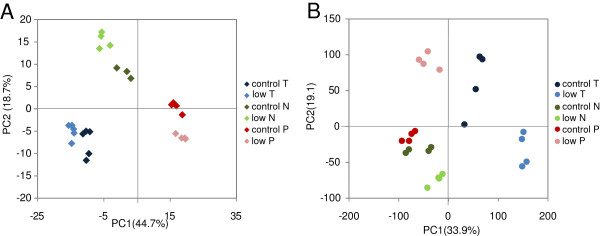
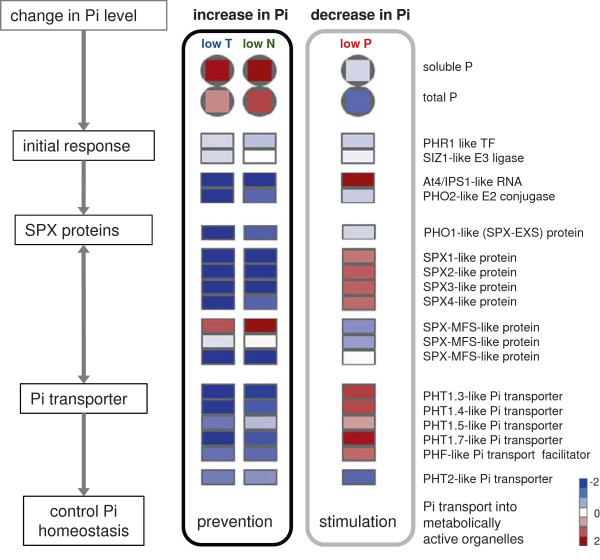
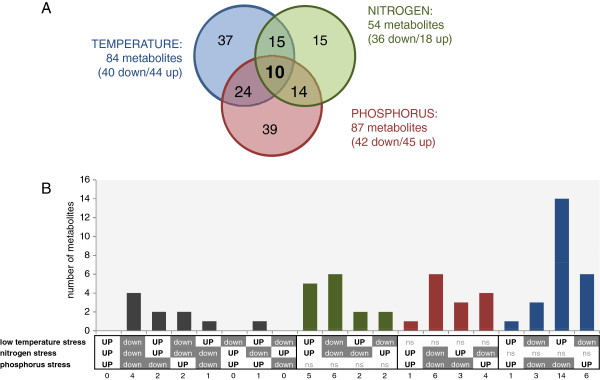
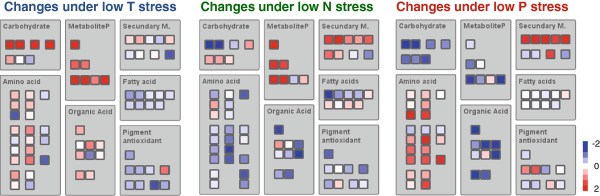
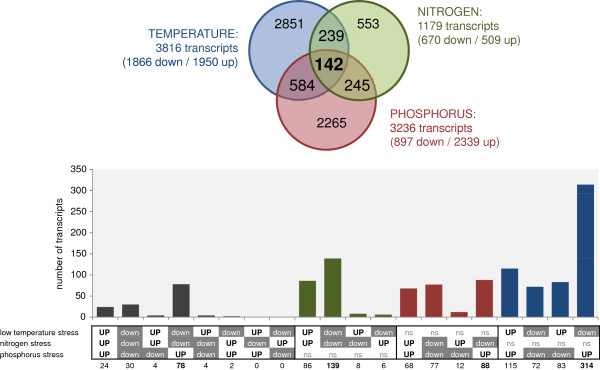
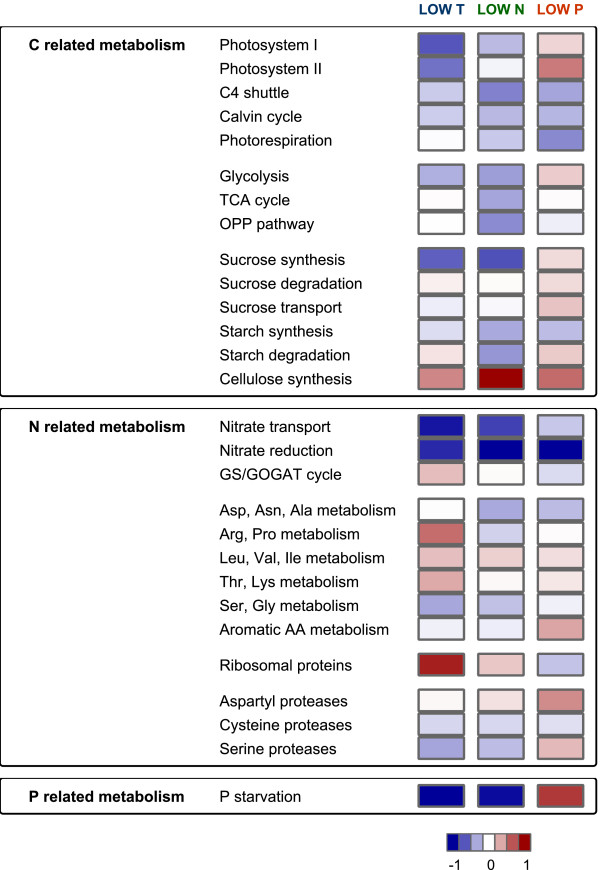
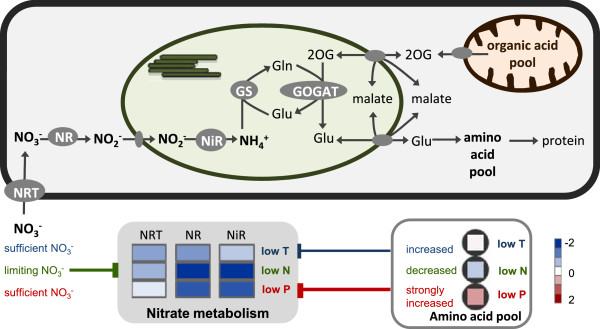
To address these questions, changes in transcriptome, metabolome and ionome were analyzed in maize source leaves from plants suffering low temperature, low nitrogen (N) and low phosphorus (P) stress. The selection of maize as study object provided data directly from an important crop species and the so far underexplored C4 metabolism. Growth retardation was comparable under all tested stress conditions. The only primary metabolic pathway responding similar to all stresses was nitrate assimilation, which was down-regulated. The largest group of commonly regulated transcripts followed the expression pattern: down under low temperature and low N, but up under low P. Several members of this transcript cluster could be connected to P metabolism and correlated negatively to different phosphate concentration in the leaf tissue. Accumulation of starch under low temperature and low N stress, but decrease in starch levels under low P conditions indicated that only low P treated leaves suffered carbon starvation.
Maize employs very different strategies to manage N and P metabolism under stress. While nitrate assimilation was regulated depending on demand by growth processes, phosphate concentrations changed depending on availability, thus building up reserves under excess conditions. Carbon and energy metabolism of the C4 maize leaves were particularly sensitive to P starvation.
非生物胁迫会导致细胞内稳态紊乱。因此,碳、氮和磷代谢的平衡再调整在应激适应中起着核心作用。然而,目前尚不清楚在不同胁迫条件下,哪些初级细胞代谢部分遵循共同模式,哪些代表特定的反应。
为了解决这些问题,分析了遭受低温、低氮(N)和低磷(P)胁迫的玉米源叶的转录组、代谢组和离子组的变化。选择玉米作为研究对象提供了直接来自重要作物物种和迄今研究较少的 C4 代谢的数据。在所有测试的胁迫条件下,生长迟缓是相似的。唯一对所有胁迫都有类似反应的初级代谢途径是硝酸盐同化,其被下调。最常见的共同调控转录本组遵循以下表达模式:低温和低 N 下调,而低 P 上调。该转录本簇的几个成员可以与 P 代谢相关联,并与叶片组织中不同的磷酸盐浓度呈负相关。低温和低 N 胁迫下淀粉的积累,但低 P 条件下淀粉水平的降低表明,只有低 P 处理的叶片才会遭受碳饥饿。
玉米在胁迫下采用非常不同的策略来管理 N 和 P 代谢。虽然硝酸盐同化是根据生长过程的需求进行调节的,但磷酸盐浓度的变化取决于可用性,因此在过剩条件下会建立储备。C4 玉米叶片的碳和能量代谢对 P 饥饿特别敏感。