Institute of Infection and Global Health, Department of Infection Biology, School of Veterinary Science, The University of Liverpool, Neston, Cheshire, United Kingdom.
PLoS One. 2013 Jun 25;8(6):e67749. doi: 10.1371/journal.pone.0067749. Print 2013.
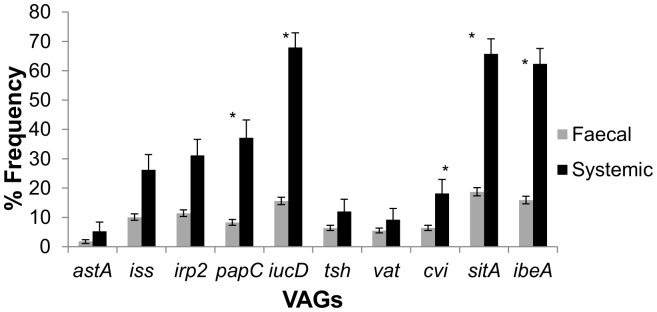
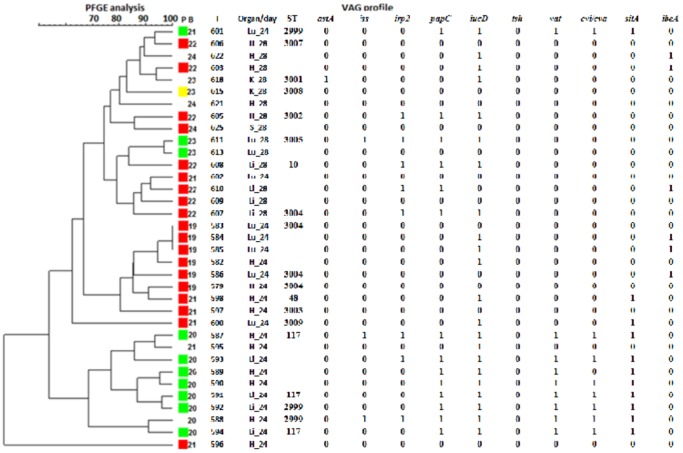
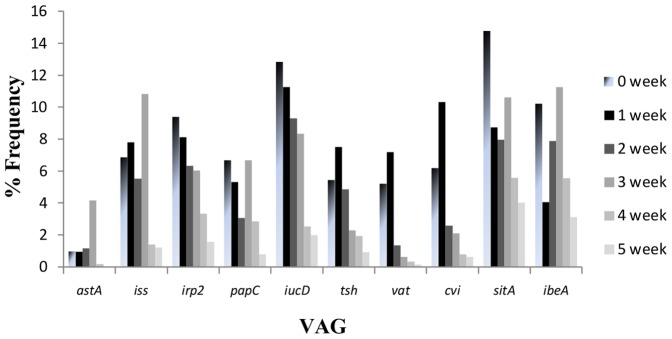
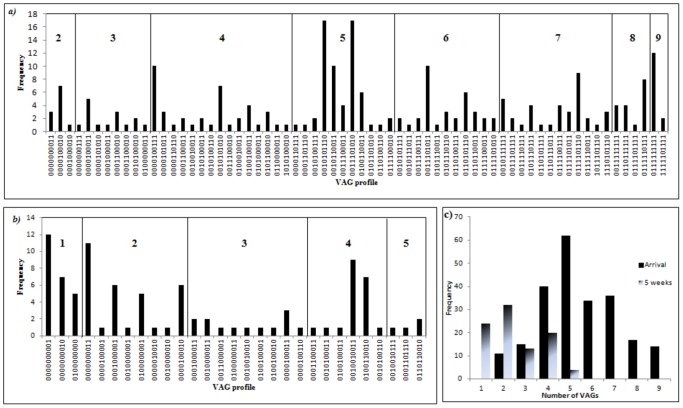
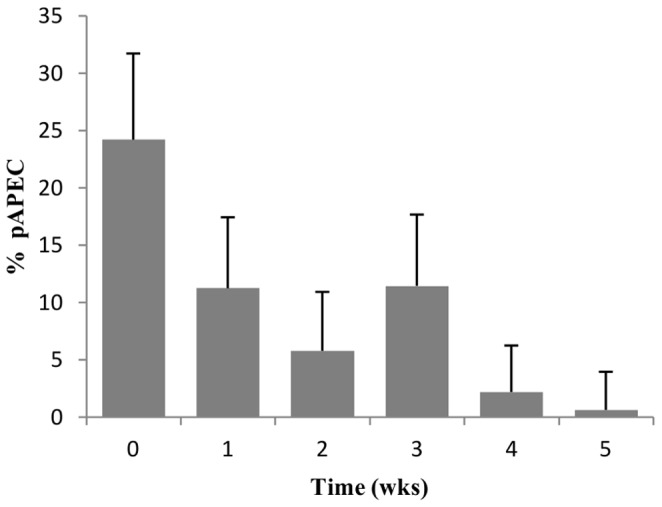
Colibacillosis is an economically important syndromic disease of poultry caused by extra-intestinal avian pathogenic Escherichia coli (APEC) but the pathotype remains poorly defined. Combinations of virulence-associated genes (VAGs) have aided APEC identification. The intestinal microbiota is a potential APEC reservoir. Broiler chickens are selectively bred for fast, uniform growth. Here we simultaneously investigate intestinal E. coli VAG carriage in apparently healthy birds and characterise systemic E. coli from diseased broiler chickens from the same flocks. Four flocks were sampled longitudinally from chick placement until slaughter. Phylogrouping, macro-restriction pulsed-field gel electrophoresis (PFGE) and multi-locus sequence typing (MLST) were performed on an isolate subset from one flock to investigate the population structure of faecal and systemic E. coli. Early in production, VAG carriage among chick intestinal E. coli populations was diverse (average Simpson's D value = 0.73); 24.05% of intestinal E. coli (n = 160) from 1 day old chicks were carrying ≥5 VAGs. Generalised Linear models demonstrated VAG prevalence in potential APEC populations declined with age; 1% of E. coli carrying ≥5 VAGs at slaughter and demonstrated high strain diversity. A variety of VAG profiles and high strain diversity were observed among systemic E. coli. Thirty three new MLST sequence types were identified among 50 isolates and a new sequence type representing 22.2% (ST-2999) of the systemic population was found, differing from the pre-defined pathogenic ST-117 at a single locus. For the first time, this study takes a longitudinal approach to unravelling the APEC paradigm. Our findings, supported by other studies, highlight the difficulty in defining the APEC pathotype. Here we report a high genetic diversity among systemic E. coli between and within diseased broilers, harbouring diverse VAG profiles rather than single and/or highly related pathogenic clones suggesting host susceptibility in broilers plays an important role in APEC pathogenesis.
大肠杆菌病是一种由禽致病性大肠杆菌(APEC)引起的、对禽类具有重要经济意义的综合征疾病,但该病原的表型仍未得到明确界定。毒力相关基因(VAG)的组合有助于 APEC 的鉴定。肠道微生物群是 APEC 的潜在储库。肉鸡是经过选择性培育的,具有快速、均匀的生长速度。在这里,我们同时调查了来自同一批鸡群的健康雏鸡肠道大肠杆菌 VAG 携带情况,并对来自同一批鸡群的患病肉鸡的系统大肠杆菌进行了特征描述。从雏鸡放置到屠宰,对四个鸡群进行了纵向采样。对来自一个鸡群的分离株亚群进行了菌群分组、宏限制脉冲场凝胶电泳(PFGE)和多位点序列分型(MLST)分析,以研究粪便和系统大肠杆菌的种群结构。在生产早期,雏鸡肠道大肠杆菌种群的 VAG 携带情况多种多样(平均 Simpson's D 值为 0.73);1 日龄雏鸡的 160 株肠道大肠杆菌中有 24.05%携带了≥5 种 VAG。广义线性模型表明,具有潜在 APEC 特征的大肠杆菌种群的 VAG 流行率随着年龄的增长而下降;屠宰时,携带≥5 种 VAG 的大肠杆菌比例为 1%,表现出高菌株多样性。系统大肠杆菌中观察到多种 VAG 谱和高菌株多样性。在 50 株分离株中发现了 33 种新的 MLST 序列类型,其中一种新的序列类型(ST-2999)代表了系统种群的 22.2%,与之前定义的致病性 ST-117 在一个单一基因座上存在差异。本研究首次采用纵向方法揭示了 APEC 范式。我们的研究结果得到了其他研究的支持,突出了明确界定 APEC 表型的困难。在这里,我们报告了患病肉鸡之间和内部系统大肠杆菌的高度遗传多样性,携带多种 VAG 谱,而不是单一和/或高度相关的致病性克隆,这表明肉鸡的宿主易感性在 APEC 发病机制中起着重要作用。