Shokhirev Maxim Nikolaievich, Hoffmann Alexander
Signaling Systems Laboratory, Department of Chemistry and Biochemistry, University of California San Diego, La Jolla, California, United States of America ; San Diego Center for Systems Biology, La Jolla, California, United States of America ; Graduate Program in Bioinformatics and Systems Biology, University of California San Diego, La Jolla, California, United States of America.
PLoS One. 2013 Jun 27;8(6):e67620. doi: 10.1371/journal.pone.0067620. Print 2013.
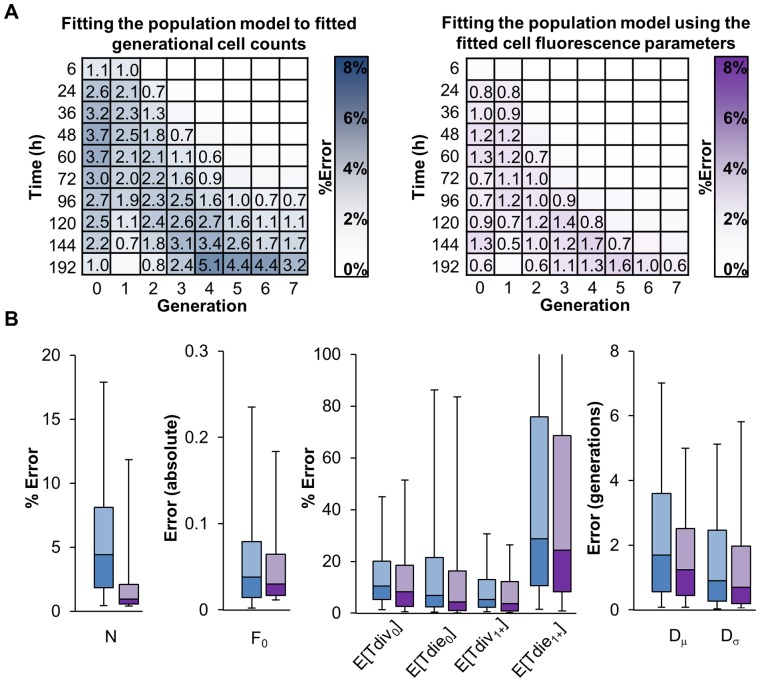
The immune response is a concerted dynamic multi-cellular process. Upon infection, the dynamics of lymphocyte populations are an aggregate of molecular processes that determine the activation, division, and longevity of individual cells. The timing of these single-cell processes is remarkably widely distributed with some cells undergoing their third division while others undergo their first. High cell-to-cell variability and technical noise pose challenges for interpreting popular dye-dilution experiments objectively. It remains an unresolved challenge to avoid under- or over-interpretation of such data when phenotyping gene-targeted mouse models or patient samples. Here we develop and characterize a computational methodology to parameterize a cell population model in the context of noisy dye-dilution data. To enable objective interpretation of model fits, our method estimates fit sensitivity and redundancy by stochastically sampling the solution landscape, calculating parameter sensitivities, and clustering to determine the maximum-likelihood solution ranges. Our methodology accounts for both technical and biological variability by using a cell fluorescence model as an adaptor during population model fitting, resulting in improved fit accuracy without the need for ad hoc objective functions. We have incorporated our methodology into an integrated phenotyping tool, FlowMax, and used it to analyze B cells from two NFκB knockout mice with distinct phenotypes; we not only confirm previously published findings at a fraction of the expended effort and cost, but reveal a novel phenotype of nfkb1/p105/50 in limiting the proliferative capacity of B cells following B-cell receptor stimulation. In addition to complementing experimental work, FlowMax is suitable for high throughput analysis of dye dilution studies within clinical and pharmacological screens with objective and quantitative conclusions.
免疫反应是一个协同的动态多细胞过程。感染后,淋巴细胞群体的动态变化是分子过程的总和,这些分子过程决定了单个细胞的激活、分裂和寿命。这些单细胞过程的时间分布非常广泛,一些细胞正在进行第三次分裂,而另一些细胞则正在进行第一次分裂。高细胞间变异性和技术噪声对客观解释流行的染料稀释实验提出了挑战。在对基因靶向小鼠模型或患者样本进行表型分析时,避免对此类数据的解释不足或过度解释仍然是一个未解决的挑战。在这里,我们开发并表征了一种计算方法,用于在有噪声的染料稀释数据的背景下对细胞群体模型进行参数化。为了能够客观地解释模型拟合,我们的方法通过对解空间进行随机采样、计算参数敏感性并进行聚类以确定最大似然解范围来估计拟合敏感性和冗余性。我们的方法在群体模型拟合过程中使用细胞荧光模型作为适配器,从而兼顾了技术和生物学变异性,无需特设目标函数即可提高拟合精度。我们已将我们的方法整合到一个综合表型分析工具FlowMax中,并使用它来分析来自两只具有不同表型的NFκB基因敲除小鼠的B细胞;我们不仅以一小部分的工作量和成本证实了先前发表的发现,而且还揭示了nfkb1/p105/50在限制B细胞受体刺激后B细胞增殖能力方面的一种新表型。除了补充实验工作外,FlowMax还适用于临床和药理筛选中染料稀释研究的高通量分析,并能得出客观和定量的结论。