Department of Nutrition, University of Oslo, NO-0316 Oslo, Norway.
Int J Behav Nutr Phys Act. 2013 Jul 6;10:89. doi: 10.1186/1479-5868-10-89.
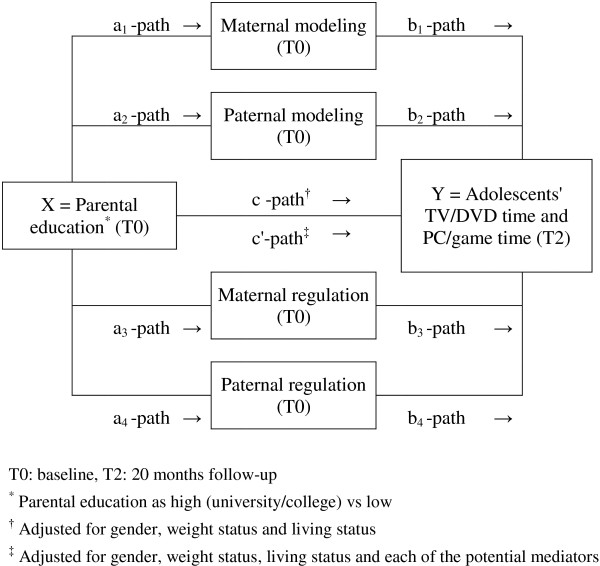
The present study investigated associations in gender dyads of parents' and adolescents' time spent on television and video viewing (TV/DVD), and computer and electronic game use (PC/games) at the ages of 11 and 13 years. Possible mediating effects of parental modelling and parental regulation in the relationship between parental education and adolescents' prospective TV/DVD and PC/game time were further examined.
A total of 908 adolescents, participating at both ages 11 and 13 years in the Norwegian HEalth In Adolescents (HEIA) cohort study (2007-2009), were included in the analyses. Data on adolescents', mothers' and fathers' self reported time spent on TV/DVD and PC/games were measured at both time points by questionnaires. Correlation coefficients were used to examine gender dyads of parents' and adolescents' reports. Mediation analyses using linear regression investigated possible mediation effects of parental modelling and parental regulation in the prospective relationship between parental education and adolescents' time spent on TV/DVD and PC/games between the ages of 11 and 13 years.
Correlations of screen time behaviours in gender dyads of parents and adolescents showed significant associations in time spent on TV/DVD at the age of 11 and 13 years. Associations between mothers and sons and between fathers and daughters were also observed in time spent on PC/games at the age of 11 years. Maternal and paternal modelling was further found to mediate the relationship between parental education and adolescents' prospective TV/DVD time between the ages of 11 and 13 years. No mediation effect was observed for parental regulation, however a decrease in both maternal and paternal regulation at the age of 11 years significantly predicted more TV/DVD time among adolescents at the age of 13 years.
Cross-sectional and longitudinal relationships were observed in gender dyads of parents' and adolescents' screen time behaviours at the ages of 11 and 13 years, and further studies including both parents and their children should be emphasized. Moreover, maternal and paternal modelling were found to be important target variables in interventions aiming to reduce social differences by parental education in adolescents' prospective time spent on TV/DVD.
本研究调查了 11 岁和 13 岁时父母和青少年在看电视和视频(电视/ DVD)以及使用电脑和电子游戏(PC/游戏)方面的时间分配在性别对中的关联。进一步研究了父母榜样和父母监管在父母教育与青少年未来电视/ DVD 和 PC/游戏时间之间的关系中的中介作用。
共有 908 名青少年参加了挪威青少年健康研究(HEIA)队列研究(2007-2009 年),并在 11 岁和 13 岁时都参加了分析。青少年、母亲和父亲的自我报告的电视/ DVD 和 PC/游戏时间数据在两个时间点均通过问卷进行测量。使用相关系数来检验父母和青少年报告的性别对之间的关联。使用线性回归进行中介分析,以研究父母教育与青少年 11 至 13 岁期间电视/ DVD 和 PC/游戏时间之间的前瞻性关系中父母榜样和父母监管的可能中介作用。
父母和青少年性别对的屏幕时间行为的相关性表明,11 岁和 13 岁时在电视/ DVD 上的时间存在显著关联。还观察到母亲和儿子以及父亲和女儿之间在 11 岁时在 PC/游戏上的时间存在关联。进一步发现,母亲和父亲的榜样作用在父母教育与青少年 11 至 13 岁期间的未来电视/ DVD 时间之间的关系中起中介作用。然而,没有观察到父母监管的中介作用,但是 11 岁时母亲和父亲监管的减少显著预测了 13 岁时青少年在电视/ DVD 上的时间增加。
在 11 岁和 13 岁时,观察到父母和青少年性别对的屏幕时间行为存在横断面和纵向关系,应强调包括父母及其子女在内的进一步研究。此外,发现母亲和父亲的榜样作用是减少父母教育对青少年未来电视/ DVD 时间的社会差异的干预措施中的重要目标变量。