Piva Marta Rabello, DE Souza Lélia Batista, Martins-Filho Paulo Ricardo Saquete, Nonaka Cassiano Francisco Weege, DE Santana Santos Thiago, DE Souza Andrade Emanuel Sávio, Piva Diogo
Department of Oral Pathology, Federal University of Sergipe, Sanatório, Aracaju 49060-100, Sergipe;
Oncol Lett. 2013 Jun;5(6):1909-1914. doi: 10.3892/ol.2013.1302. Epub 2013 Apr 11.
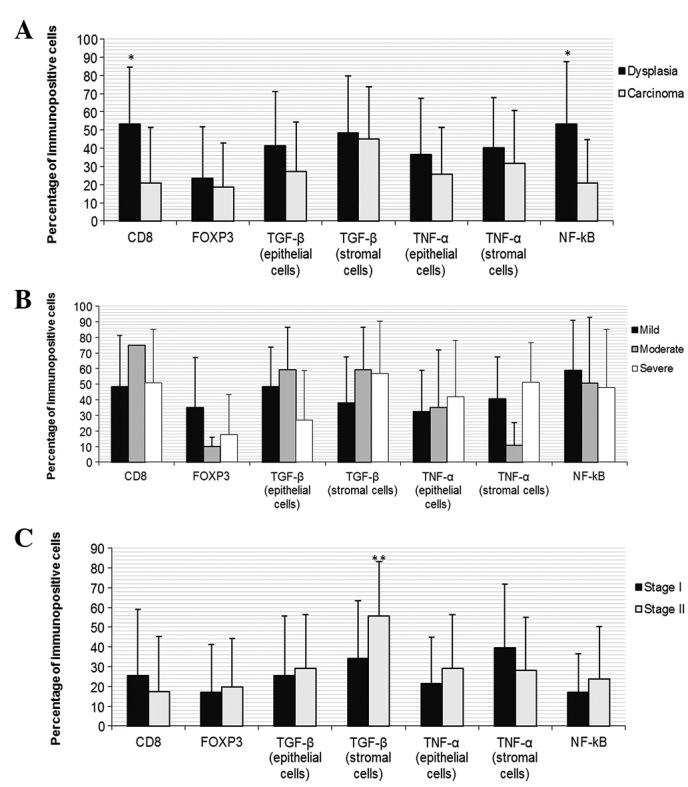
Due to the frequent presence of inflammation in cases of carcinoma and its use as a parameter for the assessment of tumor aggressiveness, the role of inflammation in oral carcinogenesis was investigated. This was performed by evaluating the expression of cellular markers, cytokines and nuclear transcription factors that identify the cells that participate in the antitumor defense in cases of oral epithelial dysplasia (OED) and oral squamous cell carcinoma (OSCC). A semi-quantitative immunohistochemical analysis was performed for the transcription factors cluster of differentiation 8 (CD8), forkhead box P3 (FOXP3), transforming growth factor (TGF)-β, tumor necrosis factor (TNF)-α and nuclear factor κ-light chain enhancer of activated B-cells (NF-κB), in cases of OED and OSCC. CD8, TGF-β, TNF-α and NF-κB participated in the processes of tumor transformation and progression. The presence of inflammatory infiltrate in cases of OED favors the transformation and invasion process when stromal TNF-α and NF-kB are overexpressed, as NF-kB activated by TNF-α during inflammation predisposes the lesion to transformation, functioning as a link between inflammation and cancer. The control of these inflammatory mediators may prevent malignant transformation in the oral cavity.
由于炎症在癌症病例中经常出现,且被用作评估肿瘤侵袭性的一个参数,因此对炎症在口腔癌发生中的作用进行了研究。这是通过评估细胞标志物、细胞因子和核转录因子的表达来实现的,这些标志物可识别参与口腔上皮发育异常(OED)和口腔鳞状细胞癌(OSCC)病例中抗肿瘤防御的细胞。对OED和OSCC病例中的转录因子分化簇8(CD8)、叉头框P3(FOXP3)、转化生长因子(TGF)-β、肿瘤坏死因子(TNF)-α和活化B细胞的核因子κ轻链增强子(NF-κB)进行了半定量免疫组织化学分析。CD8、TGF-β、TNF-α和NF-κB参与了肿瘤转化和进展过程。当基质TNF-α和NF-κB过度表达时,OED病例中炎症浸润的存在有利于转化和侵袭过程,因为炎症期间TNF-α激活的NF-κB使病变易于转化,充当炎症与癌症之间的联系。控制这些炎症介质可能会预防口腔中的恶性转化。