KPMG Plexus, Breukelen, The Netherlands.
BMC Fam Pract. 2013 Jul 8;14:95. doi: 10.1186/1471-2296-14-95.
Following the introduction of elements of managed competition in the Netherlands in 2006, General Practitioners (GPs) and patients were given the role to select treatment hospital using public quality information. In this study we investigate to what extent hospital preferences of GP's are affected by performance indicators on medical effectiveness and patient experiences. We selected three conditions: breast cancer, cataract surgery, and hip and knee replacement.
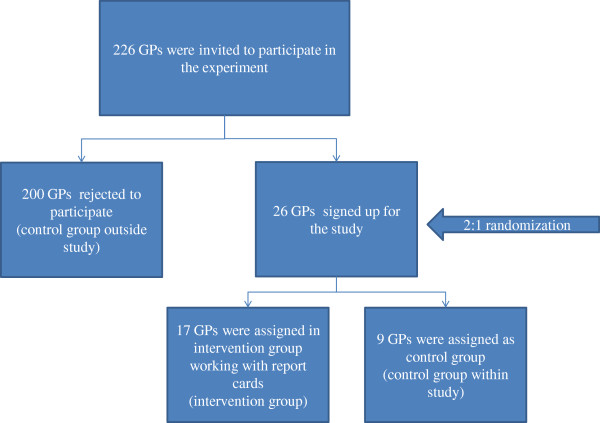
After an inquiry 26 out of 226 GPs in the region signed up to participate in our study. After a 2:1 randomization, we analyzed the referral patterns in the region using three groups of GPs: GPs (n=17) who used the report cards and received personal clarification, GPs that signed up for the study but were assigned to the control group (n=9), and the GPs outside the study (n=200).We conducted a difference in differences analysis where the choice for a particular hospital was the dependent variable and time (2009 or 2010), the sum score of the CQI, the sum score of the PI's and dummy variables for the individual hospitals were used as independent variables.
The analysis of the conditions together and cataract surgery and hip and knee replacement separately, showed no significant relationships between the scores on the report cards and the referral patterns of the GPs. For breast cancer our analysis revealed that GPs in the intervention group refer 1.0% (p=0.01) more to hospitals that score one percent point better on the indicators for medical effectiveness.
Our study provides empirical evidence that GP referral patterns were unaffected by the available quality information, except for the outcome indicators for breast cancer care that were presented. This finding was surprising since our study was designed to identify changes in hospital preference (1) amongst the most motivated GP's, (2) that received personal clarification of the performance indicators, and (3) selected indicators/conditions from a large set of indicators that they believed were most important. This finding may differ when quality information is based on outcome indicators with a clinically relevant difference, as shown by our indicators for breast cancer treatment. We believe that the current set of (largely process) hospital quality indicators do not serve the GP's information needs and consequently quality plays little role in the selection of hospitals for treatment.
2006 年,荷兰引入了管理竞争因素后,全科医生(GP)和患者被赋予了使用公共质量信息选择治疗医院的角色。在这项研究中,我们调查了 GP 对医院的偏好程度受到医疗效果和患者体验的绩效指标的影响程度。我们选择了三种情况:乳腺癌、白内障手术以及髋关节和膝关节置换术。
在调查之后,该地区的 226 名全科医生中有 26 名报名参加了我们的研究。经过 2:1 的随机分组,我们使用三组全科医生分析了该地区的转诊模式:使用报告卡并收到个人澄清的全科医生(n=17),报名参加研究但被分配到对照组的全科医生(n=9),以及研究之外的全科医生(n=200)。我们进行了差异中的差异分析,其中特定医院的选择是因变量,时间(2009 年或 2010 年)、CQI 的总和得分、PI 的总和得分以及个别医院的虚拟变量是自变量。
对三种情况的综合分析以及白内障手术和髋关节和膝关节置换术的单独分析都表明,报告卡的得分与 GP 的转诊模式之间没有显著关系。对于乳腺癌,我们的分析表明,干预组的 GP 向医疗效果指标得分提高一个百分点的医院转诊的比例高出 1.0%(p=0.01)。
我们的研究提供了经验证据,表明全科医生的转诊模式不受可用质量信息的影响,除了所呈现的乳腺癌护理结果指标之外。这一发现令人惊讶,因为我们的研究旨在确定(1)在最有动力的 GP 中,(2)他们收到了绩效指标的个人澄清,以及(3)从他们认为最重要的大量指标中选择的医院偏好的变化。当质量信息基于具有临床相关差异的结果指标时,这种发现可能会有所不同,正如我们的乳腺癌治疗指标所示。我们认为,当前的医院质量指标(主要是流程)集不能满足 GP 的信息需求,因此质量在治疗医院的选择中几乎没有发挥作用。