Life Sciences Institute, 210 Washtenaw Avenue, University of Michigan, Ann Arbor, Michigan 48109-2216, United States.
Biochemistry. 2013 Jul 30;52(30):5125-32. doi: 10.1021/bi4002985. Epub 2013 Jul 16.
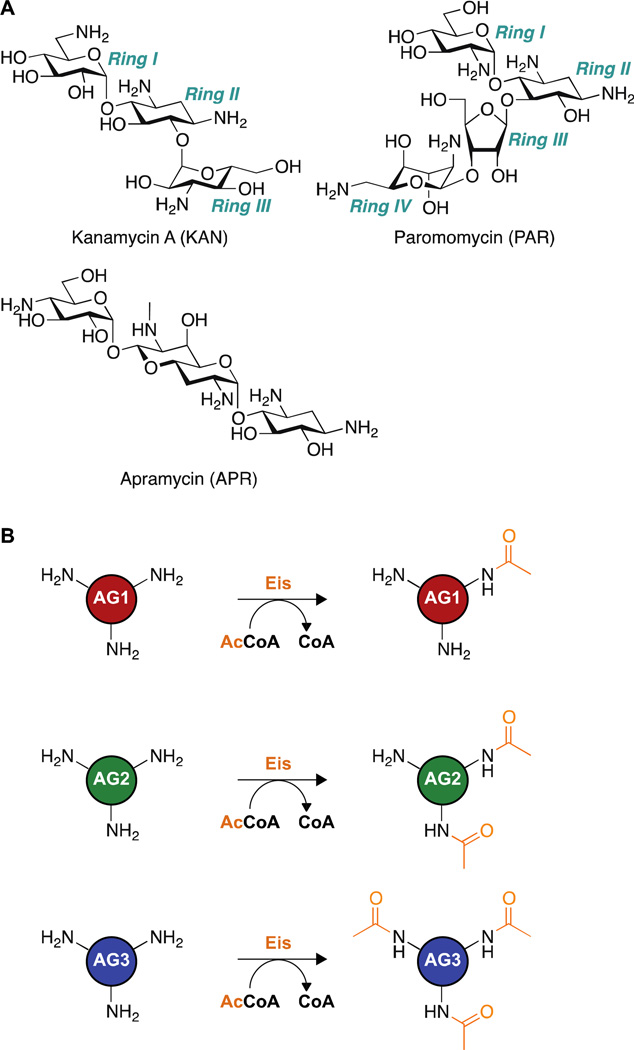
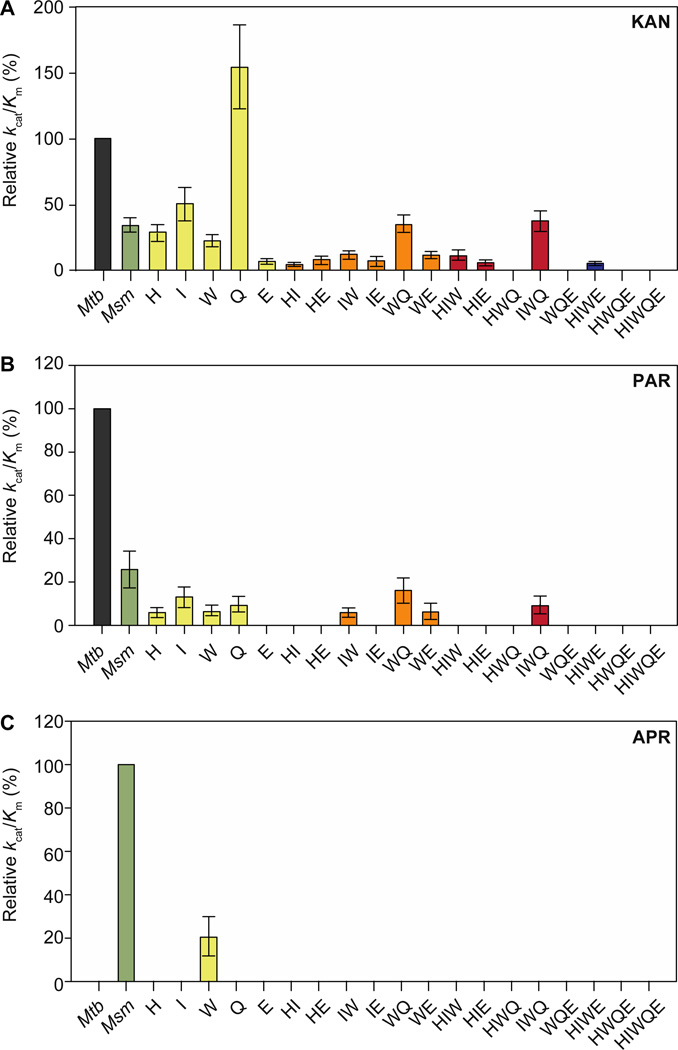
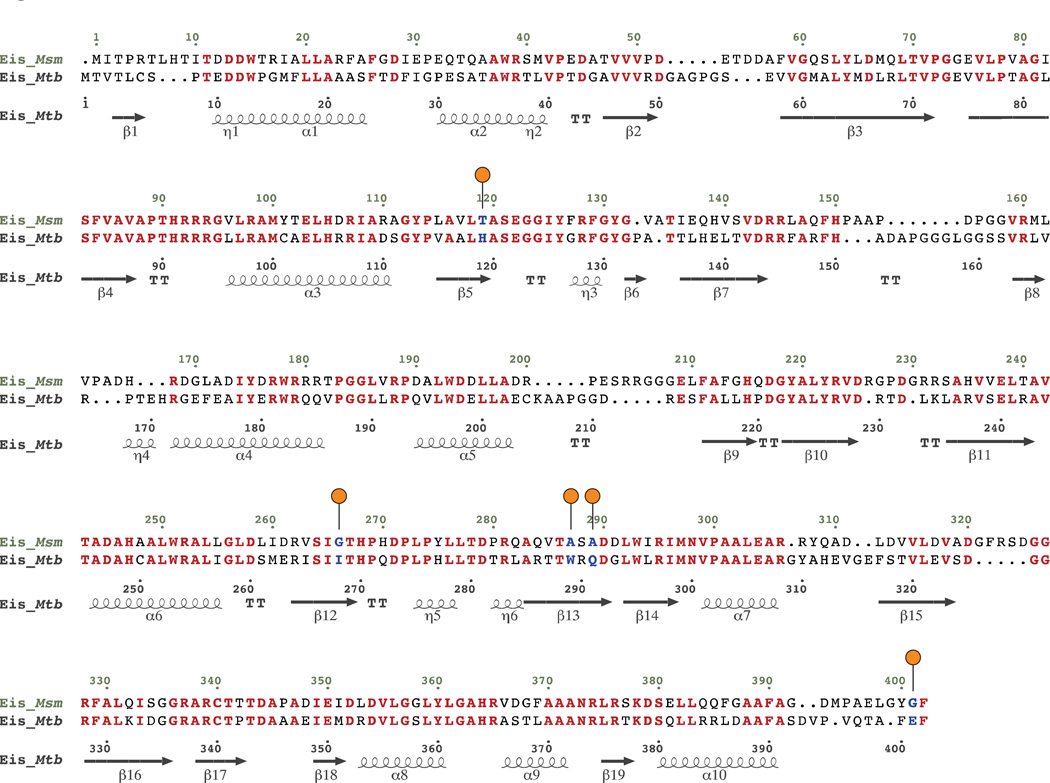
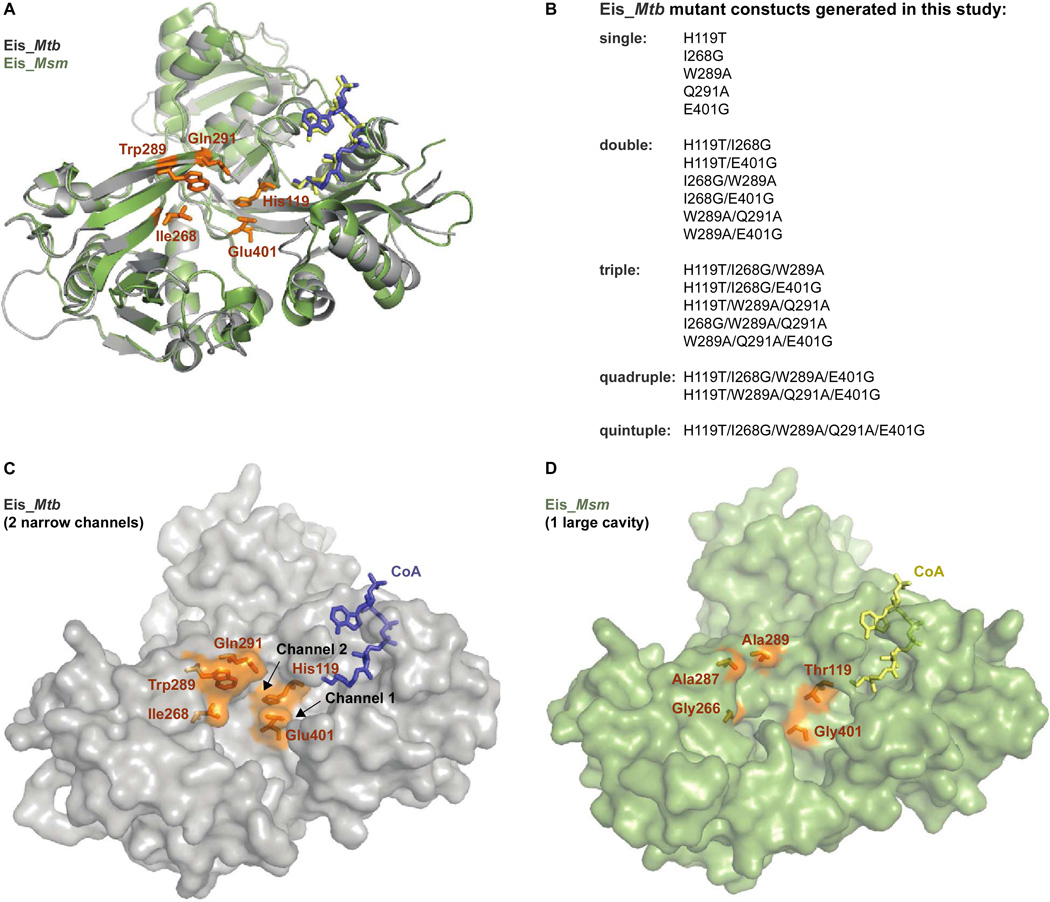
The upsurge in drug-resistant tuberculosis (TB) is an emerging global problem. The increased expression of the enhanced intracellular survival (Eis) protein is responsible for the clinical resistance to aminoglycoside (AG) antibiotics of Mycobacterium tuberculosis . Eis from M. tuberculosis (Eis_Mtb) and M. smegmatis (Eis_Msm) function as acetyltransferases capable of acetylating multiple amines of many AGs; however, these Eis homologues differ in AG substrate preference and in the number of acetylated amine groups per AG. The AG binding cavity of Eis_Mtb is divided into two narrow channels, whereas Eis_Msm contains one large cavity. Five bulky residues lining one of the AG binding channels of Eis_Mtb, His119, Ile268, Trp289, Gln291, and Glu401, have significantly smaller counterparts in Eis_Msm, Thr119, Gly266, Ala287, Ala289, and Gly401, respectively. To identify the residue(s) responsible for AG binding in Eis_Mtb and for the functional differences from Eis_Msm, we have generated single, double, triple, quadruple, and quintuple mutants of these residues in Eis_Mtb by mutating them into their Eis_Msm counterparts, and we tested their acetylation activity with three structurally diverse AGs: kanamycin A (KAN), paromomyin (PAR), and apramycin (APR). We show that penultimate C-terminal residue Glu401 plays a critical role in the overall activity of Eis_Mtb. We also demonstrate that the identities of residues Ile268, Trp289, and Gln291 (in Eis_Mtb nomenclature) dictate the differences between the acetylation efficiencies of Eis_Mtb and Eis_Msm for KAN and PAR. Finally, we show that the mutation of Trp289 in Eis_Mtb into Ala plays a role in APR acetylation.
耐多药结核病(TB)的激增是一个新出现的全球问题。增强型细胞内生存(Eis)蛋白表达增加导致结核分枝杆菌对抗生素氨基糖苷类(AG)的临床耐药。来自结核分枝杆菌(Eis_Mtb)和耻垢分枝杆菌(Eis_Msm)的 Eis 作为乙酰转移酶,能够乙酰化许多 AG 的多种胺;然而,这些 Eis 同源物在 AG 底物偏好和每个 AG 乙酰化的胺基团数量上存在差异。Eis_Mtb 的 AG 结合腔分为两个狭窄的通道,而 Eis_Msm 包含一个大腔。Eis_Mtb 的一个 AG 结合通道中五个大的侧链残基,His119、Ile268、Trp289、Gln291 和 Glu401,在 Eis_Msm 中分别有较小的对应物 Thr119、Gly266、Ala287、Ala289 和 Gly401。为了确定负责 Eis_Mtb 中 AG 结合的残基以及与 Eis_Msm 功能差异的原因,我们通过将这些残基突变为 Eis_Msm 的对应物,在 Eis_Mtb 中生成了这些残基的单个、双个、三个、四个和五个突变体,并使用三种结构不同的 AG 测试了它们的乙酰化活性:卡那霉素 A(KAN)、巴龙霉素(PAR)和安普霉素(APR)。我们表明,倒数第二个 C 末端残基 Glu401 在 Eis_Mtb 的整体活性中起着关键作用。我们还证明了残基 Ile268、Trp289 和 Gln291(在 Eis_Mtb 命名法中)的身份决定了 Eis_Mtb 和 Eis_Msm 对 KAN 和 PAR 的乙酰化效率之间的差异。最后,我们表明 Eis_Mtb 中的 Trp289 突变为 Ala 会影响 APR 的乙酰化。