Southern California Coastal Water Research Project, 3535 Harbor Boulevard, Costa Mesa, CA 92626, USA.
J Environ Public Health. 2013;2013:848049. doi: 10.1155/2013/848049. Epub 2013 Jun 10.
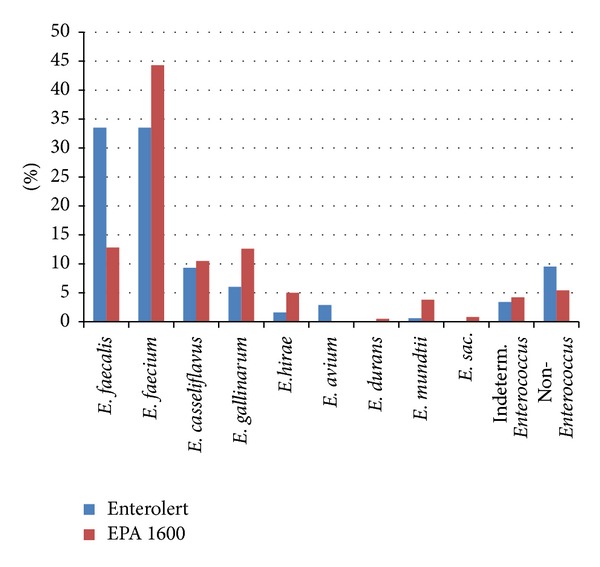
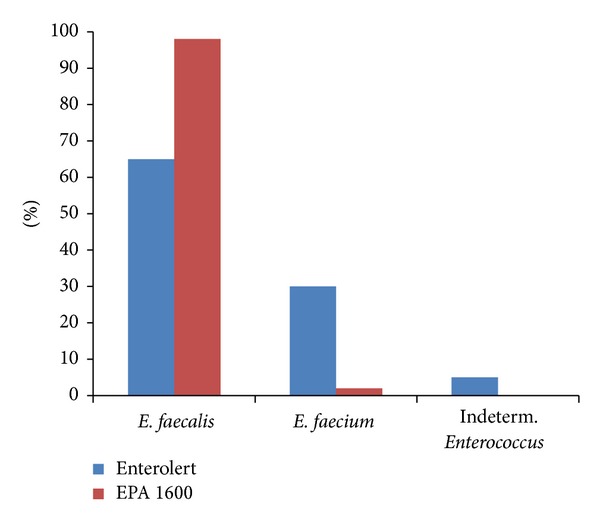
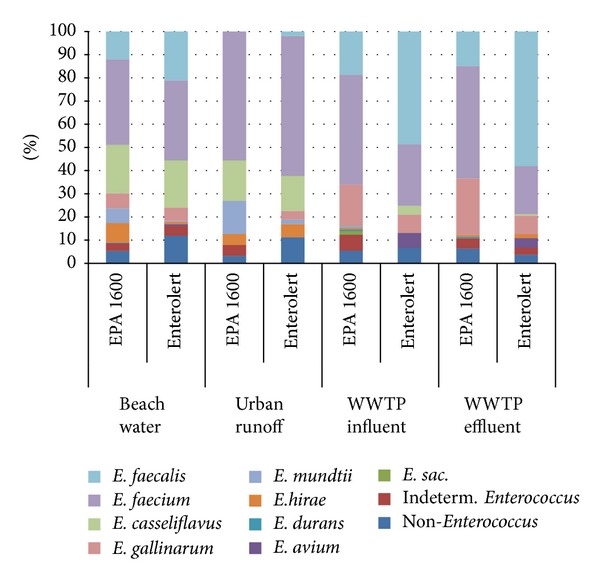
EPA Method 1600 and Enterolert are used interchangeably to measure Enterococcus for fecal contamination of public beaches, but the methods occasionally produce different results. Here we assess whether these differences are attributable to the selectivity for certain species within the Enterococcus group. Both methods were used to obtain 1279 isolates from 17 environmental samples, including influent and effluent of four wastewater treatment plants, ambient marine water from seven different beaches, and freshwater urban runoff from two stream systems. The isolates were identified to species level. Detection of non-Enterococcus species was slightly higher using Enterolert (8.4%) than for EPA Method 1600 (5.1%). E. faecalis and E. faecium, commonly associated with human fecal waste, were predominant in wastewater; however, Enterolert had greater selectivity for E. faecalis, which was also shown using a laboratory-created sample. The same species selectivity was not observed for most beach water and urban runoff samples. These samples had relatively higher proportions of plant associated species, E. casseliflavus (18.5%) and E. mundtii (5.7%), compared to wastewater, suggesting environmental inputs to beaches and runoff. The potential for species selectivity among water testing methods should be considered when assessing the sanitary quality of beaches so that public health warnings are based on indicators representative of fecal sources.
EPA Method 1600 和 Enterolert 可互换用于测量公共海滩粪便污染的肠球菌,但这两种方法偶尔会产生不同的结果。在这里,我们评估这些差异是否归因于肠球菌组内某些特定物种的选择性。这两种方法都用于从 17 个环境样本中获得 1279 个分离物,包括四个污水处理厂的进水和出水、七个不同海滩的环境海水以及两个溪流系统的城市淡水径流。分离物被鉴定到种水平。使用 Enterolert 检测到的非肠球菌物种略高于 EPA Method 1600(5.1%)(8.4%)。通常与人类粪便废物相关的 E. faecalis 和 E. faecium 在废水中占优势;然而,Enterolert 对 E. faecalis 具有更高的选择性,这也通过实验室创建的样本得到了证明。对于大多数海滩水和城市径流样本,并没有观察到相同的物种选择性。与废水相比,这些样本具有相对较高比例的与植物相关的物种,即 E. casseliflavus(18.5%)和 E. mundtii(5.7%),这表明海滩和径流受到环境输入的影响。在评估海滩的卫生质量时,应考虑水质检测方法之间的物种选择性,以便基于代表粪便来源的指标发布公共卫生警报。