Cancer Research Center, IBMCC, USAL-CSIC, Department of Medicine and Cytometry Service, University of Salamanca and Institute for Biomedical Research of Salamanca, Salamanca, Spain.
PLoS One. 2013 Jul 3;8(7):e67751. doi: 10.1371/journal.pone.0067751. Print 2013.
Chronic lymphocytic leukemia (CLL)-like monoclonal B lymphocytosis (MBL) with (MBL(hi)) or without (MBL(lo)) absolute B-lymphocytosis precedes most CLL cases,the specific determinants for malignant progression remaining unknown.
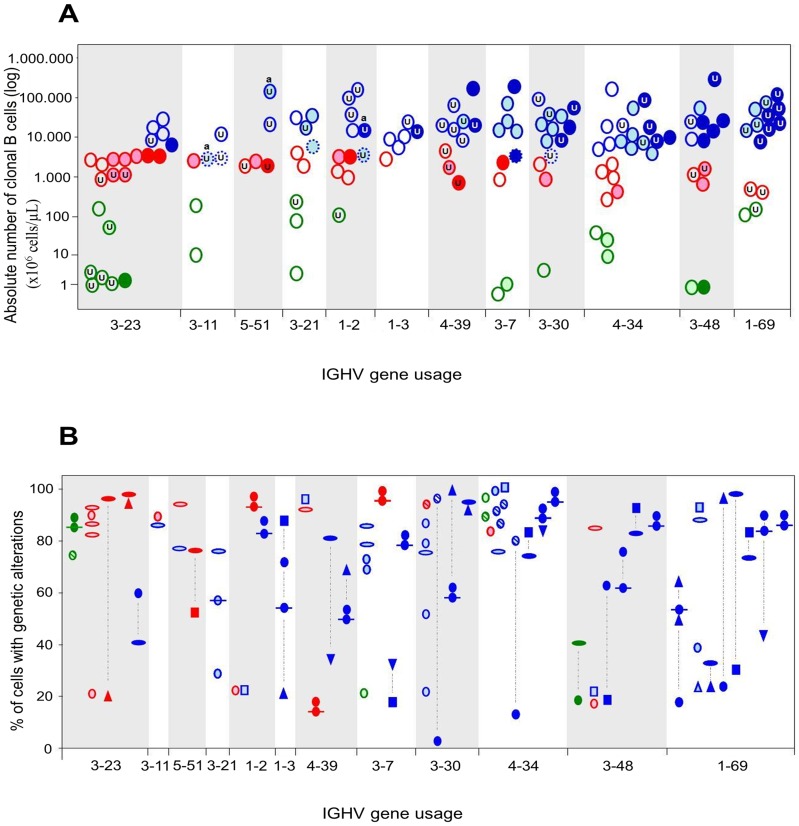
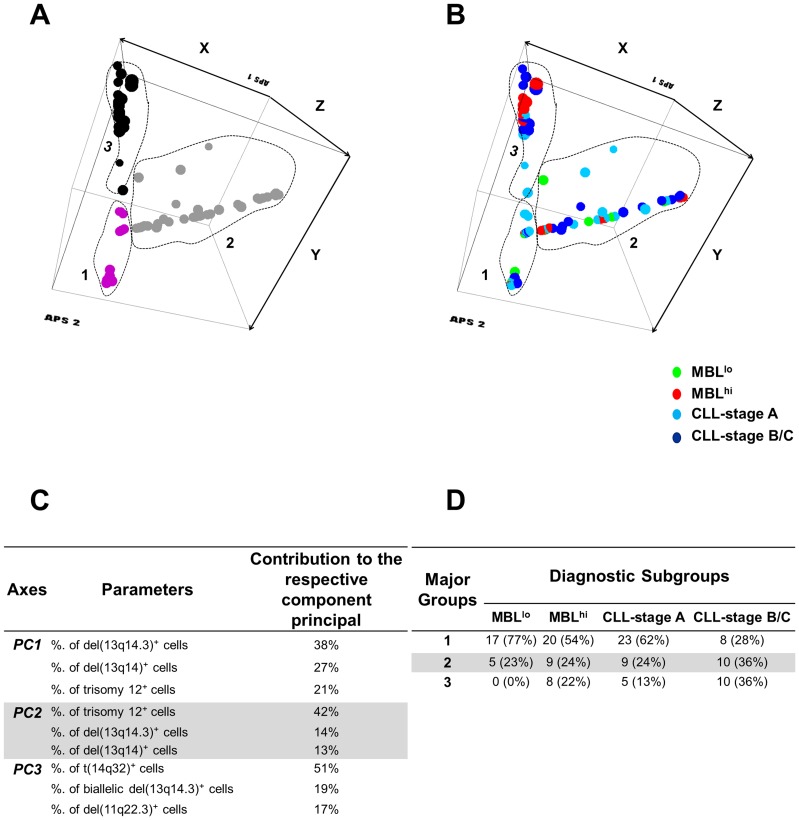
METHODOLOGY/PRINCIPAL FINDINGS: For this purpose, simultaneous iFISH and molecular analysis of well-established cytogenetic alterations of chromosomes 11, 12, 13, 14 and 17 together with the pattern of rearrangement of the IGHV genes were performed in CLL-like cells from MBL and CLL cases. Our results based on 78 CLL-like MBL and 117 CLL clones from 166 subjects living in the same geographical area, show the existence of three major groups of clones with distinct but partially overlapping patterns of IGHV gene usage, IGHV mutational status and cytogenetic alterations. These included a group enriched in MBL(lo) clones expressing specific IGHV subgroups (e.g. VH3-23) with no or isolated good-prognosis cytogenetic alterations, a second group which mainly consisted of clinical MBL(hi) and advanced stage CLL with a skewed but different CLL-associated IGHV gene repertoire (e.g. VH1-69), frequently associated with complex karyotypes and poor-prognosis cytogenetic alterations, and a third group of clones with intermediate features, with prevalence of mutated IGHV genes, and higher numbers of del(13q)(+) clonal B-cells.
CONCLUSIONS/SIGNIFICANCE: These findings suggest that the specific IGHV repertoire and IGHV mutational status of CLL-like B-cell clones may modulate the type of cytogenetic alterations acquired, their rate of acquisition and/or potentially also their clinical consequences. Further long-term follow-up studies investigating the IGHV gene repertoire of MBL(lo) clones in distinct geographic areas and microenvironments are required to confirm our findings and shed light on the potential role of some antigen-binding BCR specificities contributing to clonal evolution.
伴有(MBL(hi))或不伴有(MBL(lo))绝对 B 淋巴细胞增多的慢性淋巴细胞白血病(CLL)样单克隆 B 淋巴细胞增多症(MBL)先于大多数 CLL 病例,恶性进展的具体决定因素仍不清楚。
方法/主要发现:为此,我们对 MBL 和 CLL 病例中的 CLL 样细胞同时进行 iFISH 和 11、12、13、14 和 17 号染色体已确立的细胞遗传学改变以及 IGHV 基因重排模式的分子分析。我们基于来自生活在同一地理区域的 166 名受试者的 78 例 CLL 样 MBL 和 117 例 CLL 克隆的研究结果显示,存在具有不同但部分重叠的 IGHV 基因使用、IGHV 突变状态和细胞遗传学改变模式的三个主要克隆群。这些克隆群包括一个富含 MBL(lo)克隆的群组,这些克隆表达特定的 IGHV 亚群(例如 VH3-23),具有无或孤立的良好预后细胞遗传学改变,第二个群组主要由临床 MBL(hi)和晚期 CLL 组成,具有偏倚但不同的与 CLL 相关的 IGHV 基因库(例如 VH1-69),常与复杂的细胞遗传学改变和预后不良的细胞遗传学改变相关,以及具有中间特征的第三个群组,具有突变 IGHV 基因的普遍性,并且具有更高数量的 del(13q)(+)克隆 B 细胞。
结论/意义:这些发现表明,CLL 样 B 细胞克隆的特定 IGHV 库和 IGHV 突变状态可能调节获得的细胞遗传学改变的类型、获得的速度和/或潜在地也调节其临床后果。进一步需要对不同地理区域和微环境中的 MBL(lo)克隆的 IGHV 基因库进行长期随访研究,以证实我们的发现并阐明一些抗原结合 BCR 特异性的潜在作用,这些特异性有助于克隆进化。