School of Biosciences, University of Nottingham, Sutton Bonington Campus, Leicestershire, United Kingdom.
PLoS One. 2013 Jul 2;8(7):e68191. doi: 10.1371/journal.pone.0068191. Print 2013.
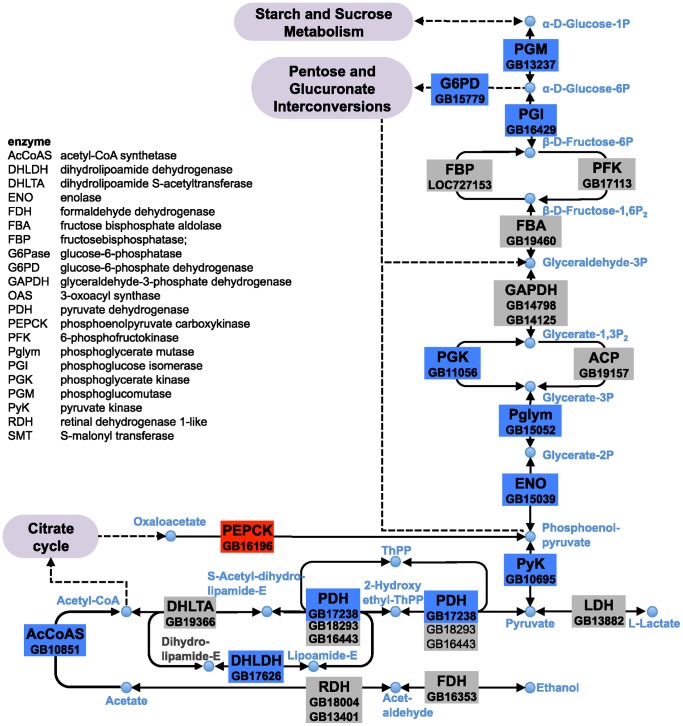
The survival of a species depends on its capacity to adjust to changing environmental conditions, and new stressors. Such new, anthropogenic stressors include the neonicotinoid class of crop-protecting agents, which have been implicated in the population declines of pollinating insects, including honeybees (Apis mellifera). The low-dose effects of these compounds on larval development and physiological responses have remained largely unknown. Over a period of 15 days, we provided syrup tainted with low levels (2 µg/L(-1)) of the neonicotinoid insecticide imidacloprid to beehives located in the field. We measured transcript levels by RNA sequencing and established lipid profiles using liquid chromatography coupled with mass spectrometry from worker-bee larvae of imidacloprid-exposed (IE) and unexposed, control (C) hives. Within a catalogue of 300 differentially expressed transcripts in larvae from IE hives, we detect significant enrichment of genes functioning in lipid-carbohydrate-mitochondrial metabolic networks. Myc-involved transcriptional response to exposure of this neonicotinoid is indicated by overrepresentation of E-box elements in the promoter regions of genes with altered expression. RNA levels for a cluster of genes encoding detoxifying P450 enzymes are elevated, with coordinated downregulation of genes in glycolytic and sugar-metabolising pathways. Expression of the environmentally responsive Hsp90 gene is also reduced, suggesting diminished buffering and stability of the developmental program. The multifaceted, physiological response described here may be of importance to our general understanding of pollinator health. Muscles, for instance, work at high glycolytic rates and flight performance could be impacted should low levels of this evolutionarily novel stressor likewise induce downregulation of energy metabolising genes in adult pollinators.
物种的生存取决于其适应环境变化和新压力源的能力。新的人为压力源包括新烟碱类作物保护剂,这些保护剂被认为是传粉昆虫(包括蜜蜂)数量下降的原因。这些化合物对幼虫发育和生理反应的低剂量影响在很大程度上仍不清楚。在 15 天的时间里,我们向位于野外的蜂巢提供了含有低浓度(2µg/L(-1))新烟碱类杀虫剂吡虫啉的糖浆。我们通过 RNA 测序测量了转录水平,并使用液相色谱-质谱联用技术从吡虫啉暴露(IE)和未暴露的对照(C)蜂巢的工蜂幼虫中建立了脂质图谱。在 IE 蜂巢幼虫中 300 个差异表达转录物的目录中,我们检测到参与脂质-碳水化合物-线粒体代谢网络的基因显著富集。通过在表达发生变化的基因的启动子区域中 E 盒元件的过度表达,表明 Mycin 参与了对这种新烟碱类杀虫剂的暴露的转录反应。编码解毒 P450 酶的基因簇的 RNA 水平升高,糖酵解和糖代谢途径的基因协同下调。环境响应的 Hsp90 基因的表达也降低,表明发育程序的缓冲和稳定性降低。这里描述的多方面生理反应可能对我们对传粉者健康的一般理解很重要。例如,肌肉在高糖酵解率下工作,如果这种进化上新颖的压力源同样诱导成年传粉者的能量代谢基因下调,那么飞行性能可能会受到影响。