Department of Rheumatology, CHRU de Besançon, Boulevard Fleming, F-25030 Besançon, France.
Clin Epigenetics. 2013 Jul 11;5(1):10. doi: 10.1186/1868-7083-5-10.
Sirtuin 1 (Sirt1) is a nuclear enzyme from the class III histone deacetylases that modulates gene expression and is involved in bone and cartilage remodeling. The goal of our study was to evaluate Sirt1 activity in peripheral blood mononuclear cells in patients with osteoarthritis in comparison with control patients, and to determine the relationship between Sirt1 activity and production of TNFα, IL-6 and IL-8 by peripheral blood mononuclear cells after ex vivo treatment with resveratrol, a Sirt1 activator.
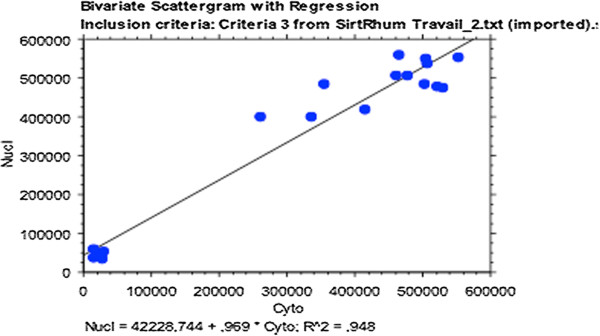
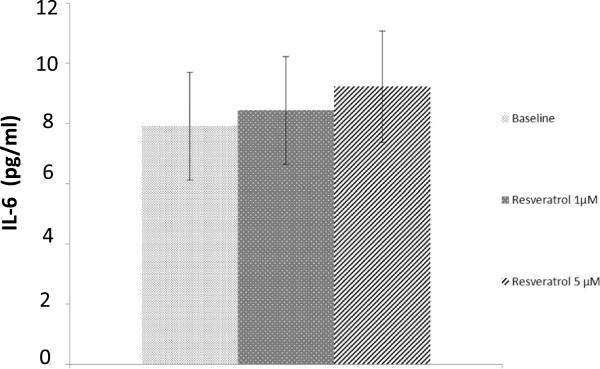
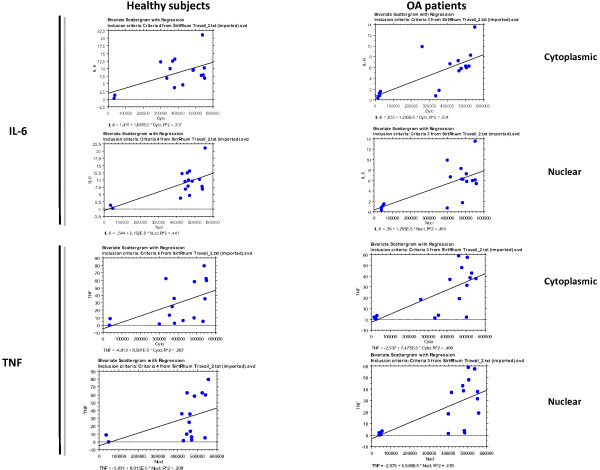
A prospective study was performed to compare the activity of Sirt1 in patients with primary osteoarthritis of the knee (American College of Rheumatology criteria) with its activity in controls. Peripheral blood mononuclear cells were isolated from peripheral blood, and Sirt1 activity evaluated from cytoplasmic and nuclear compartments using a fluorometric assay. Culture supernatant levels of TNFα, IL-6, and IL-8 were quantified before and after resveratrol ex vivo treatment. Nineteen patients with symptomatic knee osteoarthritis (age 64 ±9 years) and 18 controls (age 54 ±13 years) were included. No differences were found in cytoplasmic or nuclear Sirt1 activity between patients and controls. After resveratrol treatment, no changes in TNFα or IL-8 levels were found, but a significant dose-dependent increase in IL-6 levels was demonstrated in patients with osteoarthritis, but not controls. Sirt1 activity did not correlate with clinical activity (Lequesne's index) or inflammation (erythrocyte sedimentation rate, C-reactive protein).
Sirt1 activity (cytoplasmic and nuclear) from peripheral blood mononuclear cells did not differ between patients with osteoarthritis and controls. Ex vivo treatment of peripheral blood mononuclear cells with resveratrol was associated with a dose-dependent increase in IL-6 levels only in patients with osteoarthritis.
Sirtuin 1(Sirt1)是一种来自 III 类组蛋白去乙酰化酶的核酶,可调节基因表达,并参与骨和软骨重塑。我们的研究目的是评估与对照组相比,骨关节炎患者外周血单个核细胞中的 Sirt1 活性,并确定 Sirt1 活性与体外用白藜芦醇(一种 Sirt1 激活剂)处理后外周血单个核细胞产生 TNFα、IL-6 和 IL-8 之间的关系。
进行了一项前瞻性研究,以比较膝骨关节炎(美国风湿病学会标准)患者的 Sirt1 活性与其对照组的活性。从外周血中分离外周血单个核细胞,并使用荧光测定法评估细胞质和核区室中的 Sirt1 活性。在体外用白藜芦醇处理前后定量测定培养上清液中 TNFα、IL-6 和 IL-8 的水平。纳入 19 名有症状的膝骨关节炎患者(年龄 64±9 岁)和 18 名对照组(年龄 54±13 岁)。患者和对照组之间的细胞质或核 Sirt1 活性没有差异。用白藜芦醇处理后,TNFα 或 IL-8 水平没有变化,但在骨关节炎患者中观察到剂量依赖性的 IL-6 水平显著增加,而对照组则没有。Sirt1 活性与临床活动(Lequesne 指数)或炎症(红细胞沉降率、C 反应蛋白)无关。
外周血单个核细胞中的 Sirt1 活性(细胞质和核)在骨关节炎患者和对照组之间没有差异。体外用白藜芦醇处理外周血单个核细胞仅在骨关节炎患者中与剂量依赖性的 IL-6 水平增加相关。