Department of Health Systems, Management & Policy, Colorado School of Public Health, Aurora, CO 80045, USA.
BMC Pediatr. 2013 Jul 11;13:106. doi: 10.1186/1471-2431-13-106.
The Individuals with Disabilities Education Act (Part C) authorizes states to establish systems to provide early intervention services (e.g., therapy) for children at risk, with the incentive of federal financial support. This study examines family and neighborhood characteristics associated with currently utilizing physical, occupational, or speech therapy among very low birthweight (VLBW) 2-year-old children who meet Wisconsin eligibility requirements for early intervention services (EI) due to developmental delay.
This cross-sectional analysis used data from the Newborn Lung Project, a regional cohort study of VLBW infants hospitalized in Wisconsin's newborn intensive care units during 2003-2004. We included the 176 children who were age two at follow-up, and met Wisconsin state eligibility requirements for EI based on developmental delay. Exact logistic regression was used to describe child and neighborhood socio-demographic correlates of parent-reported receipt of therapy.
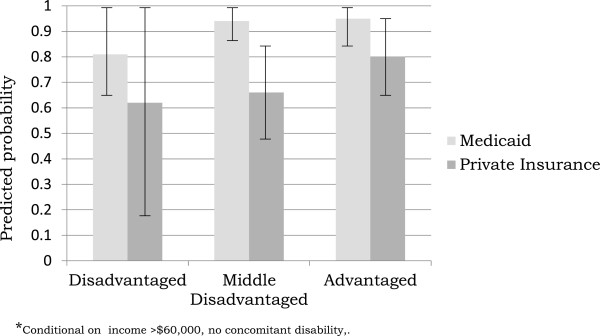
Among VLBW children with developmental delay, currently utilizing therapy was higher among children with Medicaid (aOR = 5.3, 95% CI: 1.3, 28.3) and concomitant developmental disability (aOR = 5.2, 95% CI: 2.1, 13.3) and lower for those living in a socially more disadvantaged neighborhood (aOR=0.48, 95% CI: 0.21, 0.98, per tertile).
Among a sample of VLBW 2-year olds with developmental delays who are EI-eligible in WI, 4 out of 5 were currently receiving therapy, per parent report. Participation in Medicaid positively influences therapy utilization. Children with developmental difficulties who live in socially disadvantaged neighborhoods are at highest risk for not receiving therapy.
《残疾人教育法案》(第 C 部分)授权各州建立系统,为有风险的儿童提供早期干预服务(例如治疗),并提供联邦财政支持。本研究考察了家庭和邻里特征与符合威斯康星州早期干预服务(EI)资格要求的极低出生体重(VLBW)2 岁儿童目前正在接受物理治疗、职业治疗或言语治疗之间的关系,这些儿童因发育迟缓而符合该州的 EI 资格要求。
本横断面分析使用了来自新生儿肺项目的数据,该项目是一项区域性队列研究,对 2003-2004 年期间在威斯康星州新生儿重症监护病房住院的极低出生体重儿进行了研究。我们纳入了在随访时年龄为 2 岁且因发育迟缓而符合威斯康星州 EI 资格要求的 176 名儿童。我们使用精确逻辑回归来描述与父母报告的接受治疗相关的儿童和邻里社会人口统计学相关性。
在有发育迟缓的 VLBW 儿童中,符合条件的儿童中,有医疗补助(aOR=5.3,95%CI:1.3,28.3)和并发发育障碍(aOR=5.2,95%CI:2.1,13.3)的儿童接受治疗的比例较高,而居住在社会地位较低的邻里环境中的儿童接受治疗的比例较低(aOR=0.48,95%CI:0.21,0.98,每 tertile)。
在威斯康星州符合 EI 条件的有发育迟缓的 VLBW 2 岁儿童样本中,根据家长报告,每 5 名儿童中有 4 名正在接受治疗。参加医疗补助计划会积极影响治疗的利用率。居住在社会劣势邻里环境中的有发育困难的儿童最有可能无法接受治疗。