Department of Health Systems, Management and Policy, University of Colorado at Denver, Denver, Colorado.
Rocky Mountain Human Services, Denver, Colorado.
Arch Phys Med Rehabil. 2020 May;101(5):815-821. doi: 10.1016/j.apmr.2019.10.188. Epub 2019 Nov 26.
To estimate correlates of early intervention (EI) service dosage and gains in children's functional capabilities from EI entry and discharge.
Retrospective cohort study.
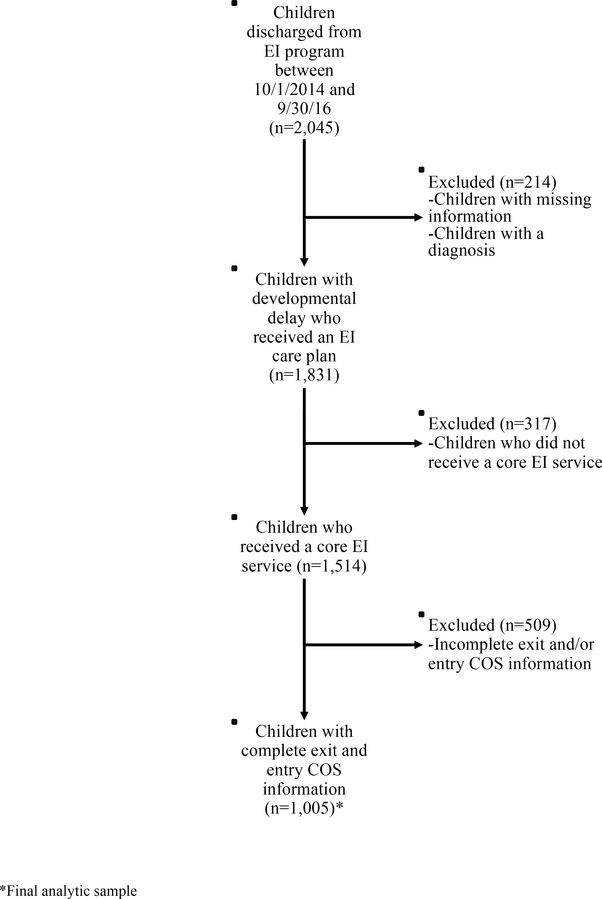
Secondary analyses of a subset of data (N=1005) collected from an EI administrative database on children discharged from a large, urban EI program between October 1, 2014 and September 30, 2016.
Children who were EI eligible due to developmental delay, had received an EI care plan and at least 1 billable EI service, and had outcomes data at EI entry and exit (N=1005). Measured child characteristics included age (49.0% 12-24mo; n=492), sex (36.0% female; n=362), number of developmental delays (76.1% had 1 developmental delay; n=765), and number of EI services received (78.5% received multiple; n=789).
Not applicable.
Outcomes were EI service intensity (hours per month) and change in functional capabilities as measured via the state-mandated Child Outcomes Summary (COS). Adjusted quantile median regression estimated EI intensity. Adjusted linear regression estimated change in function for social-emotional, cognitive, and adaptive domains of the COS. Measures of children's developmental delay severity, age at EI entry, race and ethnicity, sex, and language.
Children older than 24 months old experienced significantly higher EI service intensity (b=0.40; 95% confidence interval, 0.18-0.63). Child age and EI service intensity were significantly linked to gains in social and cognitive COS score changes from EI entry to exit.
Older children receive a higher intensity of EI services. EI service intensity and age were linked with positive changes in functional gains.
评估儿童早期干预(EI)服务剂量的相关因素,以及从 EI 进入到退出时儿童功能能力的变化。
回顾性队列研究。
对 2014 年 10 月 1 日至 2016 年 9 月 30 日期间从一个大型城市 EI 项目的 EI 管理数据库中收集的数据的子集(N=1005)进行二次分析。
因发育迟缓而符合 EI 条件的儿童,接受过 EI 护理计划且至少有 1 项计费的 EI 服务,且在 EI 进入和退出时具有结果数据(N=1005)。测量的儿童特征包括年龄(49.0%为 12-24 个月;n=492)、性别(36.0%为女性;n=362)、发育迟缓的数量(76.1%有 1 项发育迟缓;n=765)和接受的 EI 服务数量(78.5%接受了多项;n=789)。
不适用。
结果为 EI 服务强度(每月小时数)和功能能力变化,通过州规定的儿童结果摘要(COS)进行测量。调整分位数中位数回归估计 EI 强度。调整线性回归估计 COS 的社会情感、认知和适应领域的功能变化。儿童发育迟缓严重程度、EI 进入年龄、种族和民族、性别和语言的衡量标准。
24 个月以上的儿童接受的 EI 服务强度明显更高(b=0.40;95%置信区间,0.18-0.63)。儿童年龄和 EI 服务强度与 EI 进入到退出时 COS 得分变化的社会和认知功能增益显著相关。
年龄较大的儿童接受更高强度的 EI 服务。EI 服务强度和年龄与功能增益的积极变化相关。