Division of Primary Care Internal Medicine, Knowledge and Evaluation Research Unit, MN 55905, USA.
Clin Interv Aging. 2013;8:797-807. doi: 10.2147/CIA.S43817. Epub 2013 Jun 28.
Treatment intensity for elderly patients with end-stage renal disease has escalated beyond population growth. Ageism seems to have given way to a powerful imperative to treat patients irrespective of age, prognosis, or functional status. Hemodialysis (HD) is a prime example of this trend. Recent articles have questioned this practice. This paper aims to identify existing pre-synthesized evidence on HD in the very elderly and frame it from the perspective of a clinician who needs to involve their patient in a treatment decision.
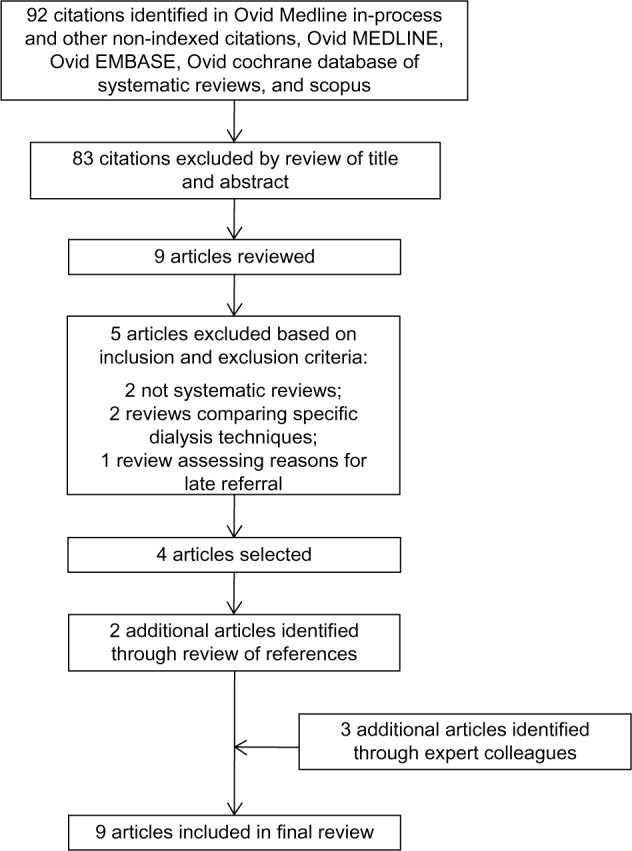
A comprehensive search of several databases from January 2002 to August 2012 was conducted for systematic reviews of clinical and economic outcomes of HD in the elderly. We also contacted experts to identify additional references. We applied the rigorous framework of decisional factors of the Grading of Recommendation, Assessment, Development and Evaluation (GRADE) to evaluate the quality of evidence and strength of recommendations.
We found nine eligible systematic reviews. The quality of the evidence to support the current recommendation of HD initiation for most very elderly patients is very low. There is significant uncertainty in the balance of benefits and risks, patient preference, and whether default HD in this patient population is a wise use of resources.
Following the GRADE framework, recommendation for HD in this population would be weak. This means it should not be considered standard of care and should only be started based on the well-informed patient's values and preferences. More studies are needed to delineate the true treatment effect and to guide future practice and policy.
终末期肾病老年患者的治疗强度已经超出了人口增长的速度。年龄歧视似乎已经让位于一种强有力的冲动,即无论患者的年龄、预后或功能状态如何,都要对其进行治疗。血液透析(HD)就是这种趋势的一个主要例子。最近的一些文章对这种做法提出了质疑。本文旨在从需要让患者参与治疗决策的临床医生的角度,确定现有关于非常老年患者血液透析的预先综合证据,并对其进行分析。
从 2002 年 1 月至 2012 年 8 月,对几个数据库进行了全面检索,以查找关于老年患者血液透析的临床和经济结果的系统评价。我们还联系了专家,以确定其他参考文献。我们应用推荐评估、发展与评价分级(GRADE)的决策因素严格框架,评估证据质量和推荐强度。
我们找到了 9 篇符合条件的系统评价。支持目前为大多数非常老年患者启动血液透析治疗的建议的证据质量非常低。在权衡利弊、患者偏好以及在这种患者群体中默认进行血液透析是否是明智的资源利用方面,存在很大的不确定性。
根据 GRADE 框架,对该人群进行 HD 的推荐是微弱的。这意味着它不应该被视为常规护理,而只能根据知情患者的价值观和偏好来启动。需要进一步研究来阐明真正的治疗效果,并指导未来的实践和政策。