Department of Spine Surgery, Xiangya Hospital, Central-South University, Changsha, Hunan, P.R. China.
Arch Med Sci. 2013 Jun 20;9(3):569-75. doi: 10.5114/aoms.2012.30956. Epub 2012 Oct 8.
Understanding the transcriptional regulatory networks that map out the coordinated responses of transcription factors and target genes would represent a significant advance in the analysis of osteosarcoma, a common primary bone malignancy. The objective of our study was to interpret the mechanisms of osteosarcoma through the regulation network construction.
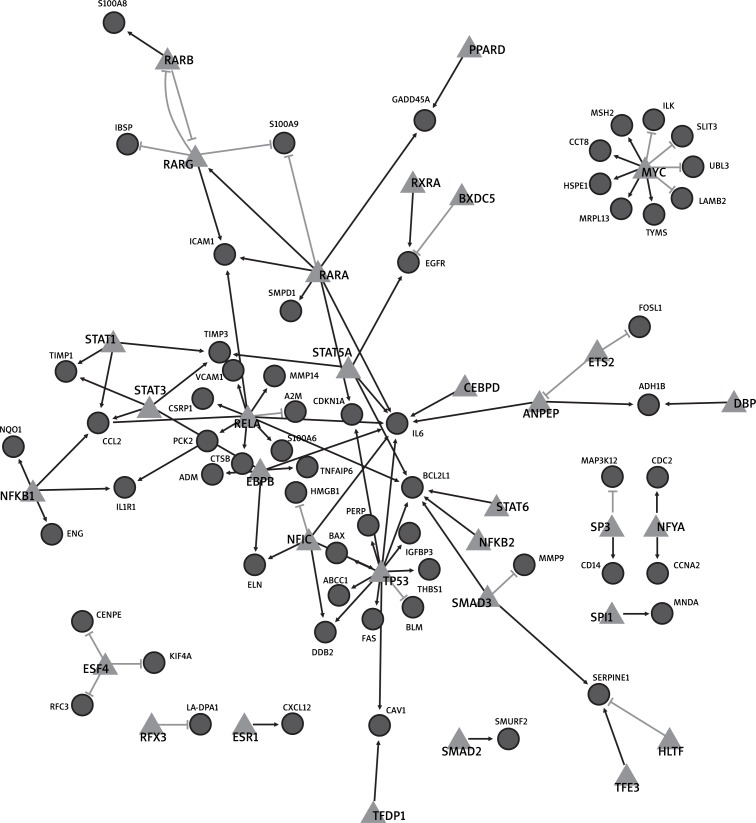
Using GSE14359 datasets downloaded from Gene Expression Omnibus data, we first screened the differentially expressed genes in osteosarcoma. We explored the regulation relationship between transcription factors and target genes using Cytoscape. The underlying molecular mechanisms of these crucial target genes were investigated by Gene Ontology function and Kyoto Encyclopedia of Genes and Genomes pathway enrichment analysis.
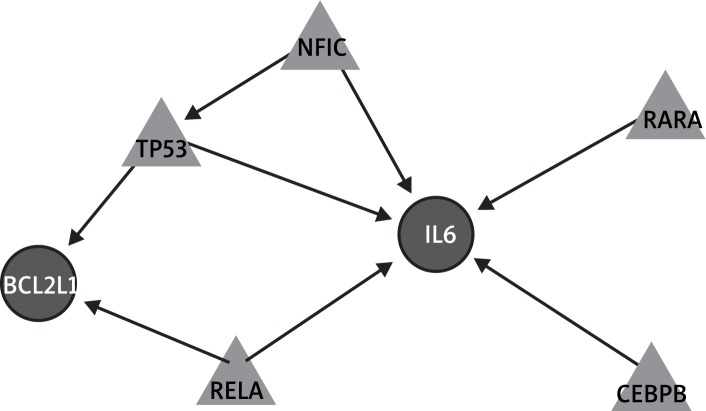
A total of 1836 differentially expressed were identified and 98 regulatory relationships were constructed between 32 transcription factors and their 60 differentially expressed target genes. Furthermore, BCL2-like 1 (BCL2L1), tumor protein p53 (TP53), v-rel reticuloendotheliosis viral oncogene homolog A (avian) (RELA), interleukin 6 (IL6), retinoic acid receptor, alpha (RARA), nuclear factor I/C (CCAAT-binding transcription factor) (NFIC), and CCAAT/enhancer binding protein, beta (CEBPB) formed a small pivotal network, in which IL-6 could be regulated by TP53, NFIC, RARA, and CEBPB, but BCL2L1 may be only regulated by TP53 and RELA. These genes had been demonstrated to be involved in osteosarcoma progression via various biological processes and pathways, including regulation of cell apoptosis, proliferation, antigen processing and presentation pathway, and phosphatidylinositol signaling system.
In general, we have obtained a regulatory network and several pathways that may play important roles in osteosarcoma, identified several pivotal genes in osteosarcoma, and predicted several potential key genes for osteosarcoma.
理解转录因子和靶基因之间协调反应的转录调控网络将代表骨肉瘤分析的重大进展,骨肉瘤是一种常见的原发性骨恶性肿瘤。我们的研究目的是通过构建调控网络来解释骨肉瘤的发生机制。
从基因表达综合数据库中下载 GSE14359 数据集,我们首先筛选骨肉瘤中的差异表达基因。我们使用 Cytoscape 探索转录因子和靶基因之间的调控关系。通过基因本体论功能和京都基因与基因组百科全书通路富集分析研究这些关键靶基因的潜在分子机制。
共鉴定出 1836 个差异表达基因,构建了 32 个转录因子与其 60 个差异表达靶基因之间的 98 个调控关系。此外,BCL2 样 1(BCL2L1)、肿瘤蛋白 p53(TP53)、v-rel 网状内皮增生病毒癌基因同源物 A(禽)(RELA)、白细胞介素 6(IL6)、维甲酸受体,α(RARA)、核因子 I/C(CCAAT 结合转录因子)(NFIC)和 CCAAT/增强子结合蛋白,β(CEBPB)形成了一个小的关键网络,其中 IL-6 可受 TP53、NFIC、RARA 和 CEBPB 调控,而 BCL2L1 可能仅受 TP53 和 RELA 调控。这些基因已被证明通过多种生物学过程和途径参与骨肉瘤的进展,包括细胞凋亡、增殖、抗原加工和呈递途径以及磷脂酰肌醇信号系统的调节。
总体而言,我们获得了一个可能在骨肉瘤中起重要作用的调控网络和几个途径,鉴定了骨肉瘤中的几个关键基因,并预测了骨肉瘤的几个潜在关键基因。