Department of Orthopedics, Ludwig-Maximilians-University of Munich, Germany.
Arch Med Sci. 2013 Jun 20;9(3):576-80. doi: 10.5114/aoms.2013.35339. Epub 2013 May 27.
Although ropivacaine and fentanyl are commonly administered intra-articularly after knee or shoulder arthroscopy for postoperative pain control, there are no studies investigating the toxicity of ropivacaine and fentanyl on human fibroblasts (hF).
Human fibroblasts were seeded in monolayer triple flasks at a density of 10(4) cells/cm(2) and plated into 96 plates at a density of 5000 cells per well. After fully aspirating the culture medium 200 µl of ropivacaine or fentanyl in its corresponding concentration or culture medium only was added to each well. After 30 min ropivacaine or fentanyl was removed and fresh culture medium was added. Fibroblast mitochondrial activity and apoptosis marker level were evaluated after 1 h, 24 h and 7 days.
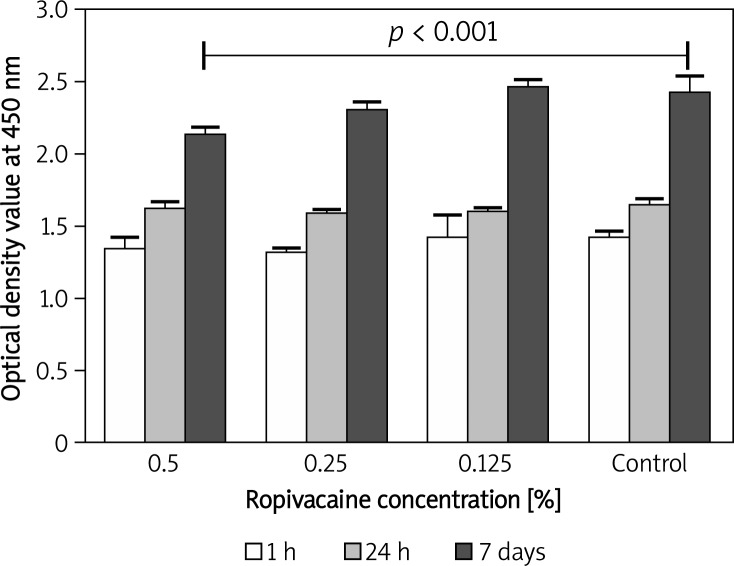
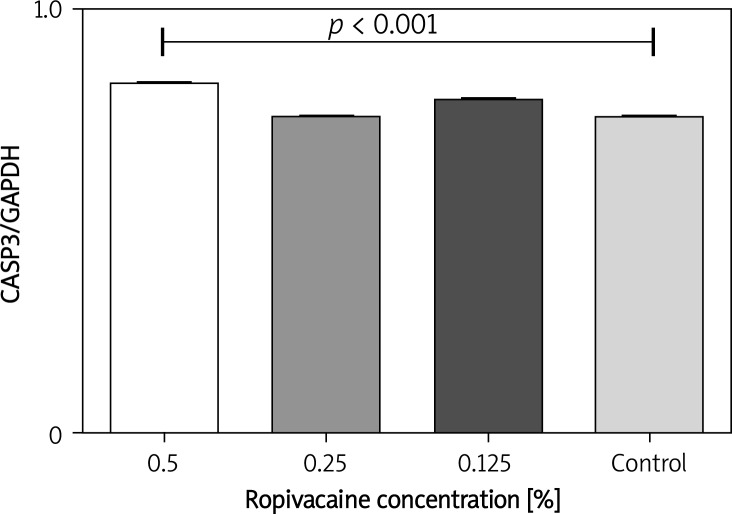
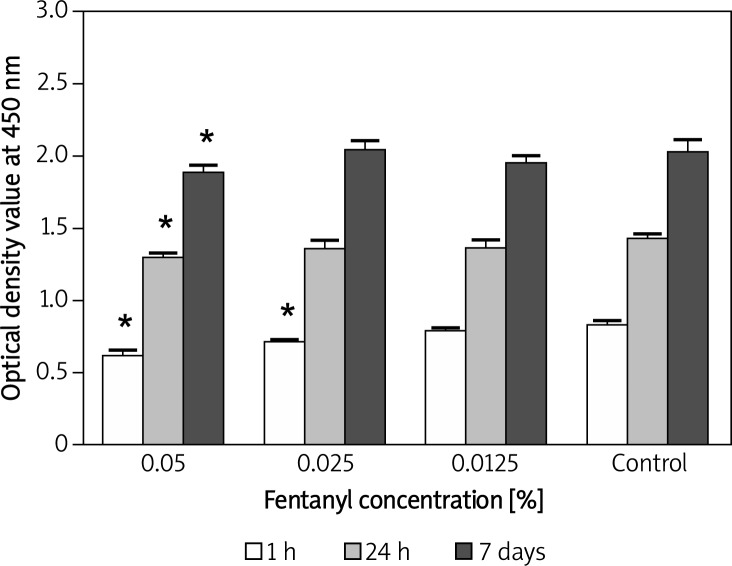
We found a significant decrease in mitochondrial activity after 7 days when exposed to 0.5% ropivacaine. Mitochondrial activity after 1 h, 24 h and 7 days was significantly decreased when fibroblasts were exposed to 0.05% fentanyl. Also, a significant decrease in mitochondrial activity was observed 1 h after exposure to 0.025% fentanyl. Cell viability remained unchanged at any other point in time. A significant increase of caspase-3, as a marker of apoptosis, was only present after exposure to 0.5% ropivacaine after 7 days.
These data suggest that both drugs have a concentration-dependent effect on mitochondrial activity in hF in vitro. This effect is more pronounced with fentanyl. Because the cytotoxicity of fentanyl, without the anticipated increase of caspase-3 as an apoptosis marker, remains unclear, we cannot support fentanyl as an alternative to ropivacaine.
罗哌卡因和芬太尼常用于膝关节或肩关节镜术后关节内注射,以控制术后疼痛,但目前尚无研究调查罗哌卡因和芬太尼对人成纤维细胞(hF)的毒性。
将人成纤维细胞以 10(4)个细胞/cm(2)的密度单层接种在三瓶培养瓶中,并以每孔 5000 个细胞的密度接种在 96 孔板中。完全吸出培养基后,向每个孔中加入相应浓度的罗哌卡因或芬太尼或仅培养基 200µl。30 分钟后,去除罗哌卡因或芬太尼,并加入新鲜培养基。分别在 1 小时、24 小时和 7 天时评估成纤维细胞线粒体活性和凋亡标志物水平。
当暴露于 0.5%罗哌卡因时,第 7 天线粒体活性显著降低。当暴露于 0.05%芬太尼时,1 小时、24 小时和 7 天后线粒体活性显著降低。当暴露于 0.025%芬太尼 1 小时后,线粒体活性也显著降低。在任何其他时间点,细胞活力均保持不变。仅在暴露于 0.5%罗哌卡因 7 天后才观察到 caspase-3(凋亡标志物)显著增加。
这些数据表明,两种药物在体外均对 hF 的线粒体活性具有浓度依赖性影响。芬太尼的作用更为明显。由于芬太尼的细胞毒性,没有预期的 caspase-3 增加作为凋亡标志物,因此我们不能支持芬太尼作为罗哌卡因的替代品。