Department of Medical Physics & Bioengineering, University College London, Malet Place Engineering Building, London, UK.
Adv Exp Med Biol. 2013;789:89-95. doi: 10.1007/978-1-4614-7411-1_13.
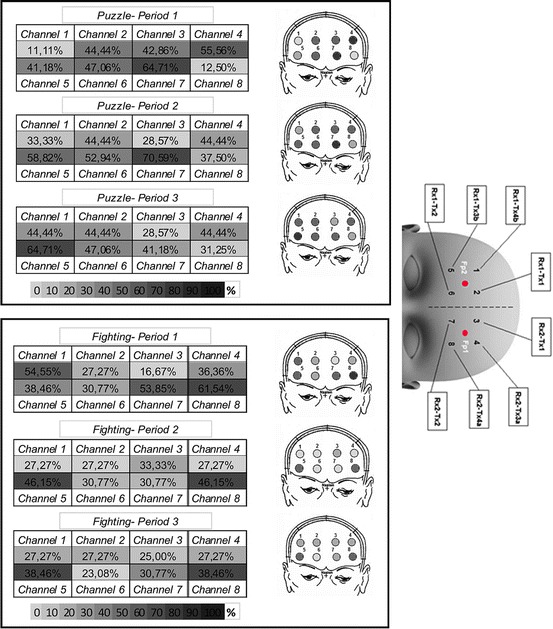
Frontal lobe activation caused by tasks such as videogames can be investigated using multichannel near-infrared spectroscopy (fNIRS), sometimes called optical topography. The aims of this study are to investigate the effects of video gaming (fighting and puzzle games) in the brain and the systemic physiology and to determine whether systemic responses during the gaming task are associated with the measurement of localised cerebral haemodynamic changes as measured by fNIRS. We used a continuous-wave 8-channel fNIRS system to measure the changes in concentration of oxy-haemoglobin (HbO2) and deoxy-haemoglobin (HHb) and changes in total haemoglobin (ΔtHb = ΔHbO2 + ΔHHb) over the frontal lobe in 30 healthy volunteers. The Portapres system was used to measure mean blood pressure (MBP) and heart rate (HR), and a laser Doppler was employed to measure the changes in scalp blood flow (or flux). Even though we observed significant changes in systemic variables during gaming, in particular in scalp flow, we also managed to see localised activation patterns over the frontal polar (FP1) region. However, in some channels over the frontal lobe, we also observed significant correlations between the HbO2 and systemic variables.
使用多通道近红外光谱仪(fNIRS),也称为光学地形图,可以研究诸如电子游戏等任务引起的额叶激活。本研究的目的是研究视频游戏(格斗游戏和益智游戏)对大脑和全身生理学的影响,并确定在游戏任务过程中的全身反应是否与通过 fNIRS 测量的局部脑血流动力学变化的测量有关。我们使用连续波 8 通道 fNIRS 系统来测量 30 名健康志愿者额叶区氧合血红蛋白(HbO2)和脱氧血红蛋白(HHb)浓度的变化以及总血红蛋白(ΔtHb = ΔHbO2 + ΔHHb)的变化。使用 Portapres 系统测量平均血压(MBP)和心率(HR),并使用激光多普勒测量头皮血流(或通量)的变化。尽管我们观察到在游戏过程中全身变量发生了明显变化,特别是在头皮血流量方面,但我们也设法在额极(FP1)区域观察到局部激活模式。然而,在额叶的一些通道中,我们还观察到 HbO2 和全身变量之间存在显著相关性。