Yehya Nadir, Topjian Alexis A, Lin Richard, Berg Robert A, Thomas Neal J, Friess Stuart H
Department of Anesthesiology and Critical Care Medicine, The Children's Hospital of Philadelphia, Philadelphia, Pennsylvania.
Pediatr Pulmonol. 2014 Jul;49(7):707-15. doi: 10.1002/ppul.22853. Epub 2013 Jul 12.
Airway pressure release ventilation (APRV) and high frequency oscillatory ventilation (HFOV) are frequently used in acute lung injury (ALI) refractory to conventional ventilation. Our aim was to describe our experience with APRV and HFOV in refractory pediatric ALI, and to identify factors associated with survival.
We analyzed 104 patients with hypoxemia refractory to conventional ventilation transitioned to either APRV or HFOV. Demographics, oxygenation index (OI), and PaO2 /FiO2 (PF ratio) were recorded before transition to either mode of nonconventional ventilation (NCV) and for every 12 hr after transition.
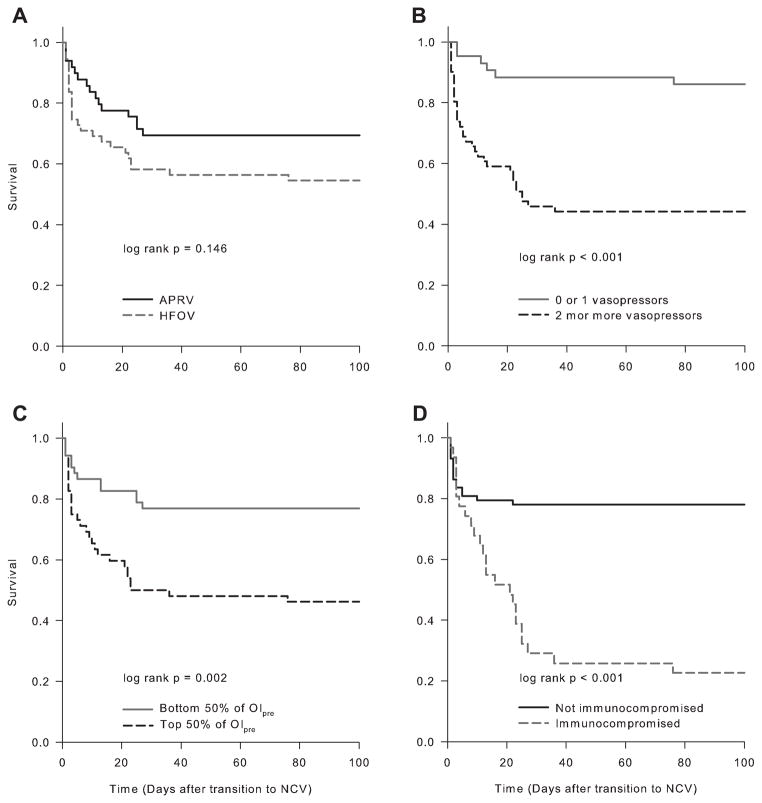
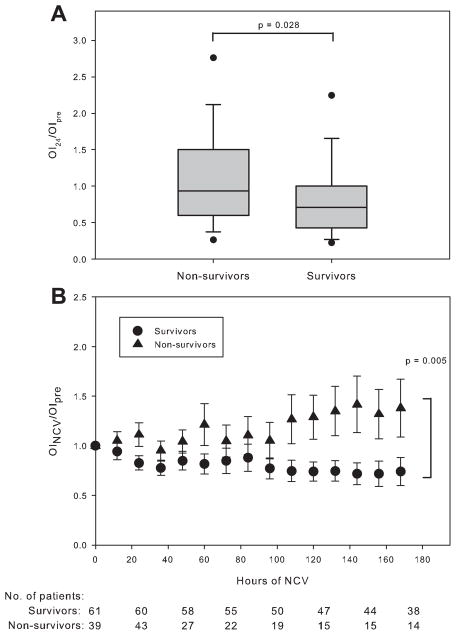
Relative to APRV, patients on HFOV were younger and had more significant lung disease evidenced by higher OI (28.5 [18.6, 36.2] vs. 21.0 [15.5, 30.0], P = 0.008), lower PF ratios (73 [59,94] vs. 99 [76,131], P = 0.002), and more frequent use of inhaled nitric oxide. In univariate analysis, HFOV was associated with more frequent neuromuscular blockade. Forty-one of 104 patients died on NCV (39.4%). Survivors demonstrated improvement in OI 24 hr after transition to NCV, whereas non-survivors did not (12.9 [8.9, 20.9] vs. 28.1 [17.6, 37.1], P < 0.001). After controlling for immunocompromised status, number of vasopressors, and OI before transition, mode of NCV was not associated with mortality.
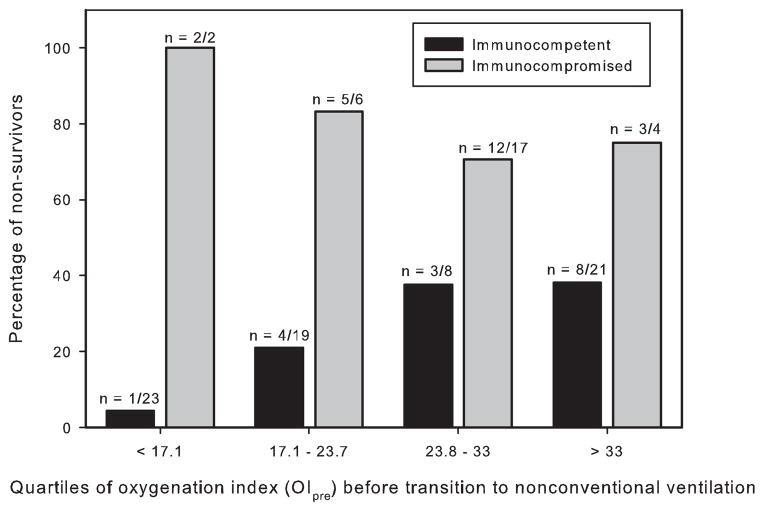
In a heterogeneous PICU population with hypoxemia refractory to conventional ventilation transitioned to NCV, improvement in oxygenation at 24 hr was associated with survival. Immunocompromised status, number of vasopressor infusions, and the OI before transition to NCV were independently associated with survival.
气道压力释放通气(APRV)和高频振荡通气(HFOV)常用于常规通气难治的急性肺损伤(ALI)。我们的目的是描述我们在难治性小儿ALI中应用APRV和HFOV的经验,并确定与生存相关的因素。
我们分析了104例常规通气难治性低氧血症患者,这些患者转而接受APRV或HFOV治疗。记录在转至任何一种非常规通气(NCV)模式之前以及转至该模式后每12小时的人口统计学数据、氧合指数(OI)和动脉血氧分压/吸入氧分数值(PF比值)。
相对于APRV,接受HFOV治疗的患者更年轻,且肺部疾病更严重,表现为OI更高(28.5[18.6,36.2]对21.0[15.5,30.0],P = 0.008)、PF比值更低(73[59,94]对99[76,131],P = 0.002)以及更频繁使用吸入一氧化氮。在单因素分析中,HFOV与更频繁的神经肌肉阻滞相关。104例患者中有41例在NCV治疗期间死亡(39.4%)。幸存者在转至NCV后24小时OI有所改善,而非幸存者则没有(12.9[8.9,20.9]对28.1[17.6,37.1],P < 0.001)。在控制免疫功能低下状态、血管升压药数量和转之前的OI后,NCV模式与死亡率无关。
在常规通气难治性低氧血症且转而接受NCV治疗的异质性儿科重症监护病房(PICU)人群中,24小时氧合改善与生存相关。免疫功能低下状态、血管升压药输注次数以及转至NCV之前的OI与生存独立相关。