US Department of Veterans Affairs, New York University, New York, NY, USA.
J Natl Cancer Inst. 2013 Sep 4;105(17):1306-13. doi: 10.1093/jnci/djt175. Epub 2013 Jul 23.
Reducing inappropriate use of imaging to stage incident prostate cancer is a challenging problem highlighted recently as a Physician Quality Reporting System quality measure and by the American Society of Clinical Oncology and the American Urological Association in the Choosing Wisely campaign. Since 2000, the National Prostate Cancer Register (NPCR) of Sweden has led an effort to decrease national rates of inappropriate prostate cancer imaging by disseminating utilization data along with the latest imaging guidelines to urologists in Sweden. We sought to determine the temporal and regional effects of this effort on prostate cancer imaging rates.
We performed a retrospective cohort study among men diagnosed with prostate cancer from the NPCR from 1998 to 2009 (n = 99 879). We analyzed imaging use over time stratified by clinical risk category (low, intermediate, high) and geographic region. Generalized linear models with a logit link were used to test for time trend.
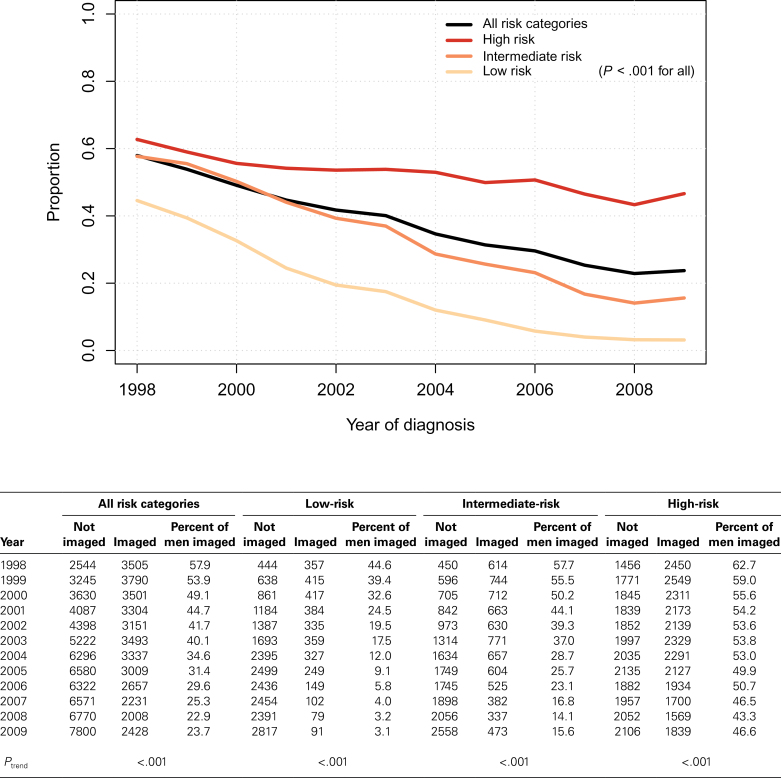
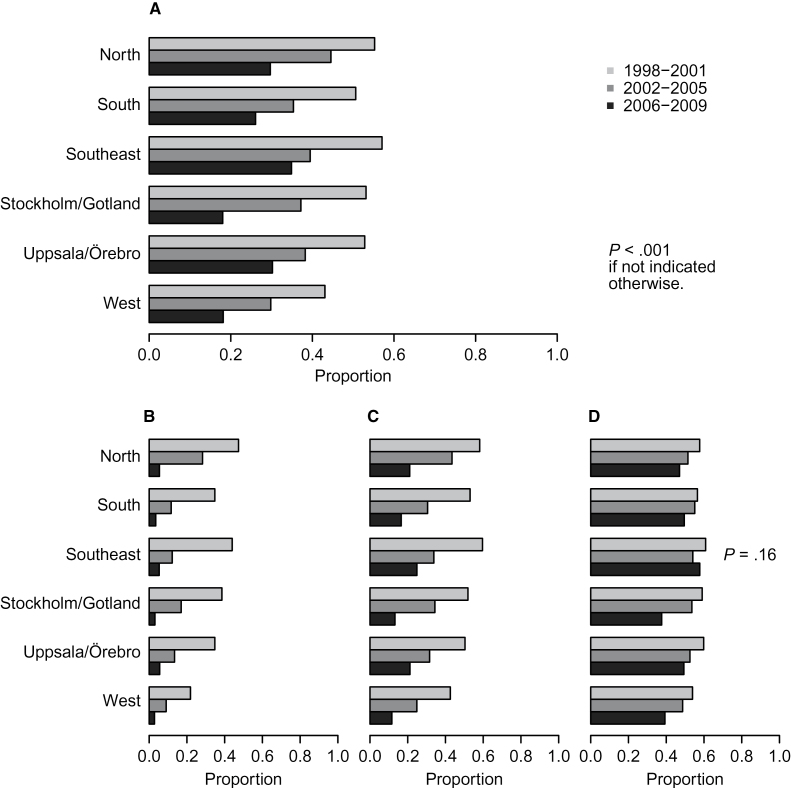
Thirty-six percent of men underwent imaging within 6 months of prostate cancer diagnosis. Overall, imaging use decreased over time, particularly in the low-risk category, among whom the imaging rate decreased from 45% to 3% (P < .001), but also in the high-risk category, among whom the rate decreased from 63% to 47% (P < .001). Despite substantial regional variation, all regions experienced clinically and statistically (P < .001) significant decreases in prostate cancer imaging.
A Swedish effort to provide data on prostate cancer imaging use and imaging guidelines to clinicians was associated with a reduction in inappropriate imaging over a 10-year period, as well as slightly decreased appropriate imaging in high-risk patients. These results may inform current efforts to promote guideline-concordant imaging in the United States and internationally.
降低偶发性前列腺癌的影像学检查的不适当使用是一个具有挑战性的问题,最近它已被列为医师质量报告系统的一项质量指标,并被美国临床肿瘤学会和美国泌尿外科学会在“明智选择”活动中强调。自 2000 年以来,瑞典国家前列腺癌登记处(NPCR)一直致力于通过向瑞典泌尿科医生传播利用数据和最新的影像学指南来降低全国范围内不适当的前列腺癌影像学检查率。我们试图确定这一努力对前列腺癌影像学检查率的时间和区域影响。
我们对 NPCR 从 1998 年至 2009 年诊断为前列腺癌的男性进行了回顾性队列研究(n=99879)。我们根据临床风险类别(低、中、高)和地理区域分析了随时间推移的影像学使用情况。使用对数链接的广义线性模型检验时间趋势。
36%的男性在前列腺癌诊断后 6 个月内进行了影像学检查。总体而言,影像学检查的使用随着时间的推移而减少,尤其是在低风险组中,其影像学检查率从 45%降至 3%(P<0.001),但在高风险组中,其影像学检查率也从 63%降至 47%(P<0.001)。尽管存在明显的地区差异,但所有地区的前列腺癌影像学检查均显著减少,且具有临床意义和统计学意义(P<0.001)。
瑞典努力向临床医生提供前列腺癌影像学检查使用情况和影像学指南数据,这与 10 年来不适当影像学检查的减少以及高危患者中适当影像学检查的略有减少有关。这些结果可能为当前在美国和国际上促进符合指南的影像学检查的努力提供信息。