Division of Urology, University of Utah, Salt Lake City, Utah.
Division of Urology, Huntsman Cancer Institute, University of Utah, Salt Lake City, Utah.
Urol Oncol. 2023 Jan;41(1):48.e19-48.e26. doi: 10.1016/j.urolonc.2022.09.007. Epub 2022 Oct 26.
Encouraging the appropriate use of staging imaging in patients with newly diagnosed prostate cancer remains a challenge. Assessing the effects of national efforts may help guide future initiatives in curtailing low-value care. The purpose of this study was to determine the impact of the Choosing Wisely campaign on imaging utilization among men with prostate cancer.
Surveillance, Epidemiology, and End Results - Medicare data were used to complete a longitudinal population-based study of men diagnosed with prostate cancer from 2007 to 2015. An interrupted time series analysis evaluated the impact of the Choosing Wisely campaign on trends of imaging utilization.
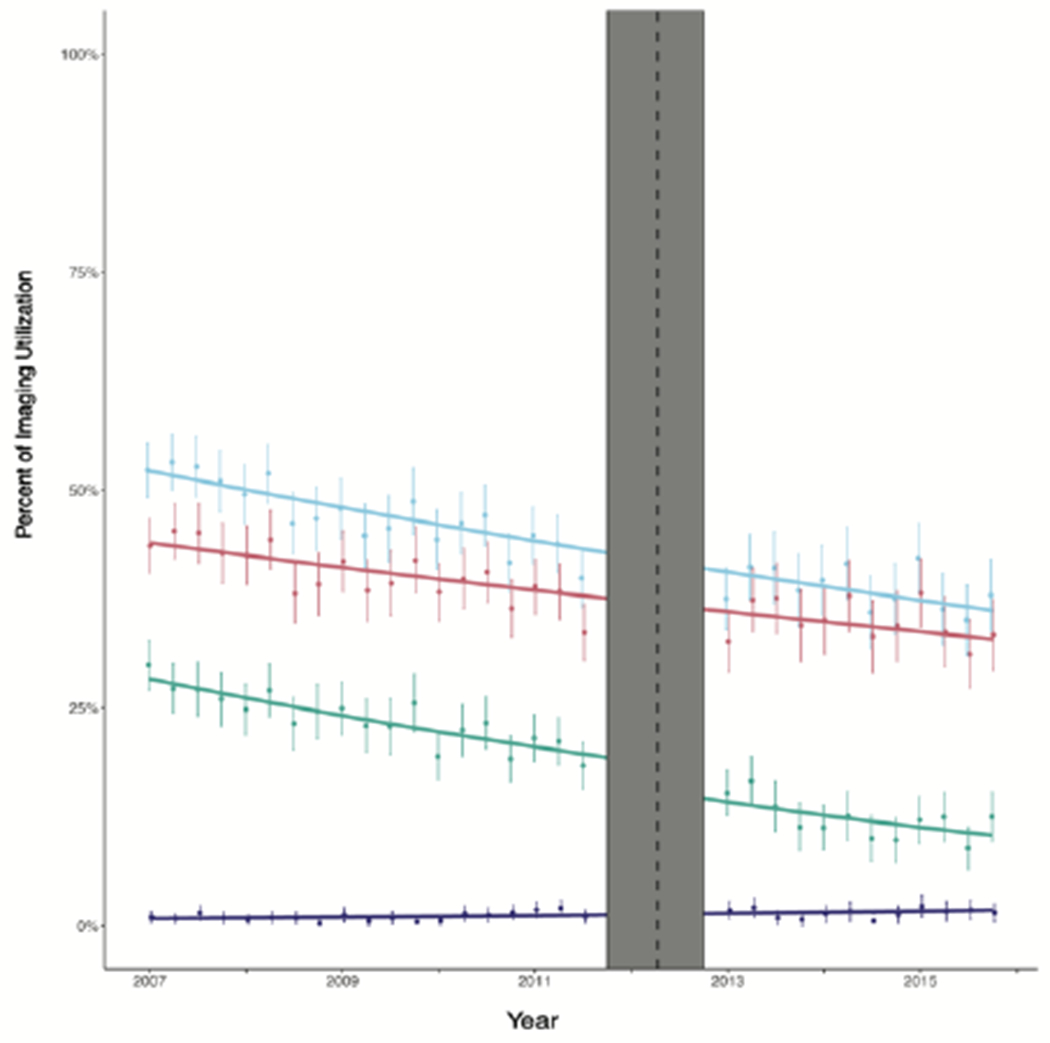
From 2007 to 2015 imaging utilization in low-risk patients decreased, with computed tomography (CT) usage declining from 45.0% to 34.4% (P<0.001) and nuclear medicine bone scan (NMBS) from 27.8% to 11.7% (P<0.001). Choosing Wisely likely contributed to an absolute reduction of 2.9% (P=0.03) in utilization of NMBS in the low-risk population. Imaging usage for all modalities increased in the high-risk population, but with 32.8% continuing to not receive guideline-supported imaging.
In 2012, the Choosing Wisely campaign sought to decrease inappropriate staging imaging for men with low-risk prostate cancer and encourage stewardship of medical resources. Overall decreases in staging imaging trends suggest a move towards higher value care. However, this study found that the Choosing Wisely recommendations had a modest impact on utilization of NMBS, but not CT or PET scans. These results may help inform future efforts to promote guideline concordant imaging.
鼓励新诊断前列腺癌患者合理使用分期成像仍然是一个挑战。评估国家努力的效果可能有助于指导未来减少低价值医疗的举措。本研究的目的是确定明智选择运动对前列腺癌患者影像学应用的影响。
使用监测、流行病学和最终结果-医疗保险数据完成了一项对 2007 年至 2015 年期间诊断为前列腺癌的男性进行的基于人群的纵向研究。中断时间序列分析评估了明智选择运动对影像学应用趋势的影响。
2007 年至 2015 年,低危患者的影像学使用率下降,计算机断层扫描(CT)使用率从 45.0%降至 34.4%(P<0.001),核医学骨扫描(NMBS)从 27.8%降至 11.7%(P<0.001)。明智选择可能导致低危人群 NMBS 使用率绝对减少 2.9%(P=0.03)。所有模式的影像学使用率在高危人群中均增加,但 32.8%的人群仍未接受指南支持的影像学检查。
2012 年,明智选择运动旨在减少低危前列腺癌男性的不适当分期成像,并鼓励对医疗资源进行管理。分期成像趋势的总体下降表明向更高价值的护理转变。然而,本研究发现,明智选择建议对 NMBS 的使用率影响不大,但对 CT 或 PET 扫描没有影响。这些结果可能有助于为未来促进符合指南的影像学应用提供信息。