Department of Urology, Penn State College of Medicine, Hershey, PA 17033, USA.
Department of Urology, Cooper University Health Care, Camden, NJ 08103, USA.
Curr Oncol. 2024 Aug 20;31(8):4746-4752. doi: 10.3390/curroncol31080354.
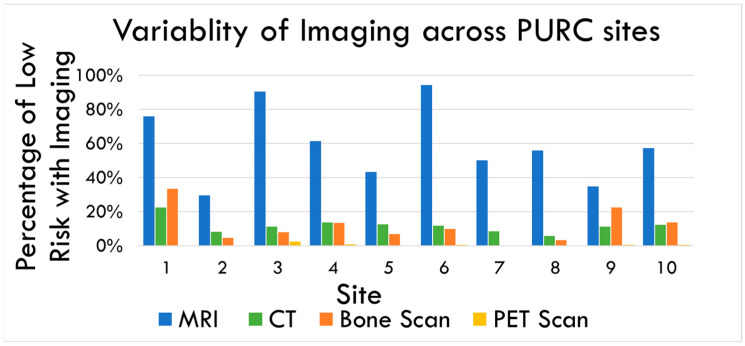
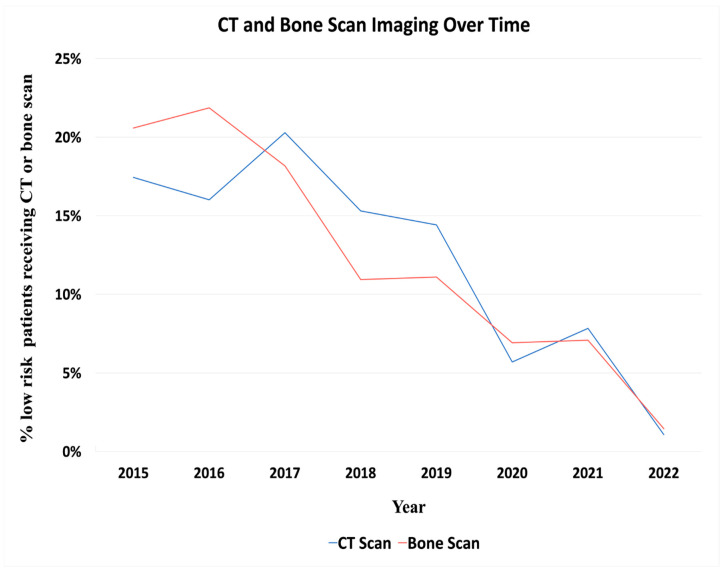
Imaging for prostate cancer defines the extent of disease. Guidelines recommend against imaging low-risk prostate cancer patients with a computed tomography (CT) scan or bone scan due to the low probability of metastasis. We reviewed imaging performed for men diagnosed with low-risk prostate cancer across the Pennsylvania Urologic Regional Collaborative (PURC), a physician-led data sharing and quality improvement collaborative. The data of 10 practices were queried regarding the imaging performed in men diagnosed with prostate cancer from 2015 to 2022. The cohort included 13,122 patients with 3502 (27%) low-risk, 2364 (18%) favorable intermediate-risk, 3585 (27%) unfavorable intermediate-risk, and 3671 (28%) high-risk prostate cancer, based on the AUA guidelines. Amongst the low-risk patients, imaging utilization included pelvic MRI (59.7%), bone scan (17.8%), CT (16.0%), and PET-based imaging (0.5%). Redundant imaging occurred in 1022 patients (29.2%). There was variability among the PURC sites for imaging used in the low-risk patients, and iterative education reduced the need for CT and bone scans. Approximately 15% of low-risk patients had staging imaging performed using either a CT or bone scan, and redundant imaging occurred in almost one-third of men. Such data underscore the need for continued guideline-based education to optimize the stewardship of resources and reduce unnecessary costs to the healthcare system.
前列腺癌的影像学检查可确定疾病的范围。指南建议,由于转移的可能性较低,对于低危前列腺癌患者,不建议使用计算机断层扫描(CT)或骨扫描进行影像学检查。我们回顾了宾夕法尼亚州泌尿科区域协作组织(PURC)中诊断为低危前列腺癌的男性所进行的影像学检查,该组织是一个由医生领导的数据共享和质量改进协作组织。我们对 10 家诊所的数据进行了查询,以了解 2015 年至 2022 年间诊断为前列腺癌的男性进行的影像学检查情况。该队列包括 13122 名患者,其中 3502 名(27%)为低危,2364 名(18%)为中危(有利),3585 名(27%)为中危(不利),3671 名(28%)为高危前列腺癌,依据 AUA 指南。在低危患者中,影像学检查包括盆腔 MRI(59.7%)、骨扫描(17.8%)、CT(16.0%)和基于 PET 的成像(0.5%)。有 1022 名患者(29.2%)存在重复影像学检查。PURC 各站点之间在低危患者中使用的影像学检查存在差异,通过迭代教育,降低了对 CT 和骨扫描的需求。大约 15%的低危患者进行了 CT 或骨扫描的分期影像学检查,近三分之一的男性存在重复影像学检查。这些数据强调了继续进行基于指南的教育的必要性,以优化资源管理并降低医疗系统的不必要成本。