Momennasab Marzieh, Moattari Marzieh, Abbaszade Abbas, Shamshiri Babak
Department of Nursing, Shiraz University of Medical Sciences, Shiraz, Iran.
Iran J Nurs Midwifery Res. 2012 Jul;17(5):343-51.
Life-threatening and stressful events, such as myocardial infarction (MI) can lead to an actual crisis, which affects the patients spiritually as well as physically, psychologically, and socially. However, the focus of health care providers is on physical needs. Furthermore, the spirituality of the patients experiencing heart attack in the light of our cultural context is not well addressed in the literature. This study is aimed at exploring the spiritual experiences of the survivors of the MI.
In this qualitative research a grounded theory approach was used. Key informants were 9 MI patients hospitalized in the coronary care units of 3 hospitals in Shiraz. In addition, 7 nurses participated in the study. In-depth interviews and a focus group were used to generate data. Data analysis was done based on Strauss and Corbin method. Constant comparison analysis was performed until data saturation.
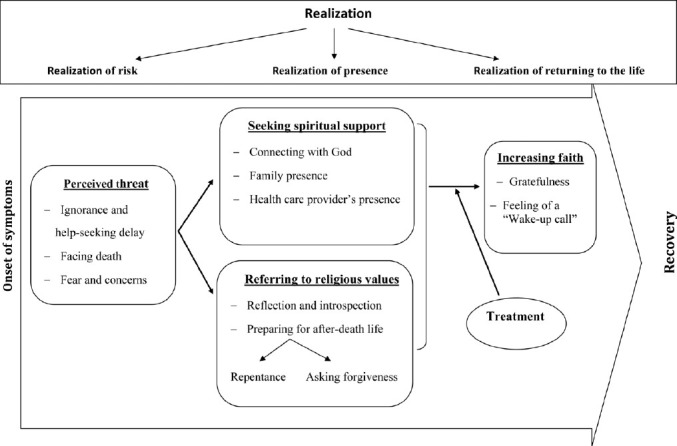
Five main categories emerged from the data, including perceived threat, seeking spiritual support, referring to religious values, increasing faith, and realization. The latter with its 3 subcategories was recognized as core category and represents a deep understanding beyond knowing. At the time of encountering MI, spirituality provided hope, strength, and peace for the participants.
Based on the results we can conclude that connecting to God, religious values, and interconnectedness to others are the essential components of the participants' spiritual experience during the occurrence of MI. Spirituality helps patients to overcome this stressful life-threatening situation.
危及生命的应激事件,如心肌梗死(MI),可引发实际的危机,这会在精神、身体、心理和社会层面影响患者。然而,医疗保健提供者关注的是身体需求。此外,鉴于我们的文化背景,文献中并未很好地探讨心脏病发作患者的精神层面。本研究旨在探索心肌梗死幸存者的精神体验。
本定性研究采用扎根理论方法。关键信息提供者为设拉子3家医院冠心病监护病房收治的9名心肌梗死患者。此外,7名护士参与了研究。通过深度访谈和焦点小组收集数据。基于施特劳斯和科尔宾方法进行数据分析。持续进行比较分析直至数据饱和。
数据中出现了五个主要类别,包括感知到的威胁、寻求精神支持、提及宗教价值观、增强信念和领悟。后者及其三个子类别被认定为核心类别,代表着超越认知的深刻理解。在遭遇心肌梗死时,精神层面为参与者提供了希望、力量与安宁。
基于研究结果,我们可以得出结论,与上帝的联系、宗教价值观以及与他人的相互联系是心肌梗死发生期间参与者精神体验的重要组成部分。精神层面有助于患者克服这种危及生命的紧张状况。