School of Biological Sciences, Universiti Sains Malaysia, Penang, Malaysia.
Parasit Vectors. 2013 Jul 15;6:206. doi: 10.1186/1756-3305-6-206.
Mating is a physiological process of crucial importance underlying the size and maintenance of mosquito populations. In sterile and incompatible insect technologies (SIT and IIT), mating is essential for mass production, persistence, and success of released individuals, and is a central parameter for judging the effectiveness of SIT/IIT programs. Some mosquitoes have an enormous reproductive potential for both themselves and pathogens and mating may contribute to persistence of infection in nature. As Aedes albopictus can transmit flaviviruses both sexually and horizontally, and as infected insects are usually derived from laboratory colonies, we investigated the implications of mating between a long-term laboratory colony of Ae. albopictus and wild populations.
Through a series of mating experiments, we examined the reproductive outcomes of sexual cross-affinity between laboratory-raised and wild adults of Ae. albopictus.
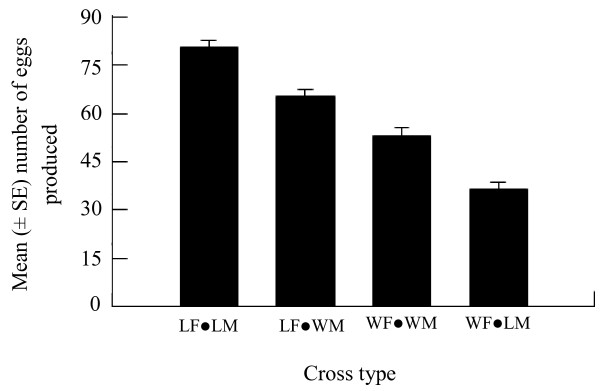
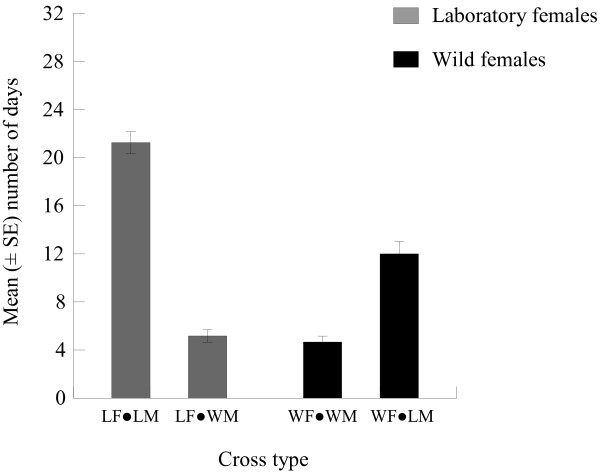
The results indicated appreciable mating compatibility between laboratory-reared and wild adults, and equivalent levels of egg production among reciprocal crosses. We also observed comparable larval eclosion in lab females mated with wild males, and increased adult longevity in female offspring from wild females|×|laboratory males crosses.
Taken together, these data suggest that Ae. albopictus can preserve its reproductive fitness over a long period of time in the laboratory environment and has valuable attributes for SIT application. These observations together with the ability to successfully inseminate heterospecific females indicate the potential of Ae. albopictus to act as an ecological barrier if non-sterilized males are massively released in areas occupied by Aedes aegypti. The observed substantial reproductive fitness combined with the capability to reproduce both, itself and viruses illustrates the potential of Ae. albopictus to pose a serious threat if infected and released accidentally.
交配是蚊群大小和维持的重要生理过程。在不育和不相容昆虫技术(SIT 和 IIT)中,交配对于大量生产、释放个体的持续存在和成功至关重要,是判断 SIT/IIT 计划有效性的中心参数。一些蚊子自身和病原体都具有巨大的繁殖潜力,交配可能有助于感染在自然界中的持续存在。由于白纹伊蚊既能通过性传播又能通过水平传播传播黄病毒,并且感染的昆虫通常来自实验室种群,因此我们研究了实验室长期饲养的白纹伊蚊与野生种群之间交配的影响。
通过一系列交配实验,我们检查了实验室饲养的和野生白纹伊蚊成虫之间的性交叉亲和力的生殖结果。
结果表明,实验室饲养的和野生成虫之间存在明显的交配相容性,并且相互交叉的产卵水平相当。我们还观察到实验室雌蚊与野生雄蚊交配后,幼虫孵化率相当,并且来自野生雌蚊|×|实验室雄蚊交配的雌蚊后代的成虫寿命延长。
总的来说,这些数据表明,白纹伊蚊在实验室环境中可以长时间保持其生殖适应性,并且具有 SIT 应用的宝贵属性。这些观察结果以及成功给异源雌蚊授精的能力表明,如果在埃及伊蚊占领的地区大量释放非不育雄蚊,白纹伊蚊有可能作为一种生态屏障。观察到的大量生殖适应性以及自身和病毒繁殖的能力表明,如果感染并意外释放,白纹伊蚊可能构成严重威胁。