Animal Ecology, Utrecht University, Utrecht, The Netherlands.
PLoS One. 2013 Jul 5;8(7):e69749. doi: 10.1371/journal.pone.0069749. Print 2013.
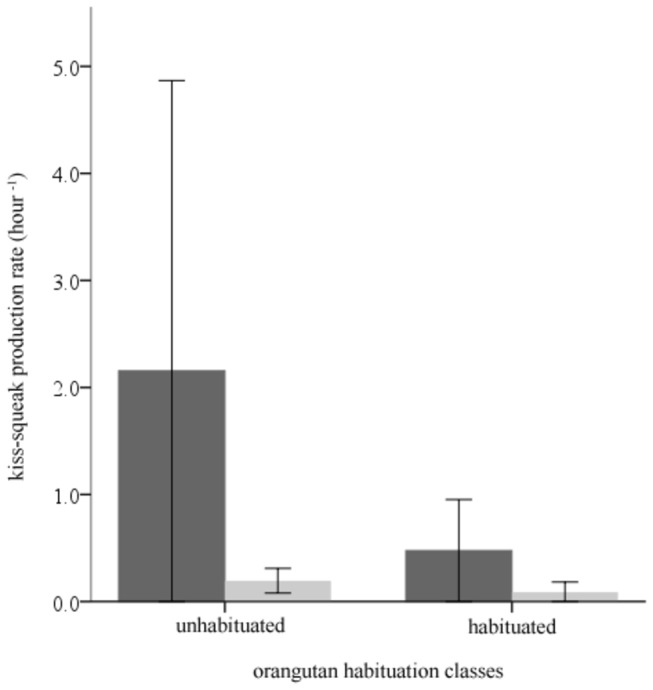
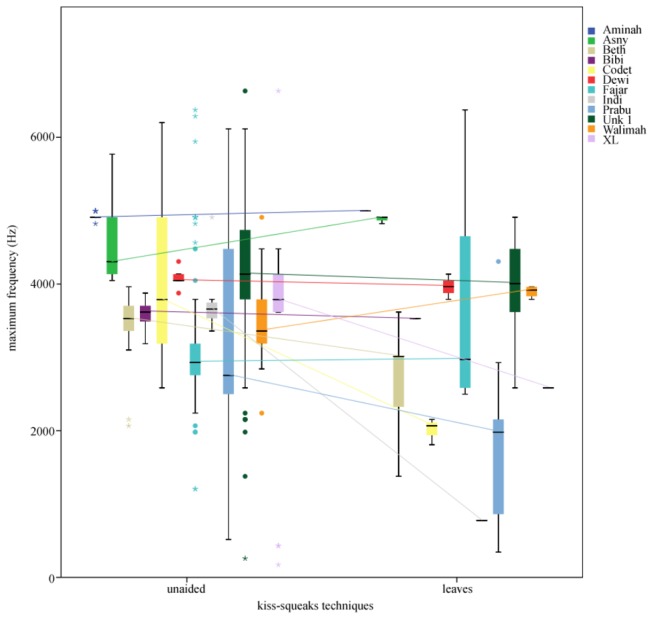
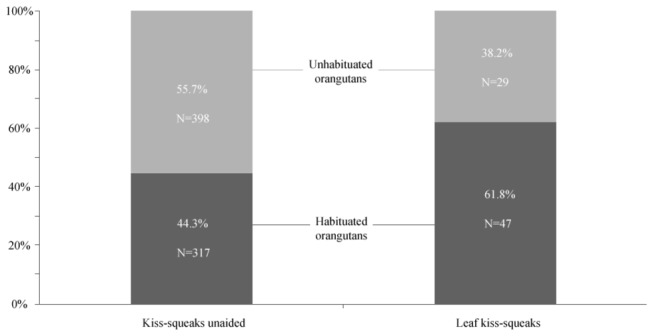
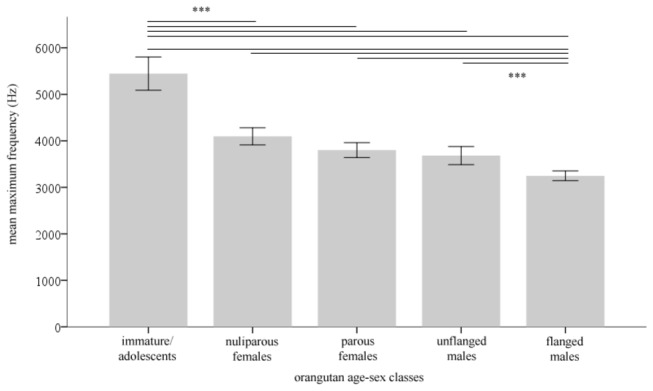
Arbitrariness is an elementary feature of human language, yet seldom an object of comparative inquiry. While arbitrary signals for the same function are relatively frequent between animal populations across taxa, the same signal with arbitrary functions is rare and it remains unknown whether, in parallel with human speech, it may involve call production in animals. To investigate this question, we examined a particular orangutan alarm call - the kiss-squeak - and two variants - hand and leaf kiss-squeaks. In Tuanan (Central Kalimantan, Indonesia), the acoustic frequency of unaided kiss-squeaks is negatively related to body size. The modified variants are correlated with perceived threat and are hypothesized to increase the perceived body size of the sender, as the use of a hand or leaves lowers the kiss-squeak's acoustic frequency. We examined the use of these variants in the same context in another orangutan population of the same sub-species and with partially similar habitat at Cabang Panti (West Kalimantan, Indonesia). Identical analyses of data from this site provided similar results for unaided kiss-squeaks but dissimilar results for hand and leaf kiss-squeaks. Unaided kiss-squeaks at Cabang Panti were emitted as commonly and showed the same relationship to body size as in Tuanan. However, at Cabang Panti, hand kiss-squeaks were extremely rare, while leaf-use neither conveyed larger body size nor was related to perceived threat. These findings indicate functional discontinuity between the two sites and therefore imply functional arbitrariness of leaf kiss-squeaks. These results show for the first time the existence of animal signals involving call production with arbitrary function. Our findings are consistent with previous studies arguing that these orangutan call variants are socially learned and reconcile the role of gestures and calls within evolutionary theories based on common ancestry for speech and music.
任意性是人类语言的基本特征,但很少成为比较研究的对象。虽然在不同动物种群之间,相同功能的任意信号相对频繁,但相同功能的任意信号却很少见,而且尚不清楚,是否与人类语言一样,它可能涉及动物的叫声产生。为了研究这个问题,我们研究了一种特定的猩猩警报叫声——亲吻声——以及两种变体——手和叶亲吻声。在 Tuanan(印度尼西亚中加里曼丹),未加修饰的亲吻声的频率与体型大小呈负相关。经过修饰的变体与感知到的威胁有关,假设它们可以增加发送者的感知体型大小,因为使用手或树叶会降低亲吻声的频率。我们在另一个同种亚种的猩猩群体中,在具有部分相似栖息地的 Cabang Panti(印度尼西亚西加里曼丹),在相同的背景下研究了这些变体的使用情况。对来自该地点的数据进行相同的分析,结果与未加修饰的亲吻声相似,但对手和叶亲吻声的结果则不同。在 Cabang Panti,未加修饰的亲吻声的发出频率与 Tuanan 相同,且与体型大小的关系也相同。然而,在 Cabang Panti,手亲吻声非常罕见,而使用树叶既不能传达更大的体型,也与感知到的威胁无关。这些发现表明两个地点之间存在功能上的不连续性,因此暗示了叶亲吻声的功能任意性。这些结果首次表明存在涉及叫声产生的具有任意功能的动物信号。我们的发现与先前的研究一致,即这些猩猩叫声变体是通过社会学习获得的,并调和了手势和叫声在基于共同祖先的言语和音乐进化理论中的作用。