Department of Structural and Computational Biology, Max F. Perutz Laboratories, University of Vienna, Campus Vienna Biocenter 5, A-1030 Vienna, Austria.
Nucleic Acids Res. 2013 Oct;41(18):8434-43. doi: 10.1093/nar/gkt618. Epub 2013 Jul 18.
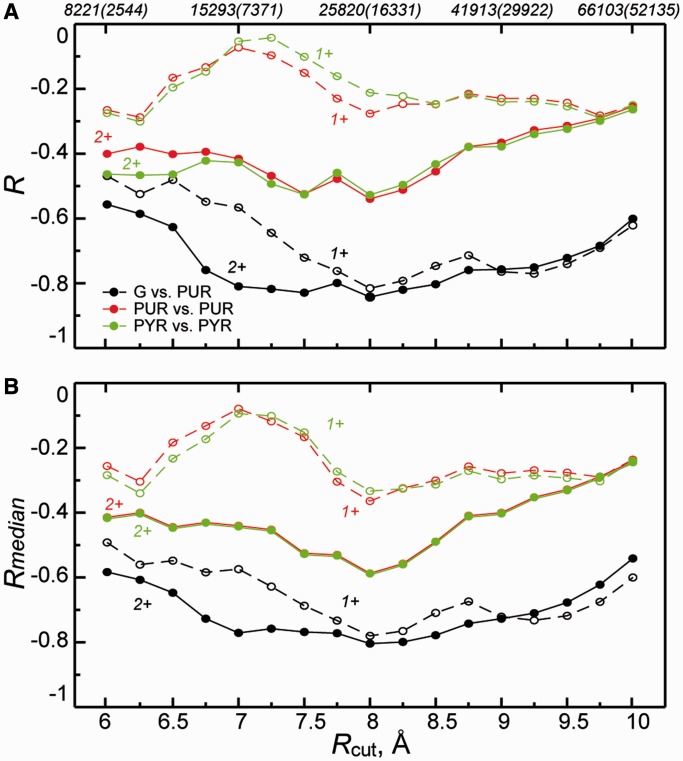
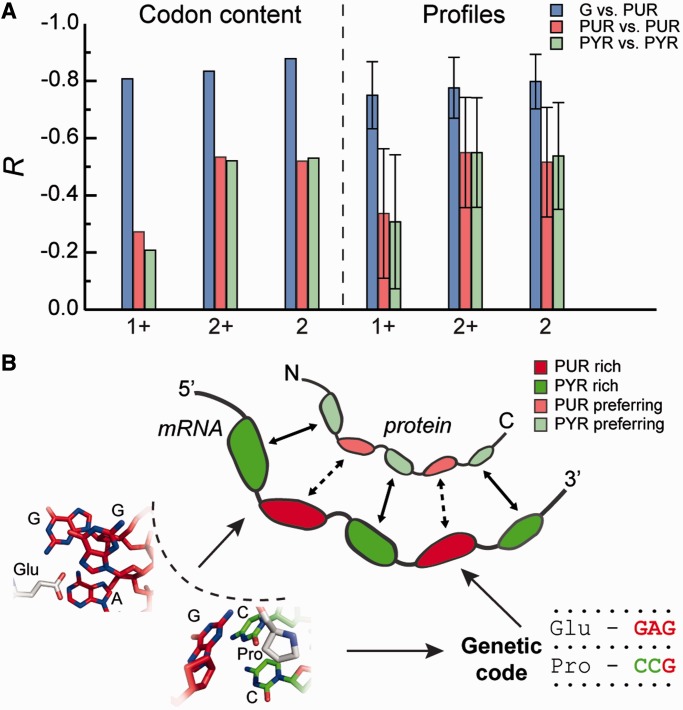
Recently, the ability to interact with messenger RNA (mRNA) has been reported for a number of known RNA-binding proteins, but surprisingly also for different proteins without recognizable RNA binding domains including several transcription factors and metabolic enzymes. Moreover, direct binding to cognate mRNAs has been detected for multiple proteins, thus creating a strong impetus to search for functional significance and basic physico-chemical principles behind such interactions. Here, we derive interaction preferences between amino acids and RNA bases by analyzing binding interfaces in the known 3D structures of protein-RNA complexes. By applying this tool to human proteome, we reveal statistically significant matching between the composition of mRNA sequences and base-binding preferences of protein sequences they code for. For example, purine density profiles of mRNA sequences mirror guanine affinity profiles of cognate protein sequences with quantitative accuracy (median Pearson correlation coefficient R = -0.80 across the entire human proteome). Notably, statistically significant anti-matching is seen only in the case of adenine. Our results provide strong evidence for the stereo-chemical foundation of the genetic code and suggest that mRNAs and cognate proteins may in general be directly complementary to each other and associate, especially if unstructured.
最近,已经有报道称,许多已知的 RNA 结合蛋白都具有与信使 RNA(mRNA)相互作用的能力,但令人惊讶的是,一些没有可识别 RNA 结合结构域的不同蛋白质也具有这种能力,包括几种转录因子和代谢酶。此外,已经检测到多个蛋白质与同源 mRNAs 的直接结合,这为寻找这些相互作用背后的功能意义和基本物理化学原理提供了强大的动力。在这里,我们通过分析已知的蛋白质-RNA 复合物的三维结构中的结合界面,推导出氨基酸和 RNA 碱基之间的相互作用偏好。通过将此工具应用于人类蛋白质组,我们揭示了 mRNA 序列的组成与它们编码的蛋白质序列的碱基结合偏好之间存在统计学上显著的匹配。例如,mRNA 序列的嘌呤密度分布与同源蛋白质序列的鸟嘌呤亲和力分布具有定量准确性(整个人类蛋白质组的中位数 Pearson 相关系数 R = -0.80)。值得注意的是,只有在腺嘌呤的情况下才会出现统计学上显著的反匹配。我们的结果为遗传密码的立体化学基础提供了强有力的证据,并表明 mRNAs 和同源蛋白质通常可能直接互补并相互结合,尤其是在无结构的情况下。