Research Group of Host-Microbe Interactions, Department of Medical Biology, Faculty of Health Sciences, University of Tromsø, Tromsø, Norway.
Microbiology (Reading). 2013 Oct;159(Pt 10):2001-2013. doi: 10.1099/mic.0.069369-0. Epub 2013 Jul 19.
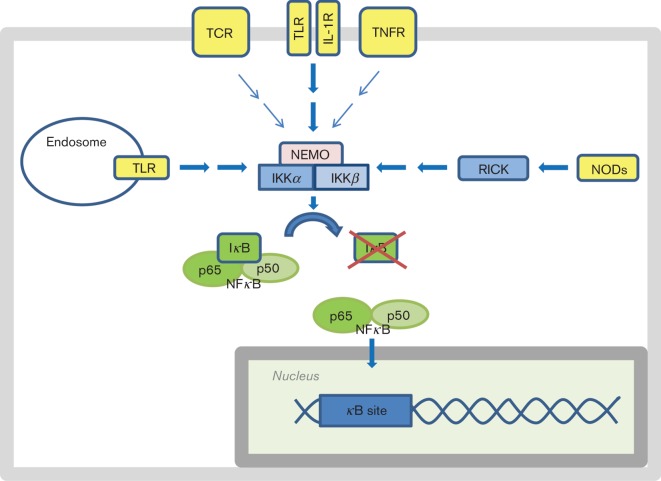
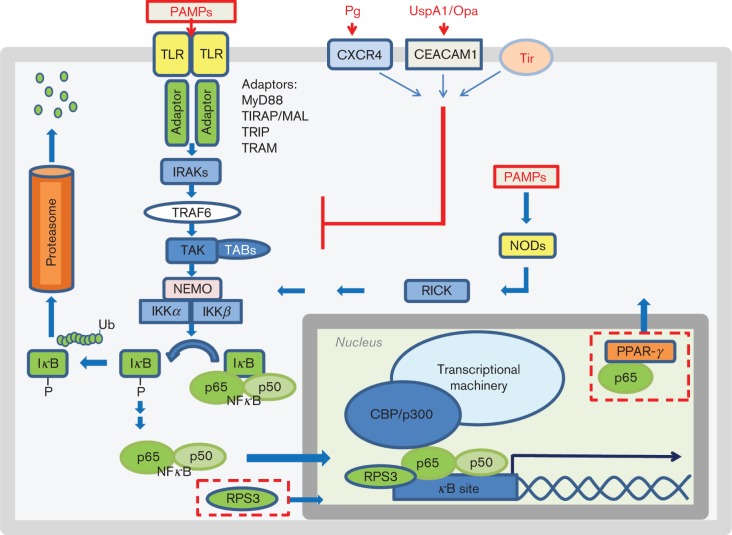
The human body is constantly challenged by a variety of commensal and pathogenic micro-organisms that trigger the immune system. Central in the first line of defence is the pattern-recognition receptor (PRR)-induced stimulation of the NFκB pathway, leading to NFκB activation. The subsequent production of pro-inflammatory cytokines and/or antimicrobial peptides results in recruitment of professional phagocytes and bacterial clearance. To overcome this, bacteria have developed mechanisms for targeted interference in every single step in the PRR-NFκB pathway to dampen host inflammatory responses. This review aims to briefly overview the PRR-NFκB pathway in relation to the immune response and give examples of the diverse bacterial evasion mechanisms including changes in the bacterial surface, decoy production and injection of effector molecules. Targeted regulation of inflammatory responses is needed and bacterial molecules developed for immune evasion could provide future anti-inflammatory agents.
人体不断受到各种共生和病原微生物的挑战,这些微生物会引发免疫系统的反应。在第一道防线中起核心作用的是模式识别受体(PRR)诱导的 NFκB 通路的刺激,导致 NFκB 的激活。随后产生的促炎细胞因子和/或抗菌肽会招募专业吞噬细胞并清除细菌。为了克服这一点,细菌已经发展出针对 PRR-NFκB 通路中每一个步骤的靶向干扰机制,以抑制宿主的炎症反应。本综述旨在简要概述 PRR-NFκB 通路与免疫反应的关系,并举例说明细菌逃避机制的多样性,包括细菌表面的变化、诱饵的产生和效应分子的注射。需要对炎症反应进行靶向调节,而细菌为了逃避免疫而产生的分子可能为未来的抗炎药物提供来源。