Evolution, Ecology and Genetics, Research School of Biology, The Australian National University, Canberra, Australian Capital Territory, Australia.
PLoS Genet. 2013;9(7):e1003635. doi: 10.1371/journal.pgen.1003635. Epub 2013 Jul 18.
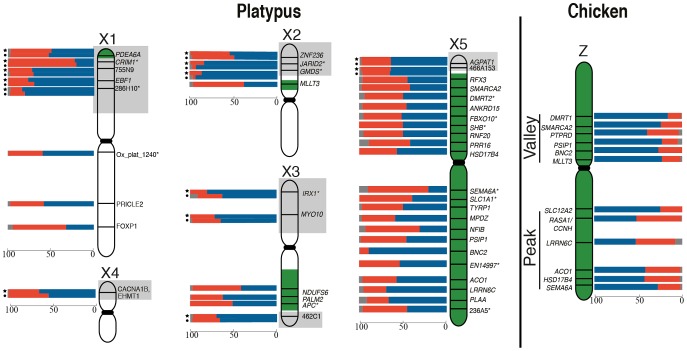
X chromosome inactivation in eutherian mammals has been thought to be tightly controlled, as expected from a mechanism that compensates for the different dosage of X-borne genes in XX females and XY males. However, many X genes escape inactivation in humans, inactivation of the X in marsupials is partial, and the unrelated sex chromosomes of monotreme mammals have incomplete and gene-specific inactivation of X-linked genes. The bird ZW sex chromosome system represents a third independently evolved amniote sex chromosome system with dosage compensation, albeit partial and gene-specific, via an unknown mechanism (i.e. upregulation of the single Z in females, down regulation of one or both Zs in males, or a combination). We used RNA-fluorescent in situ hybridization (RNA-FISH) to demonstrate, on individual fibroblast cells, inactivation of 11 genes on the chicken Z and 28 genes on the X chromosomes of platypus. Each gene displayed a reproducible frequency of 1Z/1X-active and 2Z/2X-active cells in the homogametic sex. Our results indicate that the probability of inactivation is controlled on a gene-by-gene basis (or small domains) on the chicken Z and platypus X chromosomes. This regulatory mechanism must have been exapted independently to the non-homologous sex chromosomes in birds and mammals in response to an over-expressed Z or X in the homogametic sex, highlighting the universal importance that (at least partial) silencing plays in the evolution on amniote dosage compensation and, therefore, the differentiation of sex chromosomes.
X 染色体失活在真兽类哺乳动物中被认为是受到严格控制的,这与一种补偿 XX 雌性和 XY 雄性中 X 染色体携带基因剂量差异的机制是一致的。然而,许多 X 基因在人类中没有失活,有袋动物的 X 染色体失活是部分的,而单孔类哺乳动物的不相关的性染色体则存在不完全的和基因特异性的 X 连锁基因失活。鸟类的 ZW 性染色体系统代表了第三个独立进化的羊膜动物性染色体系统,通过未知的机制(即雌性中单个 Z 的上调、雄性中一个或两个 Z 的下调,或两者的组合)实现了剂量补偿,尽管是部分的和基因特异性的。我们使用 RNA 荧光原位杂交(RNA-FISH)在单个成纤维细胞上证明了鸡 Z 上的 11 个基因和鸭嘴兽 X 染色体上的 28 个基因的失活。每个基因在同型性别的细胞中都显示出可重复的 1Z/1X 活性和 2Z/2X 活性细胞的频率。我们的结果表明,在鸡 Z 和鸭嘴兽 X 染色体上,失活的概率是基于基因(或小的结构域)的控制。这种调控机制必须是在鸟类和哺乳动物的非同源性性染色体上独立适应的,以应对同型性别的 Z 或 X 的过度表达,突出了(至少部分)沉默在羊膜动物剂量补偿进化中的普遍重要性,因此也突出了性染色体的分化。