Al Nadaf Shafagh, Deakin Janine E, Gilbert Clément, Robinson Terence J, Graves Jennifer A M, Waters Paul D
Evolution Ecology and Genetics, Research School of Biology, The Australian National University, ACT 2601, Canberra, Australia.
Chromosoma. 2012 Feb;121(1):71-8. doi: 10.1007/s00412-011-0343-8. Epub 2011 Sep 27.
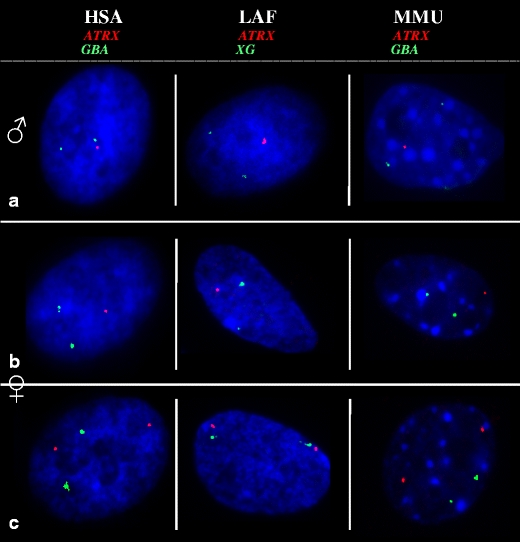
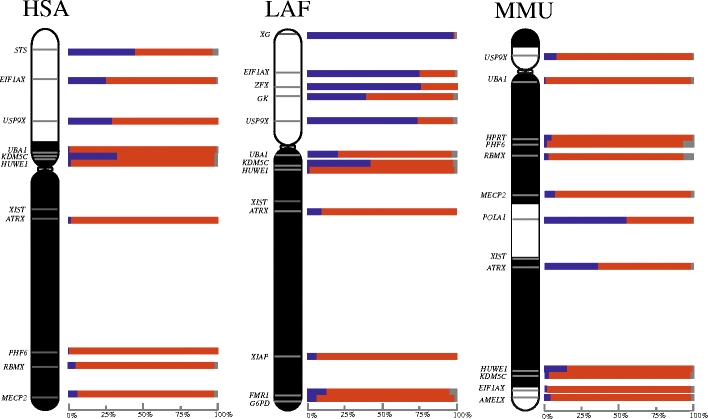
Sex chromosome dosage compensation in both eutherian and marsupial mammals is achieved by X chromosome inactivation (XCI)--transcriptional repression that silences one of the two X chromosomes in the somatic cells of females. We recently used RNA fluorescent in situ hybridization (FISH) to show, in individual nuclei, that marsupial X inactivation (in the absence of XIST) occurs on a gene-by-gene basis, and that escape from inactivation is stochastic and independent of gene location. In the absence of similar data from fibroblast cell lines of eutherian representatives, a meaningful comparison is lacking. We therefore used RNA-FISH to examine XCI in fibroblast cell lines obtained from three distantly related eutherian model species: African savannah elephant (Loxodonta africana), mouse (Mus musculus) and human (Homo sapiens). We show that, unlike the orthologous marsupial X, inactivation of the X conserved region (XCR) in eutherians generally is complete. Two-colour RNA-FISH on female human, mouse and elephant interphase nuclei showed that XCR loci have monoallelic expression in almost all nuclei. However, we found that many loci located in the evolutionarily distinct recently added region (XAR) displayed reproducible locus-specific frequencies of nuclei with either one or two active X alleles. We propose that marsupial XCI retains features of an ancient incomplete silencing mechanism that was augmented by the evolution of the XIST gene that progressively stabilized the eutherian XCR. In contrast, the recently added region of the eutherian X displays an incomplete inactivation profile similar to that observed on the evolutionarily distinct marsupial X and the independently evolved monotreme X chromosomes.
在有胎盘类和有袋类哺乳动物中,性染色体剂量补偿是通过X染色体失活(XCI)实现的,即转录抑制使雌性体细胞中的两条X染色体之一沉默。我们最近使用RNA荧光原位杂交(FISH)在单个细胞核中显示,有袋类动物的X染色体失活(在没有XIST的情况下)是逐基因发生的,并且逃避失活是随机的,与基因位置无关。由于缺乏来自有胎盘类代表的成纤维细胞系的类似数据,因此缺乏有意义的比较。因此,我们使用RNA-FISH来检测从三个远缘有胎盘类模式物种获得的成纤维细胞系中的XCI:非洲草原象(Loxodonta africana)、小鼠(Mus musculus)和人类(Homo sapiens)。我们发现,与直系同源的有袋类动物X染色体不同,有胎盘类动物中X保守区域(XCR)的失活通常是完全的。对女性、小鼠和大象间期细胞核进行的双色RNA-FISH显示,XCR位点在几乎所有细胞核中都有单等位基因表达。然而,我们发现许多位于进化上不同的最近添加区域(XAR)的位点显示出具有一个或两个活跃X等位基因的细胞核的可重复的位点特异性频率。我们提出,有袋类动物的XCI保留了一种古老的不完全沉默机制的特征,这种机制因XIST基因的进化而增强,XIST基因逐渐稳定了有胎盘类动物的XCR。相比之下,有胎盘类动物X染色体的最近添加区域显示出与在进化上不同的有袋类动物X染色体和独立进化的单孔目动物X染色体上观察到的类似的不完全失活模式。