State Key Laboratory of Oncology in Southern China, Department of Radiation Oncology, Cancer Center, Sun Yat-sen University, Guangzhou, People's Republic of China.
PLoS One. 2013 Jul 10;8(7):e67488. doi: 10.1371/journal.pone.0067488. Print 2013.
To compare the radiation-induced temporal lobe injury (TLI) in patients with nasopharyngeal carcinoma (NPC) treated with intensity-modulated radiotherapy (IMRT) or two-dimensional conventional radiotherapy (2D-CRT).
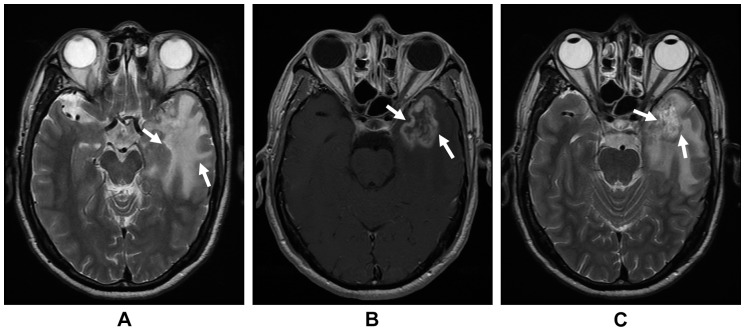
1276 cases of NPC treated with IMRT or 2D-CRT were retrospectively reviewed. A diagnosis of TLI was made on follow-up magnetic resonance imaging (MRI).
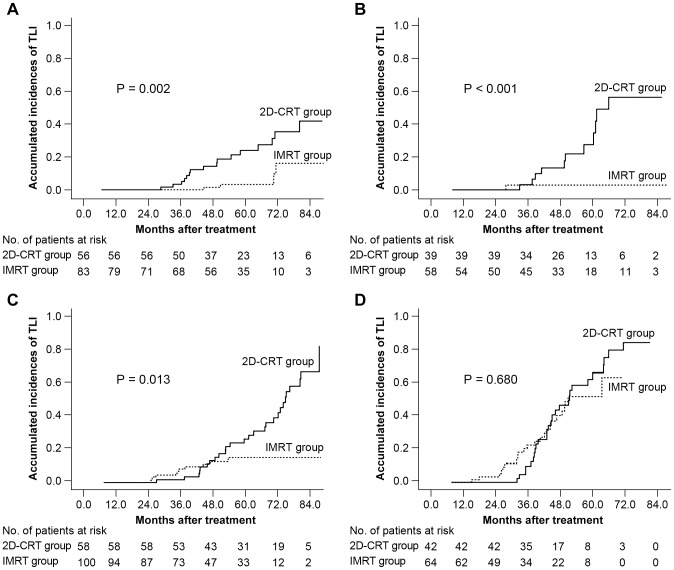
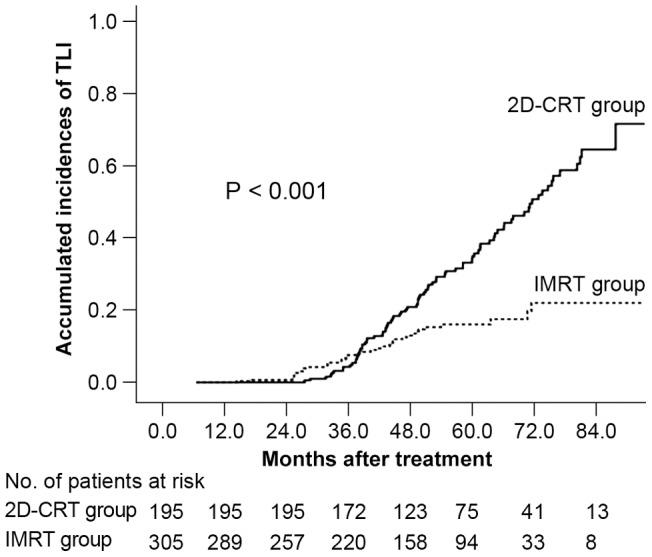
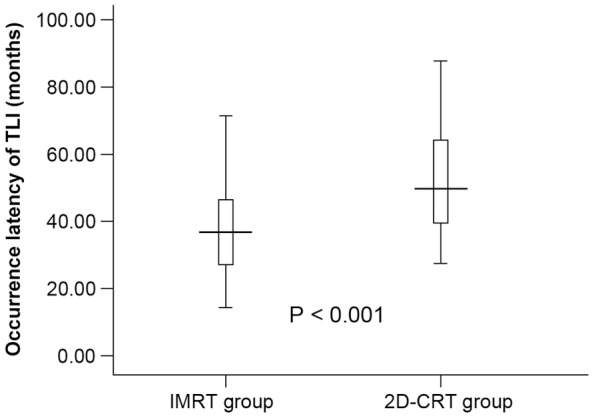
The crude incidence of TLI was 7.5% and 10.8% (P = 0.048), and the actuarial 5-year incidence was 16% and 34.9% (P<0.001) for the IMRT and 2D-CRT groups, respectively. Multivariate analysis revealed both T stage (P<0.001) and radiation technique (P<0.001) as independent predictors. Patients with T1, T2 and T3 disease had a significantly higher risk when treated with 2D-CRT (P = 0.005, 0.016, <0.001, respectively). This trend was not evident for T4 patients (P = 0.680). The 2D-CRT group had a longer latency for the development of TLI (P<0.001). Those with T4 disease had a shorter median time to TLI (P = 0.006, 0.042, <0.001 when compared with T1, T2 and T3, respectively).
IMRT is superior to 2DRT for the management of T1-T3 NPC in terms of sparing the temporal lobe. The high incidence of TLI in T4 disease needs to be addressed.
比较调强放疗(IMRT)与二维常规放疗(2D-CRT)治疗鼻咽癌(NPC)患者的放射性颞叶损伤(TLI)。
回顾性分析了 1276 例接受 IMRT 或 2D-CRT 治疗的 NPC 患者。在随访磁共振成像(MRI)上诊断为 TLI。
TLI 的粗发生率分别为 7.5%和 10.8%(P=0.048),IMRT 和 2D-CRT 组的 5 年累积发生率分别为 16%和 34.9%(P<0.001)。多因素分析显示 T 分期(P<0.001)和放疗技术(P<0.001)均为独立预测因素。T1、T2 和 T3 期患者接受 2D-CRT 治疗时,风险显著增加(P=0.005、0.016、<0.001)。T4 期患者则无此趋势(P=0.680)。2D-CRT 组 TLI 的潜伏期较长(P<0.001)。T4 期患者 TLI 的中位时间较短(与 T1、T2 和 T3 相比,P=0.006、0.042、<0.001)。
与 2D-CRT 相比,IMRT 在保护颞叶方面更具优势。T4 期 NPC 患者 TLI 发生率较高,需要加以解决。