School of Agriculture and Biology, Shanghai Jiao Tong University, Shanghai, China.
PLoS One. 2013 Jul 18;8(7):e67500. doi: 10.1371/journal.pone.0067500. Print 2013.
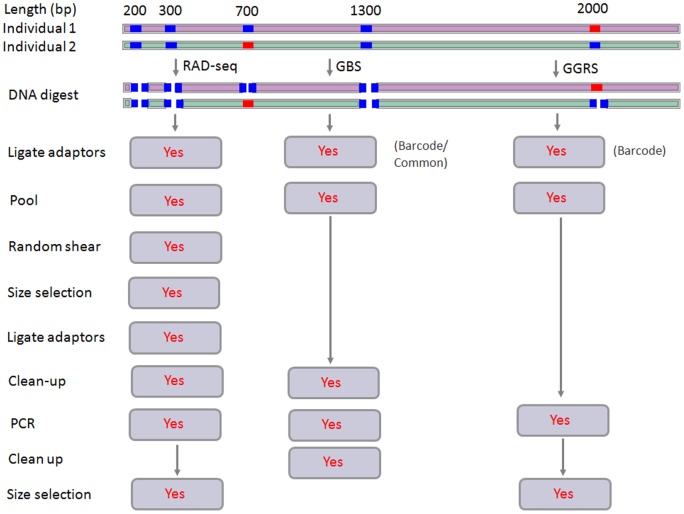
Next-generation sequencing (NGS) approaches are widely used in genome-wide genetic marker discovery and genotyping. However, current NGS approaches are not easy to apply to general outbred populations (human and some major farm animals) for SNP identification because of the high level of heterogeneity and phase ambiguity in the haplotype. Here, we reported a new method for SNP genotyping, called genotyping by genome reducing and sequencing (GGRS) to genotype outbred species. Through an improved procedure for library preparation and a marker discovery and genotyping pipeline, the GGRS approach can genotype outbred species cost-effectively and high-reproducibly. We also evaluated the efficiency and accuracy of our approach for high-density SNP discovery and genotyping in a large genome pig species (2.8 Gb), for which more than 70,000 single nucleotide polymorphisms (SNPs) can be identified for an expenditure of only $80 (USD)/sample.
下一代测序(NGS)方法广泛应用于全基因组遗传标记的发现和基因分型。然而,由于单倍型的异质性和相位模糊度高,当前的 NGS 方法不易应用于一般的杂交群体(人类和一些主要的农场动物)中的 SNP 鉴定。在这里,我们报道了一种新的 SNP 基因分型方法,称为通过基因组减少和测序进行基因分型(GGRS),用于基因分型杂交种。通过改进文库制备的程序和标记发现和基因分型的流水线,GGRS 方法可以经济有效地且高度可重复地对杂交种进行基因分型。我们还评估了我们的方法在大型基因组猪物种(2.8 Gb)中的高密度 SNP 发现和基因分型中的效率和准确性,对于该物种,只需花费 80 美元(美元)/样本,就可以鉴定出超过 70,000 个单核苷酸多态性(SNP)。