Centro Nacional de Microbiología, Instituto de Salud Carlos III, Majadahonda, Madrid, Spain.
PLoS One. 2013 Jul 9;8(7):e68248. doi: 10.1371/journal.pone.0068248. Print 2013.
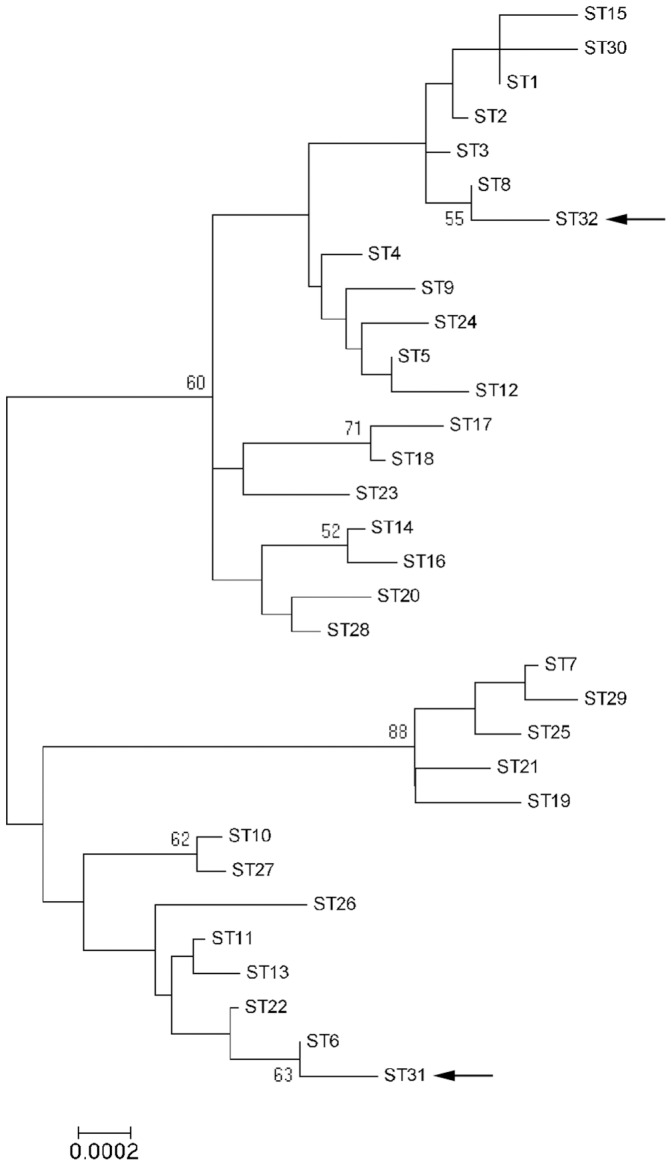
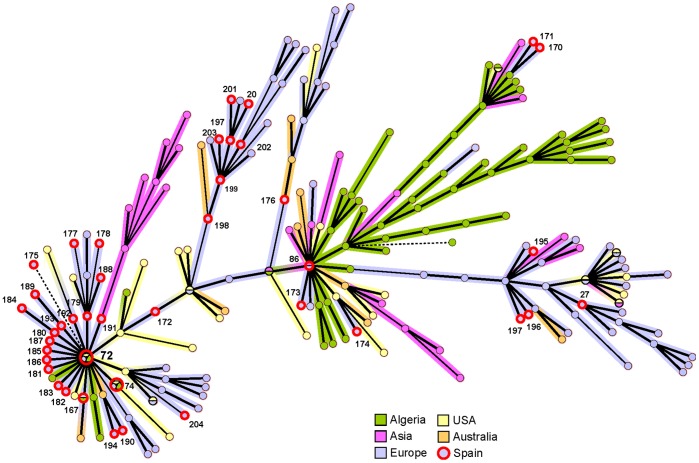
We have studied the diversity of B. henselae circulating in patients, reservoir hosts and vectors in Spain. In total, we have fully characterized 53 clinical samples from 46 patients, as well as 78 B. henselae isolates obtained from 35 cats from La Rioja and Catalonia (northeastern Spain), four positive cat blood samples from which no isolates were obtained, and three positive fleas by Multiple Locus Sequence Typing and Multiple Locus Variable Number Tandem Repeats Analysis. This study represents the largest series of human cases characterized with these methods, with 10 different sequence types and 41 MLVA profiles. Two of the sequence types and 35 of the profiles were not described previously. Most of the B. henselae variants belonged to ST5. Also, we have identified a common profile (72) which is well distributed in Spain and was found to persist over time. Indeed, this profile seems to be the origin from which most of the variants identified in this study have been generated. In addition, ST5, ST6 and ST9 were found associated with felines, whereas ST1, ST5 and ST8 were the most frequent sequence types found infecting humans. Interestingly, some of the feline associated variants never found on patients were located in a separate clade, which could represent a group of strains less pathogenic for humans.
我们研究了在西班牙循环的亨氏巴尔通体在患者、储存宿主和媒介中的多样性。总共,我们充分描述了来自 46 名患者的 53 个临床样本,以及来自拉里奥哈和加泰罗尼亚(西班牙东北部)的 35 只猫的 78 个亨氏巴尔通体分离株,从其中四只未获得分离株的阳性猫血样,以及三只经多位点序列分型和多位点可变数串联重复分析确定的阳性跳蚤。这项研究代表了用这些方法对最大系列的人类病例进行的特征描述,有 10 种不同的序列类型和 41 种 MLVA 图谱。其中两种序列类型和 35 种图谱以前没有描述过。大多数亨氏巴尔通体变体属于 ST5。此外,我们还鉴定了一个常见的图谱(72),它在西班牙分布广泛,并且随着时间的推移保持不变。事实上,这种图谱似乎是本研究中大多数鉴定出的变体的起源。此外,ST5、ST6 和 ST9 与猫有关,而 ST1、ST5 和 ST8 是感染人类的最常见的序列类型。有趣的是,一些从未在患者身上发现的与猫有关的变体位于一个单独的分支中,这可能代表一组对人类致病性较低的菌株。