Shanghai Jiaotong University, Shanghai, People's Republic of China.
PLoS Negl Trop Dis. 2011 Sep;5(9):e1301. doi: 10.1371/journal.pntd.0001301. Epub 2011 Sep 6.
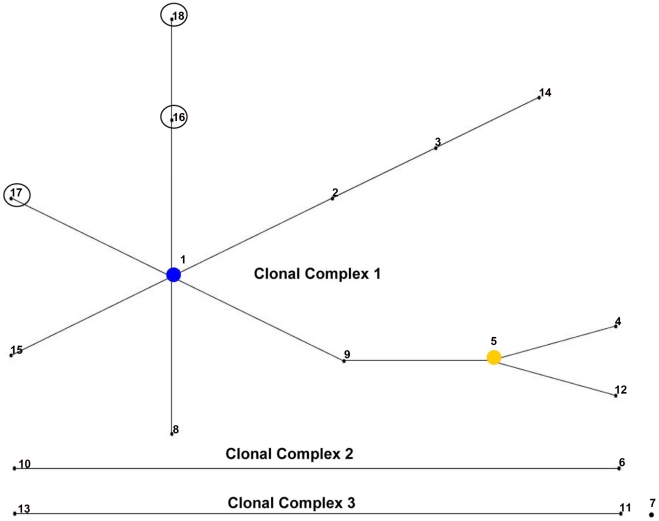
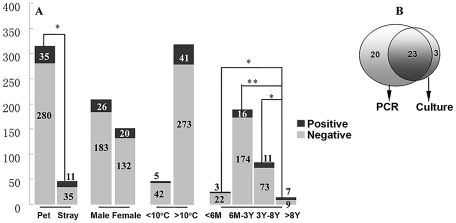
With the improvements in diagnostic techniques, Bartonella henselae (B. henselae) infection has recently been recognized to cause a widening spectrum of diseases. Cats are the natural reservoir hosts of B. henselae. The current study aims to investigate the prevalence of B. henselae infection in the cat populations in China. Polymerase chain reaction (PCR) and bacterial cultures confirm that 12.7% of the tested cats were positive for the infection. Old age and outdoor exposure were statistically associated with the infection. Multilocus sequence typing and eBURST analysis of the cat isolates collected in the present study show that 65.4% of the isolates belong to sequence type 1 (ST1). Three new STs (ST16-18) were identified in Midwestern China. These results may aid our understanding of the population structure of B. henselae in China and the relationship between human and cat strains in subsequent studies.
随着诊断技术的改进,巴尔通体(Bartonella henselae)感染最近被认为会导致更广泛的疾病谱。猫是巴尔通体的天然储存宿主。本研究旨在调查中国猫群中巴尔通体感染的流行情况。聚合酶链反应(PCR)和细菌培养证实,12.7%的受检猫呈感染阳性。年龄较大和户外暴露与感染有统计学关联。本研究中收集的猫分离株的多位点序列分型和 eBURST 分析显示,65.4%的分离株属于序列型 1(ST1)。在中国中西部地区发现了 3 种新的 ST(ST16-18)。这些结果可能有助于我们了解中国巴尔通体的种群结构,以及在后续研究中人类和猫株之间的关系。