Department of Medicine, Case Western Reserve University, Cleveland, Ohio, United States of America.
PLoS One. 2013 Jul 11;8(7):e68871. doi: 10.1371/journal.pone.0068871. Print 2013.
Previous studies by us and other have provided evidence that leukocytes play a critical role in the development of diabetic retinopathy, suggesting a possible role of the innate immune system in development of the retinopathy. Since MyD88 is a convergence point for signaling pathways of the innate immune system (including Toll-Like Receptors (TLRs) and interleukin-1ß (IL-1ß)), the purpose of this study was to assess the role of MyD88 and its dependent pathways on abnormalities that develop in retina and white blood cells related to diabetic retinopathy.
C57BL/6J mice were made diabetic with streptozotocin. Chimeric mice were generated in which MyD88-dependent pathways were deleted from bone marrow-derived only. Mice were sacrificed at 2 mos of diabetes for assessment of, leukostasis, albumin accumulation in neural retina, leukocyte-mediated killing of retinal endothelial cells, and cytokine/chemokine generation by retinas of diabetic mice in response to TLR agonists.
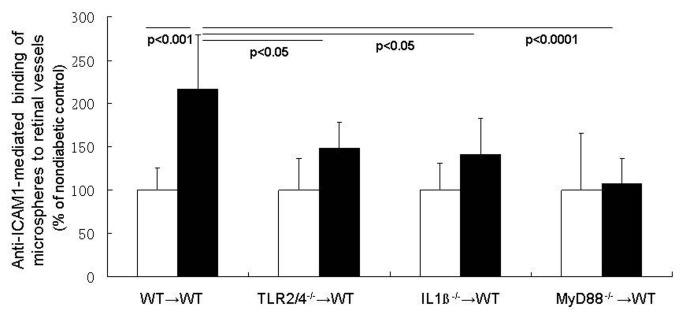
IL-6 and CXCL1 were generated in retinas from diabetic (but not nondiabetic mice) following incubation with Pam3CysK/TLR2, but incubation with other TLR ligands or IL-1ß did not induce cytokine production in retinas from nondiabetic or diabetic mice. Diabetes-induced abnormalities (leukostasis, ICAM-1 expression on the luminal surface of the vascular endothelium, retinal superoxide generation) were significantly inhibited by removing either MyD88 or the signaling pathways regulated by it (TLRs 2 and 4, and IL-1ß) from bone marrow-derived cells only. Leukocyte-mediated killing of endothelial cells tended to be decreased in the marrow-derived cells lacking TLR2/4, but the killing was significantly exacerbated if the marrow cells lacked MyD88 or the receptor for IL-1ß (IL-1ßr).
MyD88-dependent pathways play an important role in the development of diabetes-induced inflammation in the retina, and inhibition of MyD88 might be a novel target to inhibit early abnormalities of diabetic retinopathy and other complications of diabetes.
我们和其他研究人员之前的研究提供了证据,表明白细胞在糖尿病性视网膜病变的发展中起关键作用,这表明先天免疫系统可能在视网膜病变的发展中起作用。由于 MyD88 是先天免疫系统信号通路(包括 Toll 样受体 (TLR) 和白细胞介素-1β (IL-1β))的汇聚点,因此本研究旨在评估 MyD88 及其依赖途径在与糖尿病性视网膜病变相关的视网膜和白细胞中出现的异常中的作用。
用链脲佐菌素使 C57BL/6J 小鼠发生糖尿病。生成嵌合小鼠,其中仅从骨髓衍生细胞中删除 MyD88 依赖性途径。在糖尿病 2 个月时处死小鼠,以评估白细胞淤滞、神经视网膜中白蛋白积累、白细胞介导的视网膜内皮细胞杀伤以及 TLR 激动剂对糖尿病小鼠视网膜中细胞因子/趋化因子的生成。
用 Pam3CysK/TLR2 孵育后,糖尿病(而非非糖尿病)小鼠的视网膜中生成了 IL-6 和 CXCL1,但用其他 TLR 配体或 IL-1β孵育不会诱导非糖尿病或糖尿病小鼠视网膜中细胞因子的产生。仅从骨髓衍生细胞中去除 MyD88 或由其调节的信号通路(TLR2 和 4 以及 IL-1β)可显著抑制糖尿病诱导的异常(白细胞淤滞、血管内皮细胞内腔表面的 ICAM-1 表达、视网膜超氧化物生成)。缺乏 TLR2/4 的骨髓衍生细胞中白细胞介导的内皮细胞杀伤倾向于减少,但如果骨髓细胞缺乏 MyD88 或 IL-1β 的受体(IL-1βr),则杀伤明显加剧。
MyD88 依赖性途径在糖尿病诱导的视网膜炎症发展中起重要作用,抑制 MyD88 可能是抑制糖尿病性视网膜病变和其他糖尿病并发症早期异常的新靶点。