Key Laboratory of Cognition and Personality (Ministry of Education) and School of Psychology, Southwest University, Chongqing, China.
PLoS One. 2013 Jul 9;8(7):e69164. doi: 10.1371/journal.pone.0069164. Print 2013.
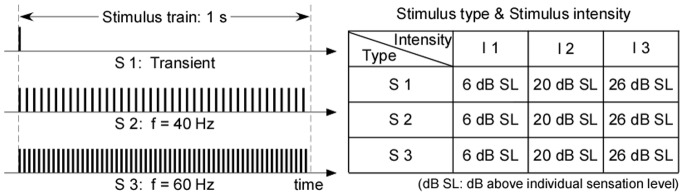
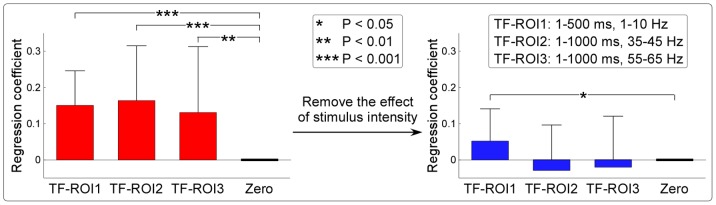
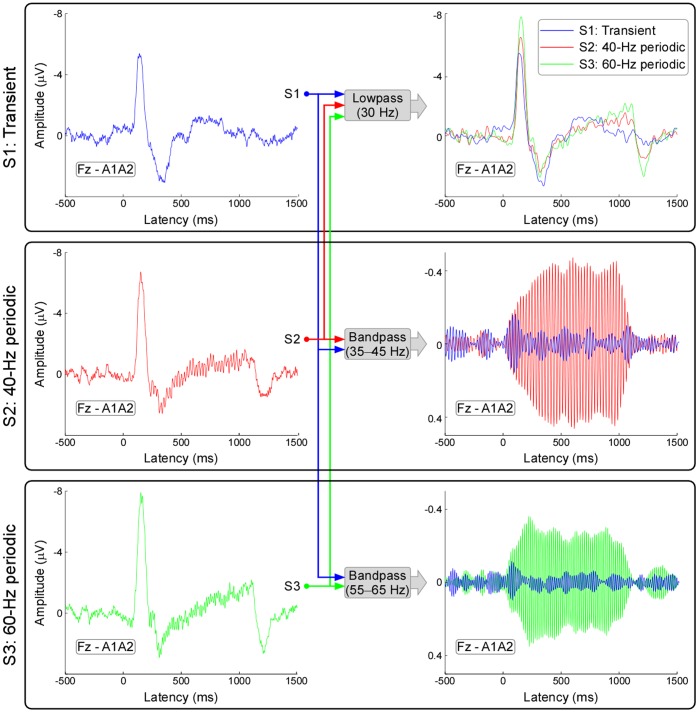
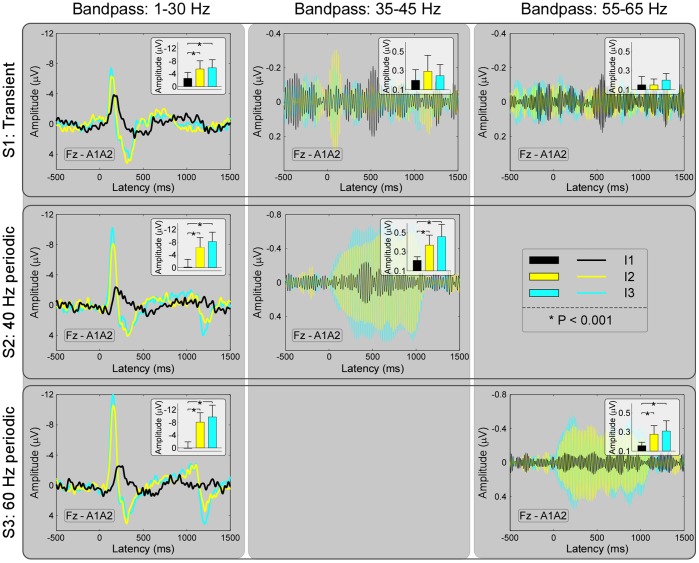
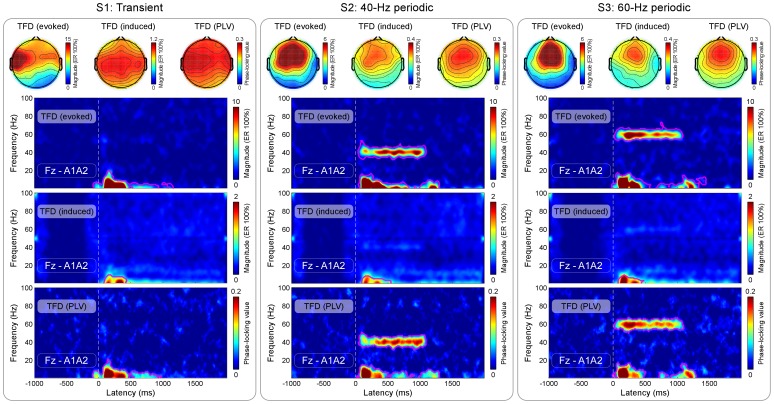
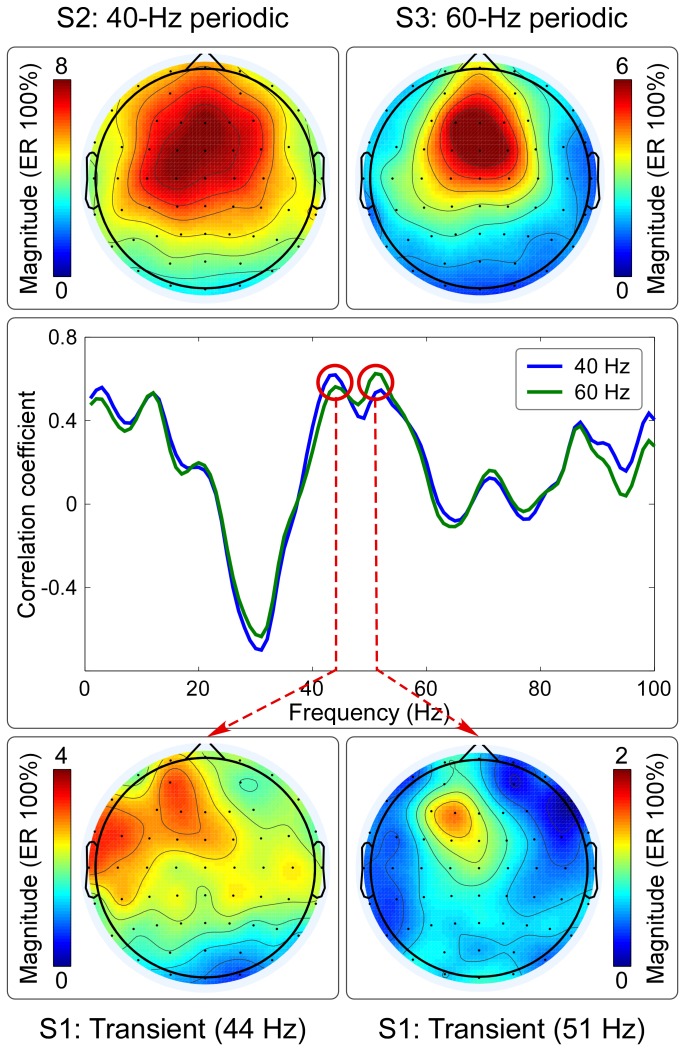
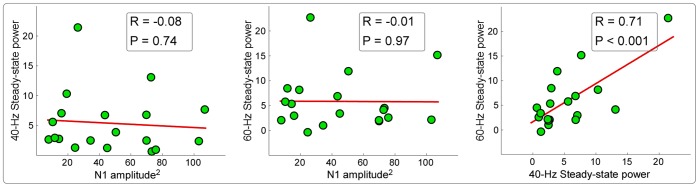
Transient event-related potentials (ERPs) and steady-state responses (SSRs) have been popularly employed to investigate the function of the human brain, but their relationship still remains a matter of debate. Some researchers believed that SSRs could be explained by the linear summation of successive transient ERPs (superposition hypothesis), while others believed that SSRs were the result of the entrainment of a neural rhythm driven by the periodic repetition of a sensory stimulus (oscillatory entrainment hypothesis). In the present study, taking auditory modality as an example, we aimed to clarify the distinct features of SSRs, evoked by the 40-Hz and 60-Hz periodic auditory stimulation, as compared to transient ERPs, evoked by a single click. We observed that (1) SSRs were mainly generated by phase synchronization, while late latency responses (LLRs) in transient ERPs were mainly generated by power enhancement; (2) scalp topographies of LLRs in transient ERPs were markedly different from those of SSRs; (3) the powers of both 40-Hz and 60-Hz SSRs were significantly correlated, while they were not significantly correlated with the N1 power in transient ERPs; (4) whereas SSRs were dominantly modulated by stimulus intensity, middle latency responses (MLRs) were not significantly modulated by both stimulus intensity and subjective loudness judgment, and LLRs were significantly modulated by subjective loudness judgment even within the same stimulus intensity. All these findings indicated that high-frequency SSRs were different from both MLRs and LLRs in transient ERPs, thus supporting the possibility of oscillatory entrainment hypothesis to the generation of SSRs. Therefore, SSRs could be used to explore distinct neural responses as compared to transient ERPs, and help us reveal novel and reliable neural mechanisms of the human brain.
瞬态事件相关电位 (ERPs) 和稳态响应 (SSRs) 已广泛用于研究人类大脑的功能,但它们之间的关系仍存在争议。一些研究人员认为 SSRs 可以通过连续瞬态 ERPs 的线性叠加来解释(叠加假说),而另一些人则认为 SSRs 是由周期性重复的感觉刺激驱动的神经节律的同步(振荡同步假说)的结果。在本研究中,以听觉模态为例,我们旨在阐明由 40-Hz 和 60-Hz 周期性听觉刺激引起的 SSRs 与由单个点击引起的瞬态 ERPs 的独特特征。我们观察到:(1) SSRs 主要由相位同步产生,而瞬态 ERPs 中的晚期反应 (LLRs) 主要由功率增强产生;(2) 瞬态 ERPs 中 LLRs 的头皮地形图明显不同于 SSRs;(3) 40-Hz 和 60-Hz SSRs 的功率均显著相关,而与瞬态 ERPs 中的 N1 功率不显著相关;(4) 虽然 SSRs 主要受到刺激强度的调制,但 MLRs 不受刺激强度和主观响度判断的显著调制,而 LLRs 即使在相同的刺激强度内也受到主观响度判断的显著调制。所有这些发现表明,高频 SSRs 与瞬态 ERPs 中的 MLRs 和 LLRs 不同,因此支持振荡同步假说对 SSRs 产生的可能性。因此,SSR 可用于探索与瞬态 ERPs 不同的神经反应,并帮助我们揭示人类大脑的新的、可靠的神经机制。