Bosl William, Mandel Joshua, Jonikas Magdalena, Ramoni Rachel Badovinac, Kohane Isaac S, Mandl Kenneth D
Children's Hospital Informatics Program, Boston Children's Hospital, Harvard Medical School, Boston, MA, United States.
Interact J Med Res. 2013 Jul 22;2(2):e13. doi: 10.2196/ijmr.2480.
Non-adherence to prescribed medications is a serious health problem in the United States, costing an estimated $100 billion per year. While poor adherence should be addressable with point of care health information technology, integrating new solutions with existing electronic health records (EHR) systems require customization within each organization, which is difficult because of the monolithic software design of most EHR products.
The objective of this study was to create a published algorithm for predicting medication adherence problems easily accessible at the point of care through a Web application that runs on the Substitutable Medical Apps, Reusuable Technologies (SMART) platform. The SMART platform is an emerging framework that enables EHR systems to behave as "iPhone like platforms" by exhibiting an application programming interface for easy addition and deletion of third party apps. The app is presented as a point of care solution to monitoring medication adherence as well as a sufficiently general, modular application that may serve as an example and template for other SMART apps.
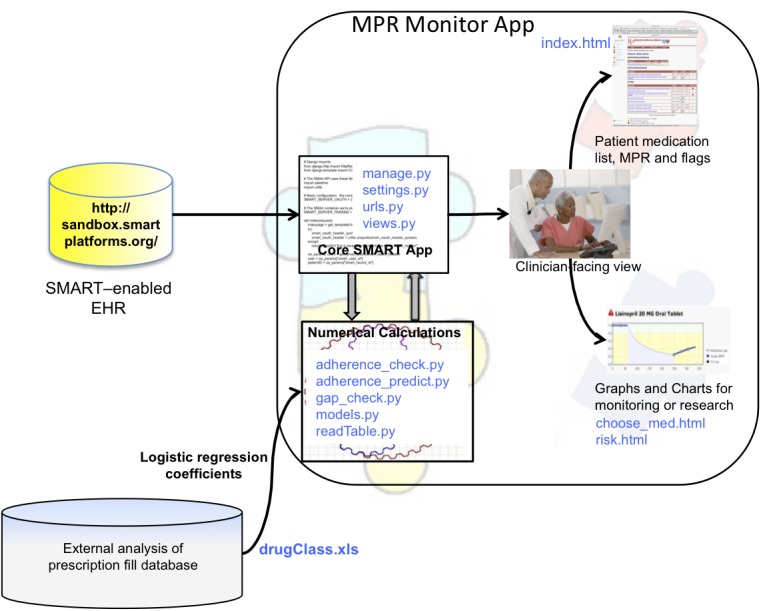
The widely used, open source Django framework was used together with the SMART platform to create the interoperable components of this app. Django uses Python as its core programming language. This allows statistical and mathematical modules to be created from a large array of Python numerical libraries and assembled together with the core app to create flexible and sophisticated EHR functionality. Algorithms that predict individual adherence are derived from a retrospective study of dispensed medication claims from a large private insurance plan. Patients' prescription fill information is accessed through the SMART framework and the embedded algorithms compute adherence information, including predicted adherence one year after the first prescription fill. Open source graphing software is used to display patient medication information and the results of statistical prediction of future adherence on a clinician-facing Web interface.
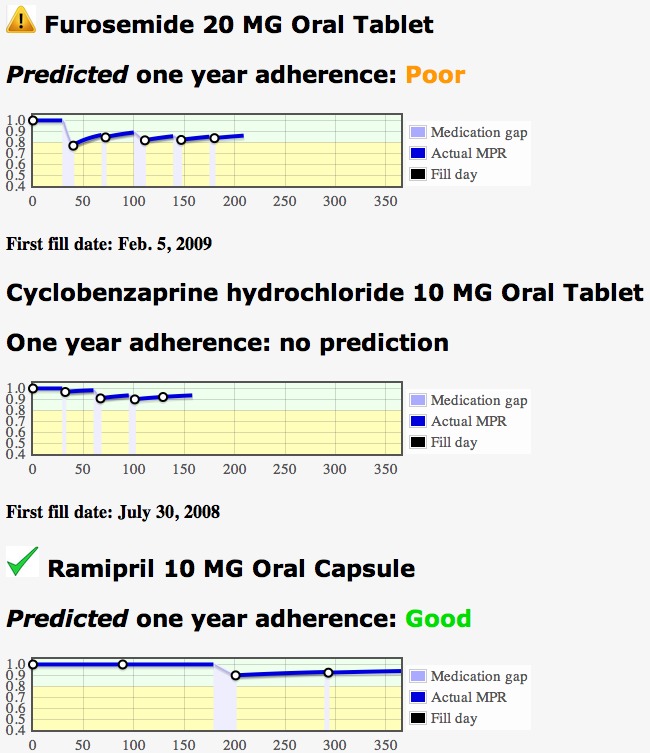
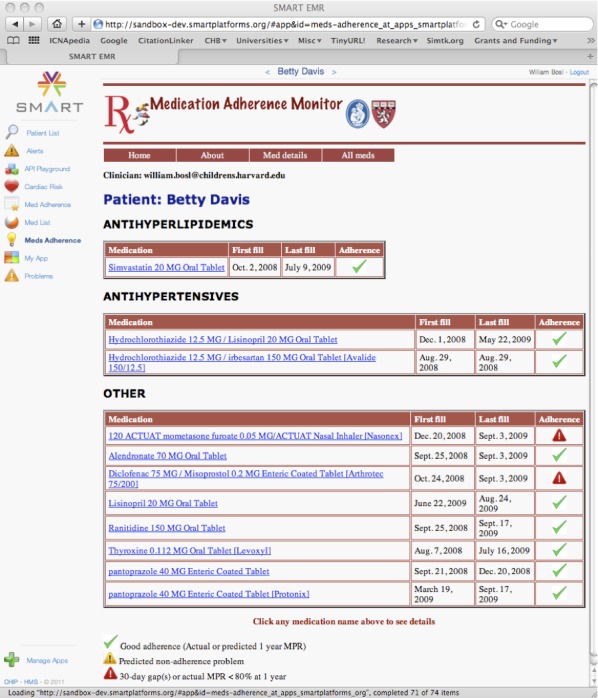
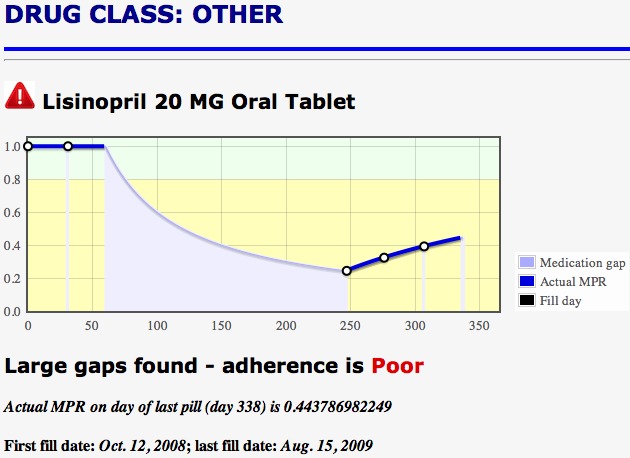
The user interface allows the physician to quickly review all medications in a patient record for potential non-adherence problems. A gap-check and current medication possession ratio (MPR) threshold test are applied to all medications in the record to test for current non-adherence. Predictions of 1-year non-adherence are made for certain drug classes for which external data was available. Information is presented graphically to indicate present non-adherence, or predicted non-adherence at one year, based on early prescription fulfillment patterns. The MPR Monitor app is installed in the SMART reference container as the "MPR Monitor", where it is publically available for use and testing. MPR is an acronym for Medication Possession Ratio, a commonly used measure of adherence to a prescribed medication regime. This app may be used as an example for creating additional functionality by replacing statistical and display algorithms with new code in a cycle of rapid prototyping and implementation or as a framework for a new SMART app.
The MPR Monitor app is a useful pilot project for monitoring medication adherence. It also provides an example that integrates several open source software components, including the Python-based Django Web framework and python-based graphics, to build a SMART app that allows complex decision support methods to be encapsulated to enhance EHR functionality.
在美国,不遵医嘱服药是一个严重的健康问题,每年造成的损失估计达1000亿美元。虽然通过即时医疗健康信息技术可以解决服药依从性差的问题,但将新解决方案与现有的电子健康记录(EHR)系统集成需要在每个组织内进行定制,这很困难,因为大多数EHR产品的软件设计是整体式的。
本研究的目的是创建一种已发表的算法,用于预测服药依从性问题,通过在可替代医疗应用、可重复使用技术(SMART)平台上运行的Web应用程序,在即时医疗点轻松获取。SMART平台是一个新兴框架,通过展示应用程序编程接口,使EHR系统能够像“iPhone类平台”一样运行,便于添加和删除第三方应用。该应用程序作为一种即时医疗点解决方案,用于监测服药依从性,也是一个足够通用的模块化应用程序,可作为其他SMART应用的示例和模板。
广泛使用的开源Django框架与SMART平台一起用于创建此应用程序的可互操作组件。Django使用Python作为其核心编程语言。这允许从大量Python数值库中创建统计和数学模块,并与核心应用程序组装在一起,以创建灵活而复杂的EHR功能。预测个体依从性的算法来自对一个大型私人保险计划中配药索赔的回顾性研究。通过SMART框架访问患者的处方配药信息,嵌入式算法计算依从性信息,包括首次处方配药后一年的预测依从性。开源绘图软件用于在面向临床医生的Web界面上显示患者用药信息和未来依从性的统计预测结果。
用户界面允许医生快速查看患者记录中的所有药物,以发现潜在的不依从问题。对记录中的所有药物应用缺口检查和当前药物持有率(MPR)阈值测试,以检测当前的不依从情况。对于有外部数据可用的某些药物类别,进行一年不依从的预测。信息以图形方式呈现,以根据早期处方配药模式指示当前的不依从情况或一年后的预测不依从情况。MPR监测应用程序作为“MPR监测器”安装在SMART参考容器中,可供公众使用和测试。MPR是药物持有率的首字母缩写,是衡量对规定用药方案依从性的常用指标。这个应用程序可以作为一个示例,通过在快速原型制作和实施周期中用新代码替换统计和显示算法来创建额外功能,或者作为新SMART应用程序的框架。
MPR监测应用程序是监测服药依从性的一个有用的试点项目。它还提供了一个示例,集成了几个开源软件组件,包括基于Python的Django Web框架和基于Python的图形,以构建一个SMART应用程序,允许封装复杂的决策支持方法以增强EHR功能。