Department of Ecology and Evolutionary Biology, Princeton University, Princeton, New Jersey, United States of America.
PLoS One. 2013 Jul 24;8(7):e68413. doi: 10.1371/journal.pone.0068413. Print 2013.
Norovirus (NoV) transmission may be impacted by changes in symptom intensity. Sudden onset of vomiting, which may cause an initial period of hyper-infectiousness, often marks the beginning of symptoms. This is often followed by: a 1-3 day period of milder symptoms, environmental contamination following vomiting, and post-symptomatic shedding that may result in transmission at progressively lower rates. Existing models have not included time-varying infectiousness, though representing these features could add utility to models of NoV transmission.
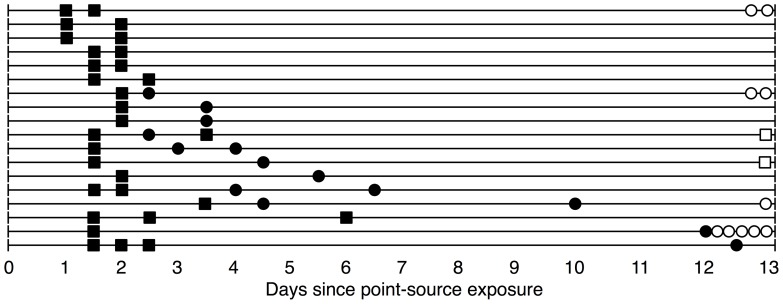
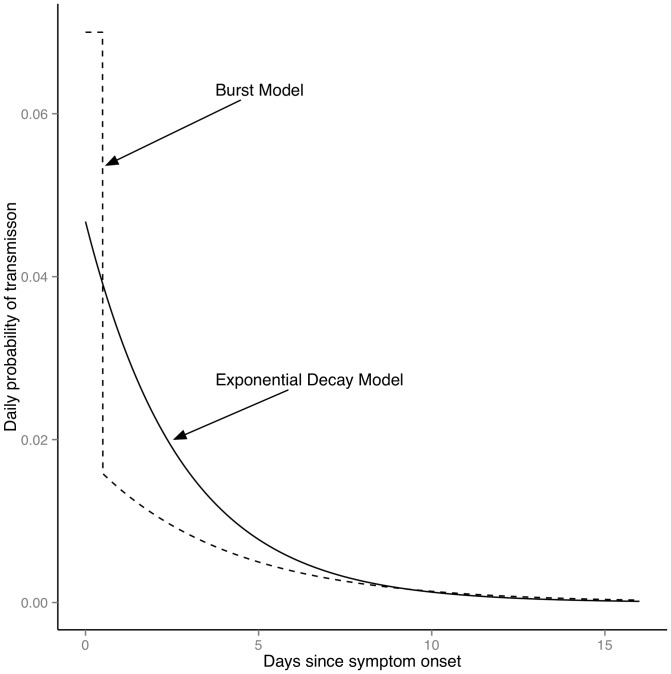
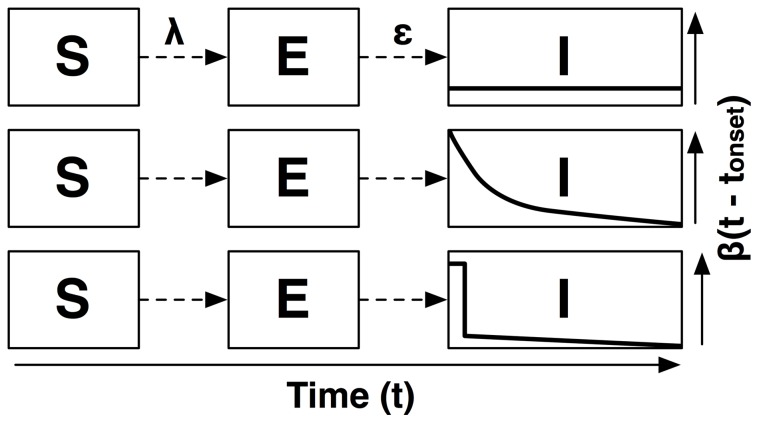
We address this by comparing the fit of three models (Models 1-3) of NoV infection to household transmission data from a 2009 point-source outbreak of GII.12 norovirus in North Carolina. Model 1 is an SEIR compartmental model, modified to allow Gamma-distributed sojourn times in the latent and infectious classes, where symptomatic cases are uniformly infectious over time. Model 2 assumes infectiousness decays exponentially as a function of time since onset, while Model 3 is discontinuous, with a spike concentrating 50% of transmissibility at onset. We use Bayesian data augmentation techniques to estimate transmission parameters for each model, and compare their goodness of fit using qualitative and quantitative model comparison. We also assess the robustness of our findings to asymptomatic infections.
We find that Model 3 (initial spike in shedding) best explains the household transmission data, using both quantitative and qualitative model comparisons. We also show that these results are robust to the presence of asymptomatic infections.
Explicitly representing explosive NoV infectiousness at onset should be considered when developing models and interventions to interrupt and prevent outbreaks of norovirus in the community. The methods presented here are generally applicable to the transmission of pathogens that exhibit large variation in transmissibility over an infection.
诺如病毒(NoV)的传播可能会受到症状强度变化的影响。突然出现的呕吐,可能会导致初始的高度传染性,通常标志着症状的开始。随后通常会出现:1-3 天的症状较轻期、呕吐后的环境污染以及无症状排毒,这可能会导致传播率逐渐降低。现有模型并未包括时变传染性,尽管这些特征的表示可能会增加 NoV 传播模型的实用性。
我们通过将三种 NoV 感染模型(模型 1-3)与北卡罗来纳州 2009 年一起水源性暴发的 GII.12 诺如病毒家庭传播数据进行比较来解决这个问题。模型 1 是一个 SEIR compartmental 模型,经过修改,可以允许潜伏期和感染期的逗留时间呈伽马分布,其中症状性病例在整个时间内均匀具有传染性。模型 2 假设传染性随发病后时间呈指数衰减,而模型 3 是不连续的,50%的传染性集中在发病时。我们使用贝叶斯数据增强技术来估计每个模型的传播参数,并使用定性和定量模型比较来比较它们的拟合优度。我们还评估了无症状感染对我们发现的稳健性。
我们发现,使用定量和定性模型比较,模型 3(发病时的爆发性排毒)最能解释家庭传播数据。我们还表明,这些结果对无症状感染的存在是稳健的。
在开发模型和干预措施以中断和预防社区中诺如病毒爆发时,应考虑明确表示爆发性 NoV 传染性。这里提出的方法通常适用于具有感染过程中传染性变化较大的病原体的传播。