School of Biological Sciences, University of Essex, Colchester, Essex, United Kingdom.
PLoS One. 2013 Jul 24;8(7):e69176. doi: 10.1371/journal.pone.0069176. Print 2013.
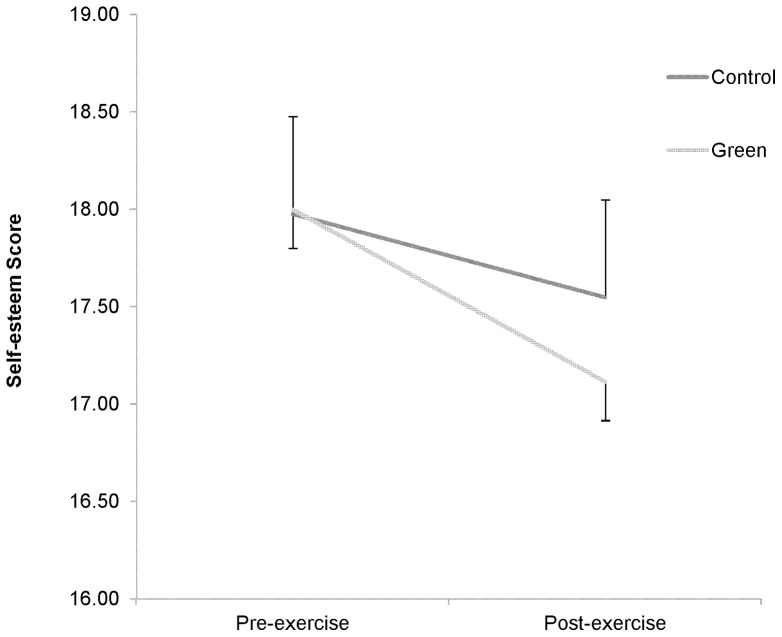
Exercising in natural, green environments creates greater improvements in adult's self-esteem than exercise undertaken in urban or indoor settings. No comparable data are available for children. The aim of this study was to determine whether so called 'green exercise' affected changes in self-esteem; enjoyment and perceived exertion in children differently to urban exercise. We assessed cardiorespiratory fitness (20 m shuttle-run) and self-reported physical activity (PAQ-A) in 11 and 12 year olds (n = 75). Each pupil completed two 1.5 mile timed runs, one in an urban and another in a rural environment. Trials were completed one week apart during scheduled physical education lessons allocated using a repeated measures design. Self-esteem was measured before and after each trial, ratings of perceived exertion (RPE) and enjoyment were assessed after completing each trial. We found a significant main effect (F (1,74), = 12.2, p<0.001), for the increase in self-esteem following exercise but there was no condition by exercise interaction (F (1,74), = 0.13, p = 0.72). There were no significant differences in perceived exertion or enjoyment between conditions. There was a negative correlation (r = -0.26, p = 0.04) between habitual physical activity and RPE during the control condition, which was not evident in the green exercise condition (r = -0.07, p = 0.55). Contrary to previous studies in adults, green exercise did not produce significantly greater increases in self-esteem than the urban exercise condition. Green exercise was enjoyed more equally by children with differing levels of habitual physical activity and has the potential to engage less active children in exercise.
在自然、绿色的环境中锻炼比在城市或室内环境中进行的锻炼更能提高成年人的自尊心。目前还没有针对儿童的可比数据。本研究旨在确定所谓的“绿色锻炼”是否会对儿童的自尊心、运动乐趣和感知用力程度产生不同的影响,与城市锻炼相比。我们评估了 11 岁和 12 岁儿童的心肺健康状况(20 米穿梭跑)和自我报告的身体活动(PAQ-A)(n=75)。每个学生都在城市和农村环境中完成了两次 1.5 英里计时跑。试验在一周内相隔一周,在体育课上使用重复测量设计进行安排。在每次试验前后测量自尊心,在完成每次试验后评估感知用力程度(RPE)和乐趣。我们发现,锻炼后自尊心的提高有显著的主效应(F(1,74)=12.2,p<0.001),但锻炼条件之间没有交互作用(F(1,74)=0.13,p=0.72)。在条件之间,感知用力程度或乐趣没有显著差异。在对照条件下,习惯性身体活动与 RPE 之间存在负相关(r=-0.26,p=0.04),而在绿色锻炼条件下则没有(r=-0.07,p=0.55)。与先前在成年人中进行的研究相反,绿色锻炼并没有比城市锻炼条件产生显著更大的自尊心提升。绿色锻炼更受不同习惯性身体活动水平的儿童的喜爱,并有潜力吸引不活跃的儿童参与锻炼。