Department of Chemical and Environmental Engineering, Yale University, New Haven, Connecticut, USA.
PLoS One. 2013 Jul 22;8(7):e69492. doi: 10.1371/journal.pone.0069492. Print 2013.
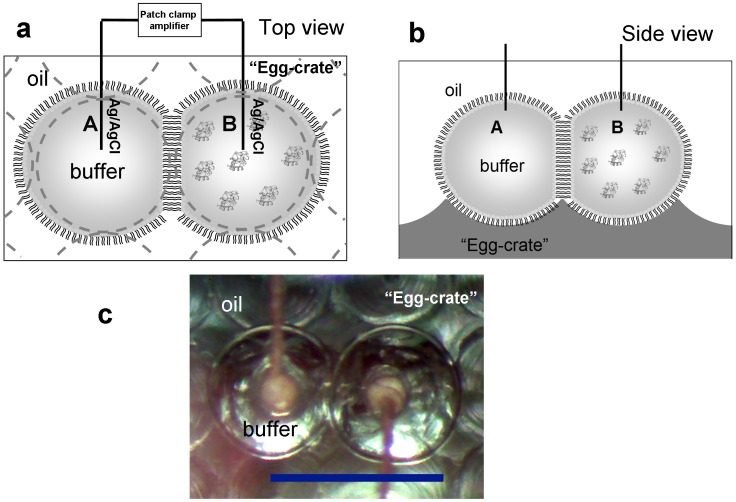
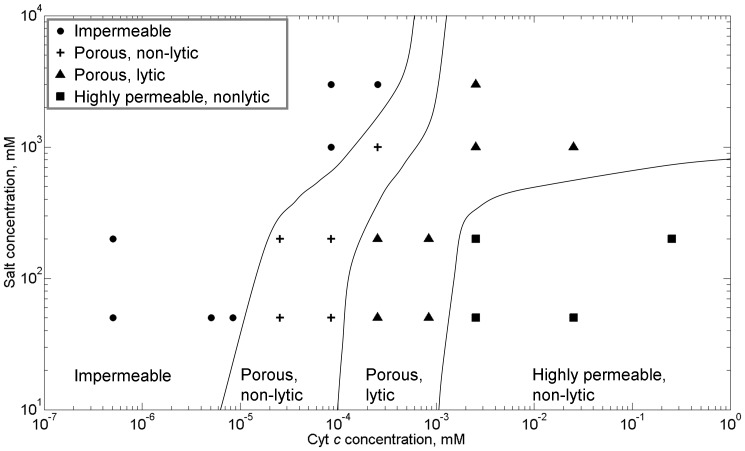
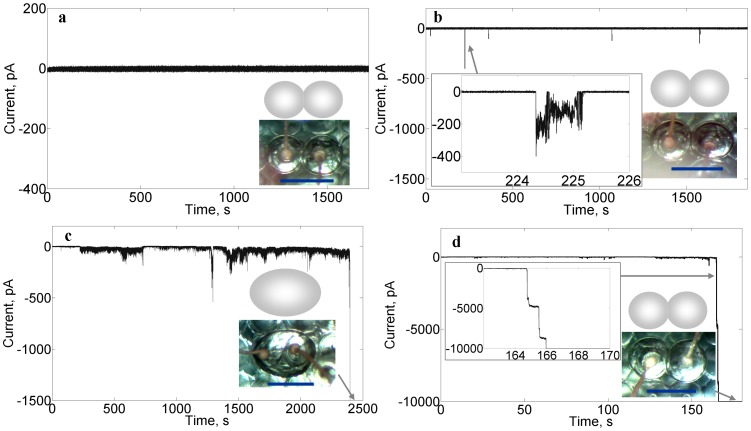
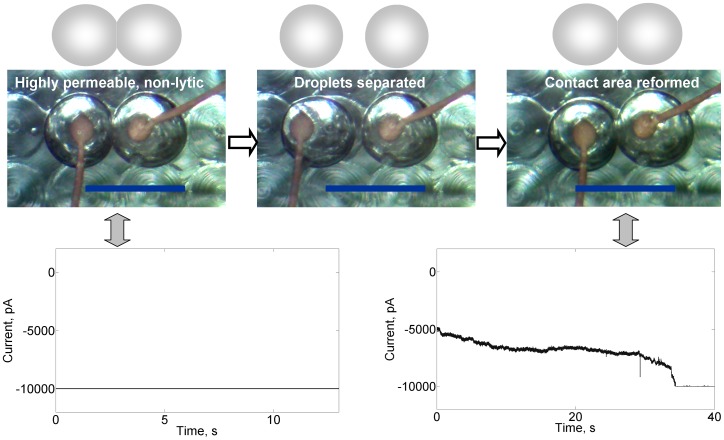
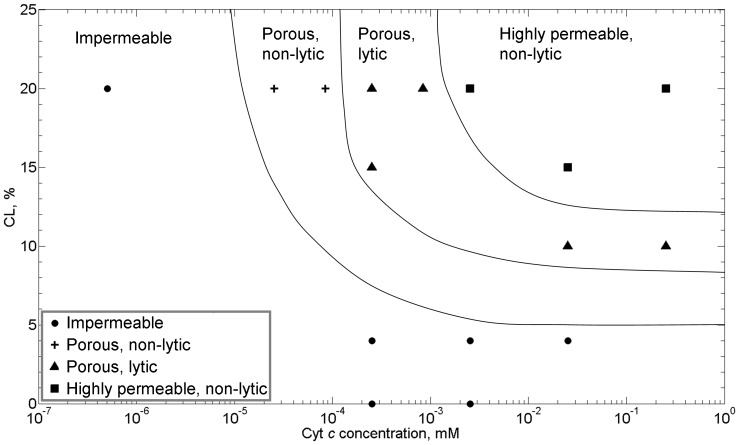
The release of cytochrome c (cyt c) from mitochondria is an important early step during cellular apoptosis, however the precise mechanism by which the outer mitochondrial membrane becomes permeable to these proteins is as yet unclear. Inspired by our previous observation of cyt c crossing the membrane barrier of giant unilamellar vesicle model systems, we investigate the interaction of cyt c with cardiolipin (CL)-containing membranes using the innovative droplet bilayer system that permits electrochemical measurements with simultaneous microscopy observation. We find that cyt c can permeabilize CL-containing membranes by induction of lipid pores in a dose-dependent manner, with membrane lysis eventually observed at relatively high (µM) cyt c concentrations due to widespread pore formation in the membrane destabilizing its bilayer structure. Surprisingly, as cyt c concentration is further increased, we find a regime with exceptionally high permeability where a stable membrane barrier is still maintained between droplet compartments. This unusual non-lytic state has a long lifetime (>20 h) and can be reversibly formed by mechanically separating the droplets before reforming the contact area between them. The transitions between behavioural regimes are electrostatically driven, demonstrated by their suppression with increasing ionic concentrations and their dependence on CL composition. While membrane permeability could also be induced by cationic PAMAM dendrimers, the non-lytic, highly permeable membrane state could not be reproduced using these synthetic polymers, indicating that details in the structure of cyt c beyond simply possessing a cationic net charge are important for the emergence of this unconventional membrane state. These unexpected findings may hold significance for the mechanism by which cyt c escapes into the cytosol of cells during apoptosis.
细胞色素 c(cyt c)从线粒体中的释放是细胞凋亡过程中的一个重要早期步骤,然而,线粒体外部膜变得对这些蛋白质通透的确切机制目前仍不清楚。受我们之前观察到 cyt c 穿过巨单层囊泡模型系统的膜障碍的启发,我们使用创新的液滴双层系统研究了 cyt c 与含有心磷脂(CL)的膜的相互作用,该系统允许进行电化学测量并同时进行显微镜观察。我们发现 cyt c 可以通过诱导含有 CL 的膜中的脂质孔以剂量依赖的方式使膜通透,最终在相对较高(µM)的 cyt c 浓度下观察到膜破裂,这是由于膜中的广泛孔形成破坏了其双层结构。令人惊讶的是,随着 cyt c 浓度的进一步增加,我们发现了一个具有异常高通透性的区域,在该区域中,稳定的膜屏障仍在液滴隔间之间保持。这种异常的非溶血性状态具有长寿命(>20 h),并且可以通过在机械分离液滴之前先分离它们之间的接触区域来可逆地形成。这些行为状态的转变是静电驱动的,通过增加离子浓度来抑制转变以及对 CL 组成的依赖性来证明。虽然阳离子 PAMAM 树状聚合物也可以诱导膜通透性,但使用这些合成聚合物无法再现非溶血性、高通透性的膜状态,这表明 cyt c 的结构细节超出了简单地具有阳离子净电荷对于这种非常规膜状态的出现是重要的。这些意外的发现可能对 cyt c 在细胞凋亡过程中逃入细胞质的机制具有重要意义。