Education Ministry, Key Laboratory of Integrated Management of Crop Diseases and Pests, College of Plant Protection, Nanjing Agricultural University, Nanjing, China.
PLoS One. 2013 Jul 24;8(7):e69715. doi: 10.1371/journal.pone.0069715. Print 2013.
A large number of insect chemosensory genes from different gene subfamilies have been identified and annotated, but their functional diversity and complexity are largely unknown. A systemic examination of expression patterns in chemosensory organs could provide important information.
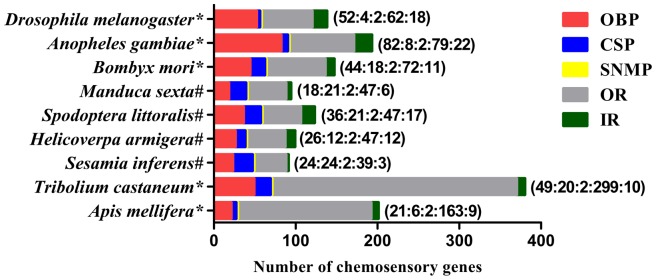
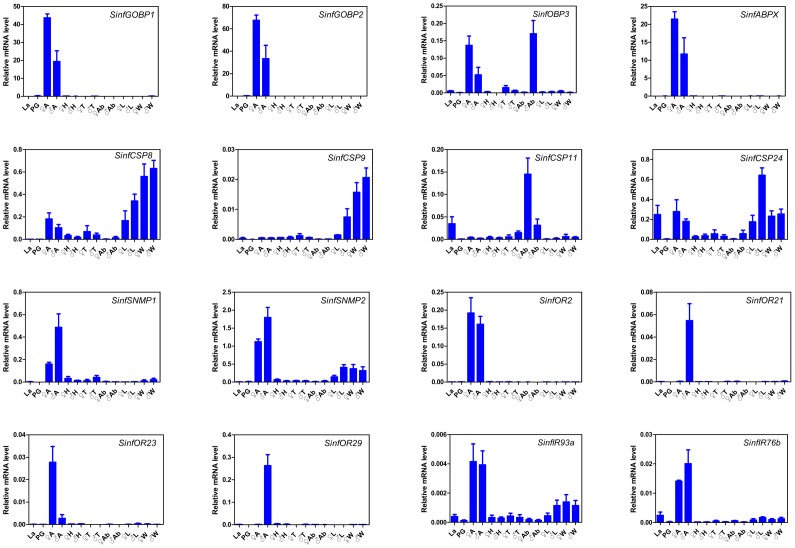
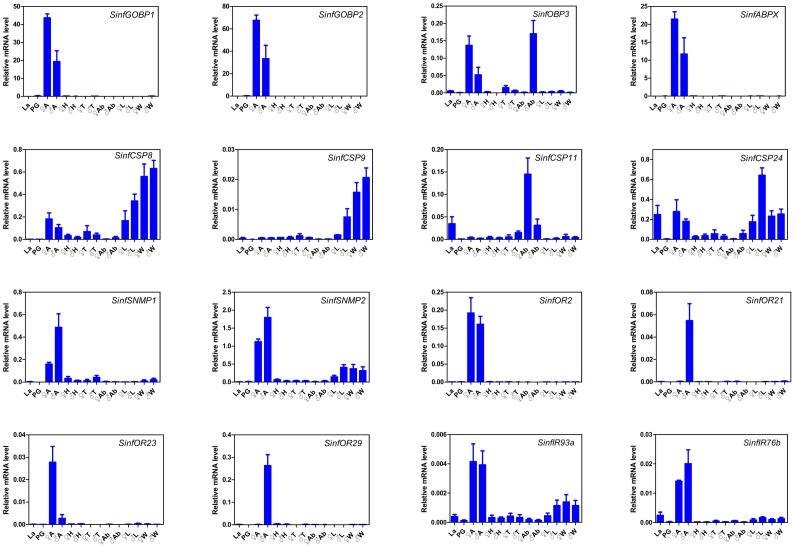
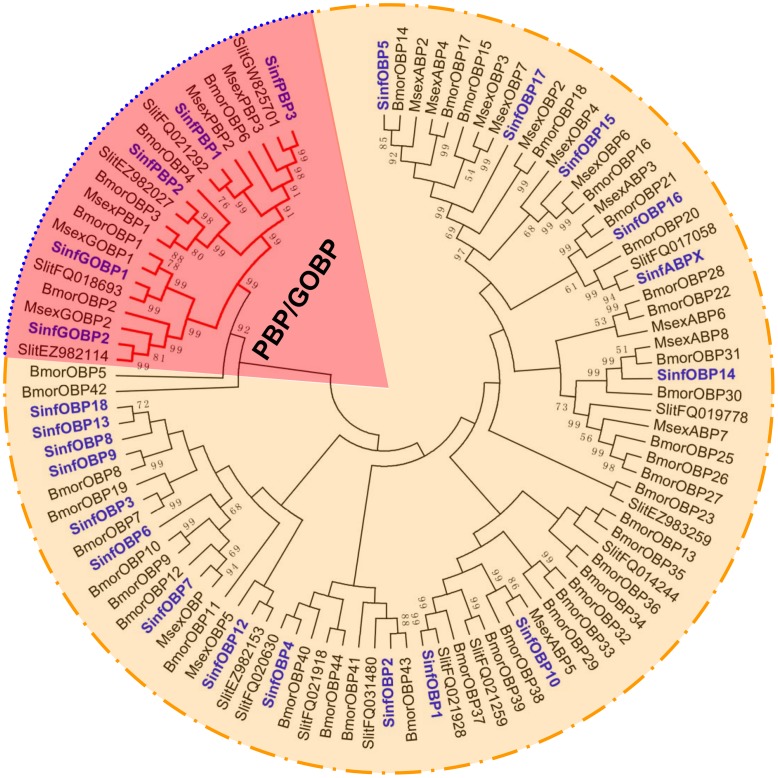
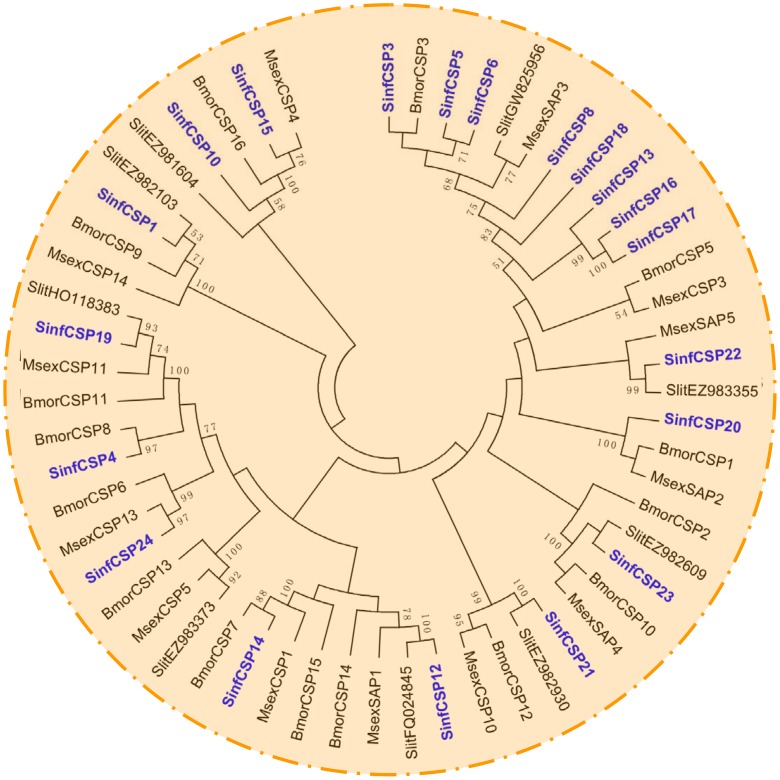
METHODOLOGY/PRINCIPAL FINDINGS: We identified 92 putative chemosensory genes by analysing the transcriptome of the antennae and female sex pheromone gland of the purple stem borer Sesamia inferens, among them 87 are novel in this species, including 24 transcripts encoding for odorant binding proteins (OBPs), 24 for chemosensory proteins (CSPs), 2 for sensory neuron membrane proteins (SNMPs), 39 for odorant receptors (ORs) and 3 for ionotropic receptors (IRs). The transcriptome analyses were validated and quantified with a detailed global expression profiling by Reverse Transcription-PCR for all 92 transcripts and by Quantitative Real Time RT-PCR for selected 16 ones. Among the chemosensory gene subfamilies, CSP transcripts are most widely and evenly expressed in different tissues and stages, OBP transcripts showed a clear antenna bias and most of OR transcripts are only detected in adult antennae. Our results also revealed that some OR transcripts, such as the transcripts of SNMP2 and 2 IRs were expressed in non-chemosensory tissues, and some CSP transcripts were antenna-biased expression. Furthermore, no chemosensory transcript is specific to female sex pheromone gland and very few are found in the heads.
Our study revealed that there are a large number of chemosensory genes expressed in S. inferens, and some of them displayed unusual expression profile in non-chemosensory tissues. The identification of a large set of putative chemosensory genes of each subfamily from a single insect species, together with their different expression profiles provide further information in understanding the functions of these chemosensory genes in S. inferens as well as other insects.
已经鉴定和注释了来自不同基因亚家族的大量昆虫化学感受基因,但它们的功能多样性和复杂性在很大程度上是未知的。对化学感受器官表达模式的系统研究可以提供重要信息。
方法/主要发现:我们通过分析斜纹夜蛾触角和雌性性信息素腺的转录组,鉴定了 92 个假定的化学感受基因,其中 87 个在该物种中是新的,包括 24 个编码气味结合蛋白(OBP)的转录本、24 个化学感受蛋白(CSP)、2 个感觉神经元膜蛋白(SNMP)、39 个气味受体(OR)和 3 个离子型受体(IR)。通过逆转录 PCR 对所有 92 个转录本进行详细的全局表达谱验证和定量,对选定的 16 个转录本进行定量实时 RT-PCR 验证和定量,对转录组分析进行了验证和定量。在化学感受基因亚家族中,CSP 转录本在不同组织和阶段广泛且均匀地表达,OBP 转录本表现出明显的触角偏倚,大多数 OR 转录本仅在成虫触角中检测到。我们的研究结果还表明,一些 OR 转录本,如 SNMP2 和 2 个 IR 转录本,在非化学感受组织中表达,一些 CSP 转录本在触角中表现出偏倚性表达。此外,没有特定于雌性性信息素腺的化学感受转录本,在头部中发现的很少。
我们的研究表明,斜纹夜蛾表达了大量的化学感受基因,其中一些在非化学感受组织中表现出不寻常的表达模式。从单个昆虫物种中鉴定出大量的假定化学感受基因,以及它们在不同表达谱中的表达,为进一步了解这些化学感受基因在斜纹夜蛾以及其他昆虫中的功能提供了更多信息。