Africa Centre for Health and Population Studies, University of KwaZulu-Natal, Somkhele, KwaZulu-Natal, South Africa.
PLoS One. 2013 Jul 23;8(7):e70126. doi: 10.1371/journal.pone.0070126. Print 2013.
Little is known about the variability of CD4 counts in the general population of sub-Saharan Africa countries affected by the HIV epidemic. We investigated factors associated with CD4 counts in a rural area in South Africa with high HIV prevalence and high antiretroviral treatment (ART) coverage.
CD4 counts, health status, body mass index (BMI), demographic characteristics and HIV status were assessed in 4990 adult resident participants of a demographic surveillance in rural KwaZulu-Natal in South Africa; antiretroviral treatment duration was obtained from a linked clinical database. Multivariable regression analysis, overall and stratified by HIV status, was performed with CD4 count levels as outcome.
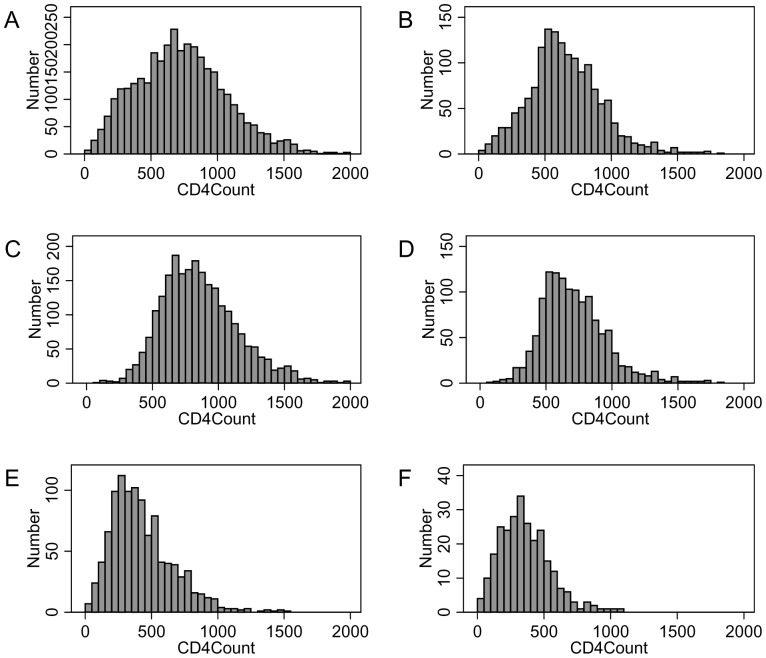
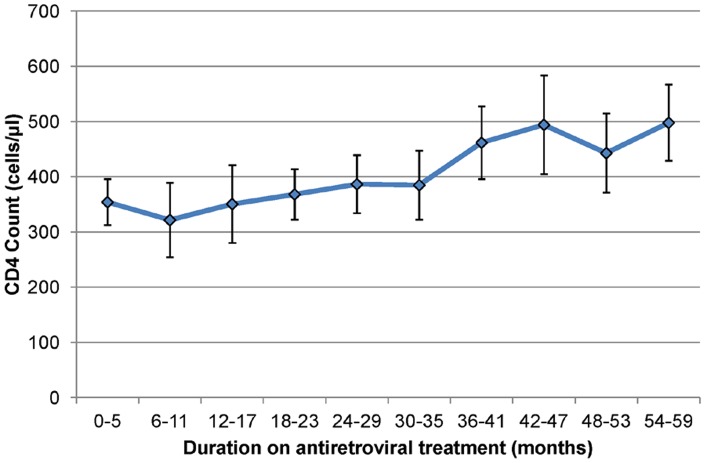
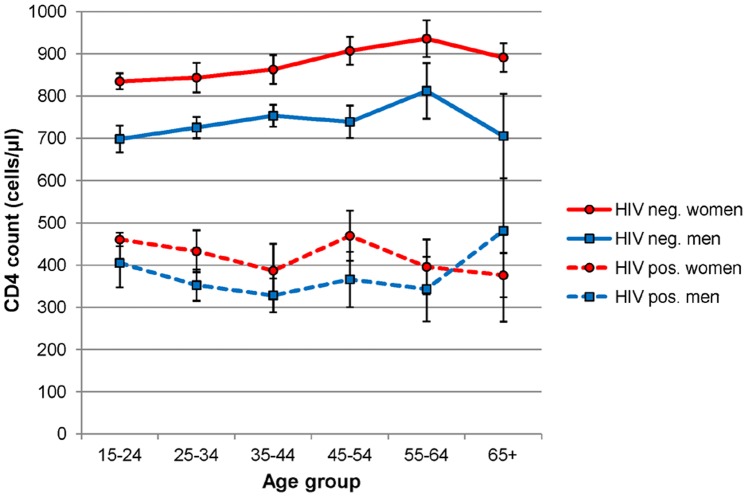
Median CD4 counts were significantly higher in women than in men overall (714 vs. 630 cells/µl, p<0.0001), both in HIV-uninfected (833 vs. 683 cells/µl, p<0.0001) and HIV-infected adults (384.5 vs. 333 cells/µl, p<0.0001). In multivariable regression analysis, women had 19.4% (95% confidence interval (CI) 16.1-22.9) higher CD4 counts than men, controlling for age, HIV status, urban/rural residence, household wealth, education, BMI, self-reported tuberculosis, high blood pressure, other chronic illnesses and sample processing delay. At ART initiation, HIV-infected adults had 21.7% (95% CI 14.6-28.2) lower CD4 counts than treatment-naive individuals; CD4 counts were estimated to increase by 9.2% (95% CI 6.2-12.4) per year of treatment.
CD4 counts are primarily determined by sex in HIV-uninfected adults, and by sex, age and duration of antiretroviral treatment in HIV-infected adults. Lower CD4 counts at ART initiation in men could be a consequence of lower CD4 cell counts before HIV acquisition.
在受艾滋病毒流行影响的撒哈拉以南非洲国家的普通人群中,人们对 CD4 计数的变异性知之甚少。我们调查了南非一个农村地区与高 HIV 流行率和高抗逆转录病毒治疗 (ART) 覆盖率相关的 CD4 计数的因素。
在南非夸祖鲁-纳塔尔省农村进行的人口监测中,评估了 4990 名成年常住居民的 CD4 计数、健康状况、体重指数 (BMI)、人口统计学特征和 HIV 状况;从一个关联的临床数据库中获得抗逆转录病毒治疗持续时间。使用 CD4 计数水平作为结果,进行了多变量回归分析,整体和按 HIV 状态分层。
总体而言,女性的 CD4 计数中位数明显高于男性(714 与 630 个细胞/µl,p<0.0001),在未感染 HIV 的成年人(833 与 683 个细胞/µl,p<0.0001)和感染 HIV 的成年人(384.5 与 333 个细胞/µl,p<0.0001)中也是如此。在多变量回归分析中,女性的 CD4 计数比男性高 19.4%(95%置信区间 (CI) 16.1-22.9),控制了年龄、HIV 状态、城乡居住、家庭财富、教育、BMI、自我报告的结核病、高血压、其他慢性疾病和样本处理延迟。在开始 ART 时,感染 HIV 的成年人的 CD4 计数比未接受治疗的个体低 21.7%(95%CI 14.6-28.2);CD4 计数估计每年增加 9.2%(95%CI 6.2-12.4)。
在未感染 HIV 的成年人中,CD4 计数主要由性别决定,在感染 HIV 的成年人中,由性别、年龄和抗逆转录病毒治疗的持续时间决定。男性在开始接受抗逆转录病毒治疗时 CD4 计数较低,可能是因为在感染 HIV 之前 CD4 细胞计数较低。