Clinical Research, Epicentre, 8 rue Saint-Sabin, 75011, Paris, France.
Medical Department, Médecins Sans Frontières, Cape Town, South Africa.
BMC Public Health. 2018 Mar 2;18(1):303. doi: 10.1186/s12889-018-5208-0.
The Joint United Nations Programme on HIV/AIDS (UNAIDS) has developed an ambitious strategy to end the AIDS epidemic. After eight years of antiretroviral therapy (ART) program we assessed progress towards the UNAIDS 90-90-90 targets in Mbongolwane and Eshowe, KwaZulu-Natal, South Africa.
We conducted a cross-sectional household-based community survey using a two-stage stratified cluster probability sampling strategy. Persons aged 15-59 years were eligible. We used face-to-face interviewer-administered questionnaires to collect information on history of HIV testing and care. Rapid HIV testing was performed on site and venous blood specimens collected from HIV-positive participants for antiretroviral drug presence test, CD4 count and viral load. At the time of the survey the CD4 threshold for ART initiation was 350 cells/μL. We calculated progression towards the 90-90-90 UNAIDS targets by estimating three proportions: HIV positive individuals who knew their status (first 90), those diagnosed who were on ART (second 90), and those on ART who were virally suppressed (third 90).
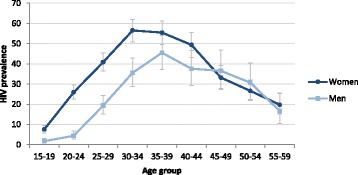
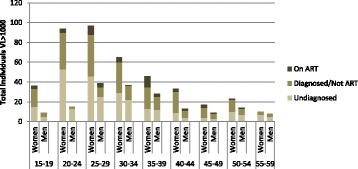
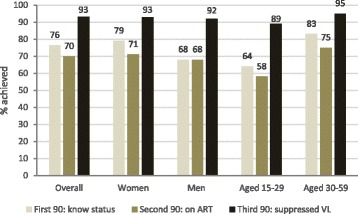
We included 5649/6688 (84.5%) individuals. Median age was 26 years (IQR: 19-40), 62.3% were women. HIV prevalence was 25.2% (95% CI: 23.6-26.9): 30.9% (95% CI: 29.0-32.9) in women; 15.9% (95% CI: 14.0-18.0) in men. Overall progress towards the 90-90-90 targets was as follows: 76.4% (95% CI: 74.1-78.6) knew their status, 69.9% (95% CI: 67.0-72.7) of those who knew their status were on ART and 93.1% (95% CI: 91.0-94.8) of those on ART were virally suppressed. By sex, progress towards the 90-90-90 targets was: 79%-71%-93% among women; and 68%-68%-92% among men (p-values of women and men comparisons were < 0.001, 0.443 and 0.584 respectively). By age, progress was: 83%-75%-95% among individuals aged 30-59 years and 64%-58%-89% among those aged 15-29 years (p-values of age groups comparisons were < 0.001, < 0.001 and 0.011 respectively).
In this context of high HIV prevalence, significant progress has been achieved with regards to reaching the UNAIDS 90-90-90 targets. The third 90, viral suppression in people on ART, was achieved among women and men. However, gaps persist in HIV diagnosis and ART coverage particularly in men and individuals younger than 30 years. Achieving 90-90-90 is feasible but requires additional investment to reach youth and men.
联合国艾滋病规划署(UNAIDS)制定了一项雄心勃勃的战略,旨在终结艾滋病疫情。在开展了八年的抗逆转录病毒疗法(ART)项目后,我们评估了在南非夸祖鲁-纳塔尔省的姆邦戈兰韦和埃绍韦实现 UNAIDS 90-90-90 目标的进展情况。
我们采用两阶段分层聚类概率抽样策略,开展了一项基于社区的横断面家庭调查。年龄在 15-59 岁的人员有资格参加。我们使用面对面访谈式问卷,收集关于艾滋病毒检测和治疗史的信息。在现场进行快速艾滋病毒检测,并从艾滋病毒阳性参与者中采集静脉血样,进行抗逆转录病毒药物检测、CD4 计数和病毒载量检测。在调查时,开始 ART 的 CD4 阈值为 350 个细胞/μL。我们通过估计三个比例来计算实现 UNAIDS 90-90-90 目标的进展情况:知道自己状况的艾滋病毒阳性个体(第一 90)、已确诊且正在接受 ART 的个体(第二 90)和正在接受 ART 且病毒得到抑制的个体(第三 90)。
我们纳入了 5649/6688(84.5%)名参与者。中位年龄为 26 岁(IQR:19-40),62.3%为女性。艾滋病毒流行率为 25.2%(95%CI:23.6-26.9):女性为 30.9%(95%CI:29.0-32.9),男性为 15.9%(95%CI:14.0-18.0)。总体而言,在实现 90-90-90 目标方面取得了以下进展:76.4%(95%CI:74.1-78.6)的人知道自己的状况,76.4%(95%CI:74.1-78.6)的已知感染者正在接受 ART,93.1%(95%CI:91.0-94.8)的 ART 使用者病毒得到抑制。按性别划分,在实现 90-90-90 目标方面的进展情况为:女性为 79%-71%-93%;男性为 68%-68%-92%(女性和男性比较的 p 值均<0.001,分别为 0.443 和 0.584)。按年龄划分,进展情况为:30-59 岁人群为 83%-75%-95%,15-29 岁人群为 64%-58%-89%(年龄组间比较的 p 值均<0.001,分别为<0.001 和 0.011)。
在这种艾滋病毒流行率较高的情况下,在实现 UNAIDS 90-90-90 目标方面取得了重大进展。第三 90,即接受 ART 的人病毒得到抑制,在女性和男性中都得到了实现。然而,在艾滋病毒诊断和 ART 覆盖率方面仍存在差距,尤其是在男性和 30 岁以下的人群中。实现 90-90-90 是可行的,但需要额外的投资来覆盖青年人和男性。